
Table of Contents
- What Golf Teams Actually Need From a Luxury Van Interior
- Custom Golf Club Storage Solutions for Vans
- Seating, Team Branding, and Interior Layouts for Four to Eight Golfers
- Power, Climate Control, and Tech Integration on the Road
- Weight Distribution and Payload Management for a Loaded Golf Van
- Best Custom Vans for Golf Trips: Van vs. SUV vs. RV
- Section 179 Tax Deduction for Luxury Vans: What Business Owners Should Know
- Maintenance Costs and Resale Value After a Conversion
- Frequently Asked Questions
Last Updated: September 20, 2026
What Golf Teams Actually Need From a Luxury Van Interior
A golf team’s van has one job: move four to eight players and their clubs to the course without anyone arriving stiff, cramped, or late. Customizing luxury van interiors for golf teams starts with that logistics problem, not the aesthetic. At GOLF Cruiser, we’ve spent more than 45 years converting full-size Chevrolet and GMC platforms, and teams consistently care about club protection, seating comfort, and how fast gear loads and unloads.
Custom Golf Club Storage Solutions for Vans
Club storage is where most conversions get it wrong: a standard cargo shelf lets heads knock together and forces players to lift bags over a lip.
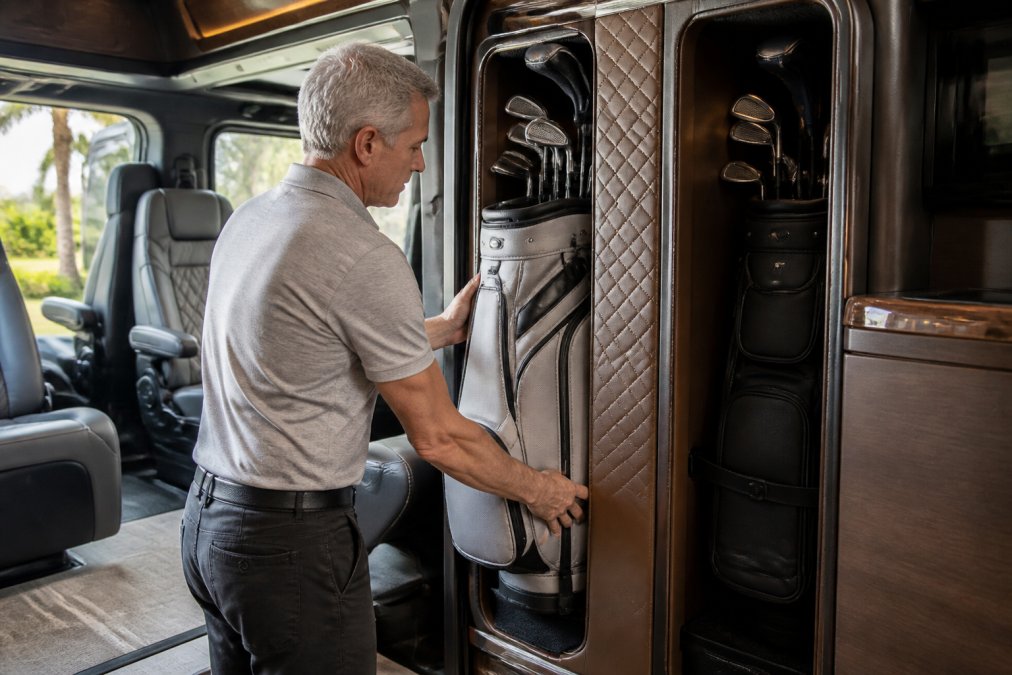
Vertical Lockers vs. Flat Floor Design
Vertical lockers hold each bag upright in its own bay, keeping clubs separated and the floor clear. Flat floor design trades that separation for volume, laying bags side by side on a low, wide platform.
- Vertical lockers: best for four to six players who want quick, individual access
- Flat floor: best for full teams hauling extra gear, coolers, and travel cases
- Hybrid layouts: lockers along one wall, flat floor down the center aisle
Ask your builder to mock up the storage bay with your actual bags before upholstery goes in. Adjusting a locker frame is cheap; re-trimming a finished wall is not.
Protecting Premium Leather and Custom Upholstery
Premium leather and custom upholstery take real abuse in a golf van: wet grips, sunscreen, grass, and cleats. Specify marine-grade or automotive-grade leather on storage-facing surfaces, and keep carpet out of the club bays. Hard trim wipes clean; carpet holds moisture and odor.
Seating, Team Branding, and Interior Layouts for Four to Eight Golfers
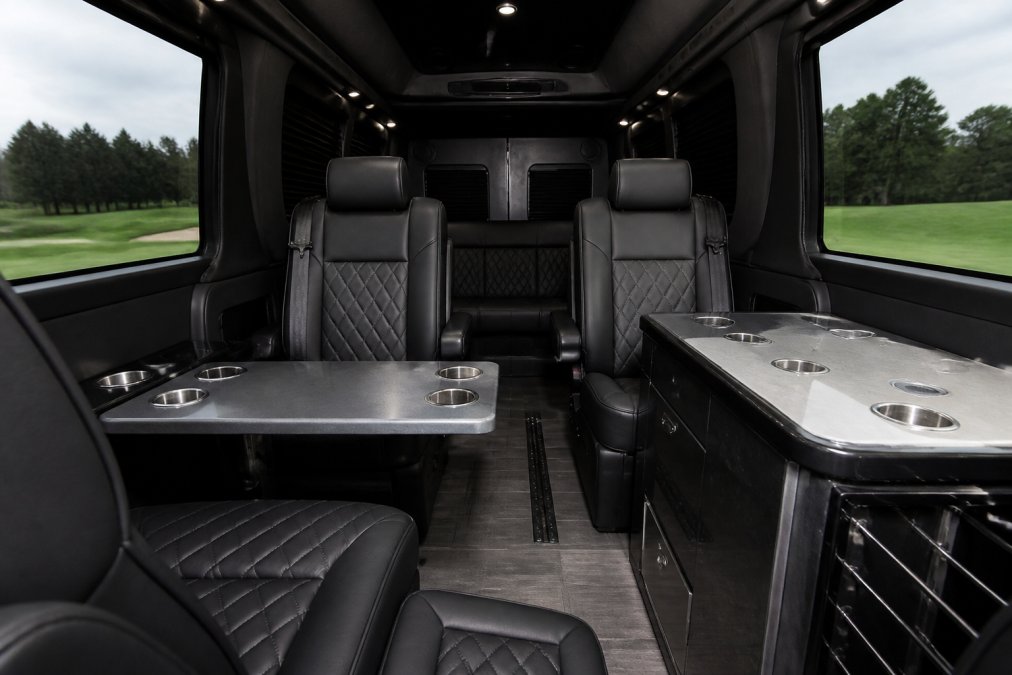
Seating drives the entire floor plan. Captain’s chairs give each player a full-size seat with armrests and recline, which matters on long drives; bench seating fits more people but limits legroom and rear access.
Captain’s Chairs, Ergonomic Seating, and Walk-In Headroom
Ergonomic seating with adjustable lumbar support is the biggest comfort upgrade for older players, and walk-in headroom lets them stand and move to their seat instead of ducking.
| Layout | Seats | Best For | Trade-Off |
|---|---|---|---|
| Four captain’s chairs | 4 | Small groups, maximum comfort | Less gear volume |
| Captain’s chairs plus rear bench | 6 | Golf buddies and family | Tighter rear access |
| Lounge-style rear seating | 4-6 | Strategy talks, card games | Heavier build |
Power, Climate Control, and Tech Integration on the Road
On-board power is the feature teams underrate until the first long road trip. Phones, rangefinders, GPS units, launch monitors, and tablets all need charging, and a single 12V socket won’t cover eight players. Treat it as an electrical system, not an accessory list, that’s what determines whether the van starts on tournament morning.
Sizing the House Battery Around Real Device Loads
Start with a load inventory: add up what the team actually plugs in, then size the house battery and charging system to cover a full day away from shore power.
- Phones: roughly 10-20 Wh per full charge, times eight players
- Rangefinders and GPS units: small draw, but they charge slowly and often sit plugged in for hours
- Tablets and launch monitors: the heaviest common load, often 30-50 Wh per charge
- A rear entertainment screen or Wi-Fi hotspot: continuous draw, not a one-time charge
Charging Architecture: Alternator, DC-to-DC, and Shore Power
Three charging paths matter in a golf van:
- Alternator charging through a DC-to-DC charger, the workhorse. It tops the house battery while you drive between courses, and it isolates the starting battery so accessories can’t drain it.
- Shore power inlet, useful for overnight top-ups at a hotel or club. A simple 30A inlet with an onboard charger keeps the house battery full before a multi-day trip.
- Solar, optional, and usually not worth the roof space on a golf van that drives most days. Skip it unless the van sits parked for long stretches.
Adding a large inverter and house battery without upgrading the charging system is the most common electrical mistake in van conversions. It drains the starting battery and leaves you stranded at the course. A DC-to-DC charger is not optional equipment, it’s the part that makes the rest of the system safe.
Outlet Placement and Device Management
Plan outlets around how players actually sit. USB-C at every captain’s chair, a 12V or AC outlet near the rear storage bay for launch monitors, and a dedicated charging shelf for rangefinders keep cables off the floor and devices off the seats. A labeled charging drawer, one slot per player, solves the “whose rangefinder is this” problem before it starts.
Climate Control for the Rear Cabin
Rear vents and a separate rear HVAC zone keep the back comfortable when the front is set for the driver. In a full-size van, the rear cabin sits far enough from the front evaporator that a single-zone system leaves it warm in summer and cold in winter. A second evaporator or rear blower tied into the main system is the fix, and it should be specified at the layout stage because it affects headliner and wall routing.
Tech Integration That Earns Its Space
Tech integration typically includes a rear entertainment system, a Wi-Fi hotspot, and a sound system for music and pre-round strategy video. The useful question is whether each item earns its footprint: a rear screen pays off for teams reviewing course video together, a hotspot for anyone running a scoring app or streaming, and a premium sound system if the van doubles as a social space after the round.
Weight Distribution and Payload Management for a Loaded Golf Van
Every conversion adds weight, and every set of clubs adds more. Payload capacity is the total weight a van can carry, including passengers, gear, and any added interior build. Exceed it and you compromise braking, handling, and tire life.
- Weigh the finished van empty before you load it
- Track passenger weight and gear weight separately
- Recheck payload any time you add a new system
Best Custom Vans for Golf Trips: Van vs. SUV vs. RV
The best custom vans for golf trips are full-size vans: they carry more gear than an SUV and drive and park more easily than an RV. The longer answer depends on how often you travel and with how many people.
| Vehicle Type | Gear Capacity | Maneuverability | Best For |
|---|---|---|---|
| Custom luxury van | High | Easy to park and drive | Teams of 4-8, frequent travel |
| Full-size SUV | Moderate | Easy | 2-4 players, light gear |
| RV | Very high | Difficult to park and maintain | Overnight trips, not day travel |
Section 179 Tax Deduction for Luxury Vans: What Business Owners Should Know
The Section 179 tax deduction for luxury vans lets qualifying businesses deduct the cost of a business vehicle in the year it’s placed in service rather than depreciating it over several years. Passenger vehicles face a depreciation cap, but vehicles above certain weight thresholds are treated differently.
Maintenance Costs and Resale Value After a Conversion
Maintenance on a converted van splits into two buckets: the chassis and the conversion. Chevrolet and GMC platforms use widely available parts and service networks, so mechanical upkeep stays predictable; the conversion side is where costs vary and most owners are unprepared.
Cleaning and Protecting Luxury Upholstery in a Golf Van
Golf gear is dirty in specific ways: wet grips, sunscreen, grass clippings, sweat, and cleat grit. Each one attacks upholstery differently, and a single cleaning routine won’t cover all of them.
- Sunscreen and sweat break down leather finishes over time. Wipe leather seating with a pH-neutral leather cleaner and follow with a conditioner every few months, more often in summer.
- Wet grips and towels are the main source of odor. Keep a sealed bin for wet items and never let damp gear sit against leather or carpet overnight.
- Grass and grit act like sandpaper on stitching. Vacuum storage bays and floor tracks weekly during the season, and use a soft brush on stitching rather than a wet rag.
- Cleat residue is the hardest on carpet. If you spec carpet at all, keep it out of the entry path and club bays, and choose a solution-dyed, moisture-resistant carpet over a plush one.
Service Intervals for Conversion Systems
The conversion has its own maintenance schedule, separate from the chassis:
- House battery: lithium banks typically last several years with proper charging; lead-acid is shorter. Capacity fade shows up first as shorter device-charging windows.
- Inverter and DC-to-DC charger: inspect connections annually. Loose terminals are the most common cause of intermittent electrical faults.
- HVAC rear zone: service the rear evaporator and blower on the same schedule as the front system.
- Upholstery and trim: condition leather twice a year minimum, and re-tighten any trim fasteners that work loose on rough roads.
What Actually Moves Resale Value
Resale value depends heavily on build quality and documentation: a well-built conversion from an established builder holds value better than a DIY job, and buyers pay more when you can show service records and original build specs. Specific choices matter too:
- Timeless finishes, neutral leather, standard trim colors, and classic layouts age better than trend-driven ones.
- Reversible modifications, bolt-in seating and storage that can be removed or reconfigured appeal to a wider pool of buyers than fully built-in systems.
- Documented electrical work, a labeled wiring diagram and service records for the house battery and inverter reassure buyers more than any cosmetic upgrade.
- Branding, team logos and custom embroidery are a selling point to the original team and a liability to everyone else. If resale matters, keep branding on removable covers or headrests rather than stitched into the seats.
The two factors that protect resale value most are a documented build and finishes that don’t date. Both cost nothing extra at the spec stage. Add a third: keep team branding removable, so the next owner isn’t paying to undo it.
Frequently Asked Questions
What are the essential interior features for a golf team transport van?
Start with dedicated golf bag storage, either vertical lockers or a flat floor design with tie-downs, so clubs do not slide during turns. Add captain’s chairs with ergonomic seating for long drives, walk-in headroom for changing shoes, climate control that reaches the rear cabin, and enough on-board power to charge phones, rangefinders, and launch monitors. Team branding, ambient lighting, and an entertainment system matter for morale, but storage volume and payload capacity decide whether the van works on tournament day.
How do you optimize van interior layouts for golf bag storage?
Measure your largest travel bag first, then plan around it. A typical staff bag needs roughly 35 to 40 centimeters of width and about 1.2 meters of height in a vertical locker. Vertical lockers free the floor for seating; flat floor design with recessed channels suits teams that load and unload quickly. Keep the heaviest gear over or ahead of the rear axle, leave a clear walkway to the captain’s chairs, and confirm total loaded weight stays inside your van’s payload rating before you commit to a layout.
Can a custom van serve as a mobile command center for golf tournaments?
Yes. Coaches and team captains use converted vans for pairings meetings, course strategy reviews, and gear staging because the interior offers seated space, a table surface, and secure storage that a standard SUV cannot match. Add a fold-out work surface, a display for reviewing hole maps, and charging for tablets and rangefinders. Climate control and ambient lighting make the space usable before sunrise tee times, and lockable storage keeps equipment safe while the team is on the course.
What are the benefits of custom upholstery in luxury golf vans?
Custom upholstery does more than look good. Marine-grade vinyl and premium leather resist sunscreen, sweat, and spilled drinks better than standard cloth, which matters when four to eight golfers rotate through the same seats. Team logo embroidery and custom finishes build a sense of identity for club teams and traveling groups. The practical benefit is durability: wipe-down surfaces stay presentable for years, and quality materials hold their shape, which protects resale value when you eventually sell or trade the van.
How does the Section 179 tax deduction for luxury vans work?
Section 179 of the Internal Revenue Code lets qualifying businesses deduct the cost of certain vehicles and equipment in the year they are placed in service, rather than depreciating them over many years. Passenger vehicles face a dollar cap, while heavier vehicles used for business can qualify for a larger deduction. Rules around gross vehicle weight rating, business-use percentage, and bonus depreciation change, so confirm your specific configuration with a CPA before you buy.
Is a custom golf van worth it if I only travel six or seven times a year?
It depends on what you replace. If you currently fly, rent a car, and pay baggage fees for clubs on every trip, a van removes those costs and the risk of damaged equipment. Frequent travelers also avoid airport delays and arrive with their own gear already loaded. If your trips are short and local, renting may cost less. Run the numbers over three years, including rental fees, flights, and club shipping, then decide.
How much does it cost to maintain and keep a converted golf van running?
Routine maintenance on the Chevrolet and GMC platforms underneath most conversions follows normal service intervals, so oil changes, brakes, and tires cost what they would on any full-size van. The conversion-specific items to budget for are upholstery cleaning, LED and electrical repairs, and any moving parts in your storage system. Ask the builder for a maintenance schedule and keep records, since documented service history supports resale value later.
How do I justify a luxury golf van to a spouse who thinks it is too expensive?
Frame it as a replacement, not an add-on. If you attend six to eight tournaments a year, add up flights, rental cars, checked bag fees, and the occasional damaged club. A van covers all of that in one asset you also use for business travel and family trips. If you own a business, the Section 179 deduction may reduce the effective cost. Then point to the practical wins: no more wrestling clubs through airports, and a comfortable place to change shoes.
Golf teams ask a lot of a vehicle: room for eight, storage for eight sets of clubs, power for everyone’s devices, and comfort after a long drive. GOLF Cruiser builds hand-built luxury vans on Chevrolet and GMC platforms with custom club storage, flexible layouts for families, golf buddies, or full teams, and the maneuverability of a van rather than an RV. If you’re ready to spec a mobile clubhouse around your team’s actual needs, contact GOLF Cruiser today to start your build.