
Table of Contents
- Key Differences Between Luxury Van Conversion Companies
- Luxury Van Conversion Cost Breakdown: What Drives the Price
- Van Conversion Tax Deduction for Business: Section 179 Explained
- GOLF Cruiser vs Standard RV: Maneuverability, Space, and Golf-Specific Design
- Build Quality, Lead Times, and Customization Options
- Total Cost of Ownership and Resale Value
- Frequently Asked Questions
Last Updated: September 24, 2026
Key Differences Between Luxury Van Conversion Companies
Comparing luxury van conversion companies starts with one question: does the builder design around your life, or around a camper’s? Most conversion shops build for camping. A smaller group builds executive transport. Very few build specifically for golfers. That distinction drives everything else, from interior layout to how clubs are stored.
GOLF Cruiser sits in that third category. The company hand-builds luxury vans on Chevrolet and GMC platforms, with over 45 years of experience in full-size vehicle conversions. Instead of a galley kitchen and a wet bath, you get custom club storage, flexible seating, and a mobile clubhouse layout for families, golf buddies, or a full team.
When you compare builders, sort them into three groups:
- Golf-specific builders: Layouts designed around clubs, gear, and tournament days
- Executive transport builders: Mobile offices and passenger comfort, no off-grid systems
- Camper van converters: Kitchens, baths, and sleeping quarters for van life
Each group solves a different problem. Paying camper-van prices for features you’ll never use is the most common mistake buyers make. If your van’s job is getting four golfers and their bags to a course in comfort, the spec sheet should look nothing like a camper’s.
Luxury Van Conversion Cost Breakdown: What Drives the Price
No two luxury van conversion quotes look alike, and that’s by design. Pricing depends on the chassis you choose, the interior finishes, and how much of the build is custom versus standardized. But “it depends” is not a useful answer for a buyer writing a check. Here is how the money actually breaks down.
The chassis is your floor, not your ceiling. A conversion starts with a donor van, typically a Chevrolet Express or GMC Savana in the full-size segment, or a Mercedes Sprinter, Ford Transit, or Ram ProMaster in the Euro-style segment. A high-roof, extended-wheelbase chassis carries a meaningful premium over a standard roof and wheelbase, and that premium compounds because a taller, longer box requires more interior material to finish.
Labor is the single largest line item in a bespoke build. Hand-built cabinetry, custom seating, and one-off storage bays are measured in shop hours, not parts. A common pattern in the industry is that labor runs a significant portion of a custom conversion’s total cost, which is why two builders quoting the “same” layout can land tens of thousands of dollars apart. Standardized packages cut labor because the shop has already jigged the cuts and templated the wiring.
Electrical systems scale almost linearly with ambition. A basic 12-volt system with a single house battery and a small inverter is a modest line item. Add lithium battery banks, roof-mounted solar, a high-output alternator, and a 3,000-watt inverter and you can easily add significant cost to the build. This is the category where buyers most often get surprised, because the upgrade path is modular and every add-on feels small in isolation.
Interior finishes are where luxury pricing lives. Marine-grade plywood and off-the-shelf laminate sit at one end. Hand-fitted hardwood cabinetry, premium upholstery, custom upholstered headliners, and integrated lighting sit at the other. The gap between those two ends on a full-size van can be the difference between a mid-range build and a high-end build.
Layout complexity is the hidden multiplier. A fixed bench and a storage bay is fast to build. A configurable club-storage system that converts to seating, plus a fold-out table and a rear lounge, takes design time, prototyping, and rework. Every moving part is a place where hours accumulate.
Because every GOLF Cruiser is hand-built, there’s no single sticker price. The company quotes each build individually, so the honest answer to “what will it cost” is: it depends on your spec. Contact GOLF Cruiser directly for current pricing on your configuration.
Ask any builder for a line-item breakdown before you sign. Shops that quote one lump sum are usually hiding where the margin sits, often in electrical systems and cabinetry. A credible quote separates chassis, labor, materials, and systems so you can see what you’re actually buying.
Standardized vs. bespoke: the timeline trade-off. Buyers consistently underestimate lead times. A shop running pre-set packages can often deliver in a matter of weeks to a few months because design is already done. A fully bespoke build typically runs several months or longer, because design, fabrication, finishing, and quality checks happen in sequence and any change order restarts part of that clock. Ask every builder for a written lead time and a written change-order policy, the policy matters more than the estimate.
Van Conversion Tax Deduction for Business: Section 179 Explained
Section 179 lets businesses deduct the purchase price of qualifying vehicles and equipment in the year they’re placed in service, rather than depreciating them over several years. For business owners, that can change the math on a luxury van significantly. The IRS publishes the current deduction limits and vehicle weight rules, so check the latest figures before you buy.
Here’s the part most buyers get wrong: qualification depends on how the vehicle is used and how it’s classified, not on how much it cost. A van used for business travel, client transport, or as a mobile command center may qualify. A van used purely for personal trips generally won’t.
Two practical steps:
- Document your business use from day one, including mileage logs and trip purpose.
- Confirm eligibility with your accountant before you order, not after.
The IRS Section 179 deduction guidance outlines the current rules and limits.
GOLF Cruiser vs Standard RV: Maneuverability, Space, and Golf-Specific Design
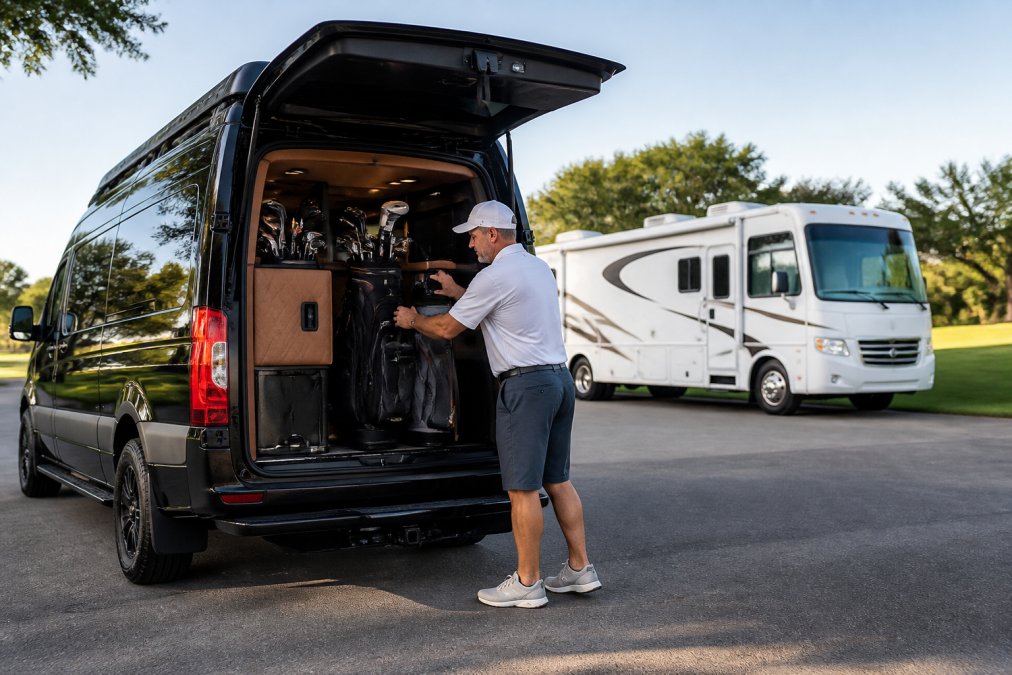
A standard RV is built for living in. A GOLF Cruiser is built for arriving. That single difference explains the maneuverability gap. RVs are wider, taller, and heavier, which makes parking at a crowded clubhouse a chore. A van-based build drives like the Chevrolet or GMC it’s based on, so it fits standard parking spaces and handles tight resort lots without drama.
| Feature | GOLF Cruiser | Standard RV |
|---|---|---|
| Parking | Fits standard spaces | Needs oversized sites |
| Club storage | Purpose-built | Improvised |
| Interior focus | Seating, gear, team space | Kitchen, bath, sleeping |
| Driving feel | Like a full-size van | Like a bus |
| Best for | Golf travel and tournaments | Extended camping trips |
Build Quality, Lead Times, and Customization Options
Build quality in this market comes down to who does the work and how long they’ve done it. GOLF Cruiser’s team brings over 45 years of full-size vehicle conversion experience, and every van is hand-built rather than assembled on a factory line. That matters most in the details: how cabinetry fits, how wiring is routed, and how the interior holds up after years of tournament travel.
The most expensive mistake in this market is ordering a bespoke layout without confirming the chassis payload capacity. Add too much cabinetry and gear, and you eat into the margin you need for passengers and luggage.
Total Cost of Ownership and Resale Value
Purchase price is only the first number. Total cost of ownership includes fuel, insurance, maintenance, depreciation, and what the van is worth when you sell it. Most comparison articles stop at the sticker. Here is the fuller picture, including the regulatory and insurance side that almost nobody covers.
The cheapest quote rarely wins over five years. Compare warranty coverage, service access, insurance insurability, and resale strength alongside the purchase price, and get the as-built weight and payload margin in writing before you commit.
Frequently Asked Questions
What should I look for when comparing luxury van conversion companies?
Focus on build quality, materials, and warranty coverage. Check if the company specializes in your use case, like golf travel. Ask about lead times, customization options, and post-conversion support. Review the total cost of ownership, including maintenance and resale value. For business buyers, confirm if the van qualifies for tax deductions under Section 179. A company with decades of experience, like GOLF Cruiser with over 45 years, often provides more reliable service and tailored designs.
Are custom luxury conversion vans worth the investment?
For frequent travelers, a custom luxury van can replace multiple vehicles and provide a mobile base. It offers more space and easier maneuverability than an RV, and can qualify for tax write-offs if used for business. Resale value tends to hold if the build quality is high. However, the upfront cost is significant. Consider how often you travel and whether the customization matches your needs. For golfers, a purpose-built van like GOLF Cruiser adds convenience and comfort that a standard SUV cannot match.
What are the benefits of choosing a GOLF Cruiser over a standard RV?
GOLF Cruiser is built on a Chevrolet or GMC van platform, making it easier to park, drive, and maintain than a large RV. It offers more interior space for gear and passengers, with custom club storage and flexible layouts. Unlike an RV, it is tailored for golfers, not campers, so you get luxury features that match your lifestyle. It also has the potential for Section 179 tax deductions, which an RV may not qualify for. Plus, it serves as a mobile clubhouse for tournament preparation.
How do I evaluate the build quality of a luxury van conversion?
Inspect the materials used in cabinetry, upholstery, and flooring. Look for tight seams, durable finishes, and ergonomic design. Ask about the electrical system, insulation, and HVAC components. A reputable company will provide details on their construction process and warranty. For example, GOLF Cruiser hand-builds each van with over 45 years of experience, ensuring attention to detail. Reading customer reviews and, if possible, viewing a finished van in person can also help assess quality.
Do luxury van conversions offer tax advantages for business use?
Yes, if the van is used for business, it may qualify for Section 179 of the IRS code, allowing you to deduct a portion of the purchase price. To qualify, the vehicle must be used more than 50% for business. Golf coaches, tournament organizers, and business owners who use the van for work-related travel can benefit. Consult your accountant to confirm eligibility. GOLF Cruiser vans are designed with business use in mind, potentially making them a smart investment for professionals.
Choosing the right builder comes down to honesty about how you’ll actually use the van. If your travel revolves around tournaments, resort weekends, and moving a team with gear, a camper-focused conversion is the wrong tool. GOLF Cruiser builds for exactly that use case, with custom club storage, flexible layouts for groups, Chevrolet and GMC platforms, and hand-built quality backed by over 45 years of experience. Get started with GOLF Cruiser and spec a van around your game, not a camper’s.