
Table of Contents
- What Defines Bespoke Van Interior Build Quality
- Custom Van Interior Quality: A Practical Inspection Framework
- Custom Van Build Materials: What Separates Premium from Standard
- Custom Van Builder Comparison: Key Evaluation Criteria
- Custom Golf Van Features and Purpose-Built Design
- Long-Term Durability and Real-World Owner Experience
- Frequently Asked Questions
Last Updated: October 10, 2026
What Defines Bespoke Van Interior Build Quality
Bespoke van interior build quality separates a purpose-built luxury vehicle from an ordinary conversion.
Build quality manifests across three dimensions: structural integrity, material selection, and attention to detail. A bespoke van interior should feel solid when you close a cabinet door, not rattle when you drive. Gaps between panels should be uniform, measured in millimeters.
Quality isn’t always visible in photos or during a brief walk-through. Many builders cut corners in places you won’t notice until months into ownership: unsealed cabinet backs, hardware without proper reinforcement, or finishes separating under temperature changes.
Custom Van Interior Quality: A Practical Inspection Framework
Evaluating bespoke van interior build quality requires a systematic approach focused on measurable characteristics that predict long-term durability and performance.
Cabinet Construction and Fastening
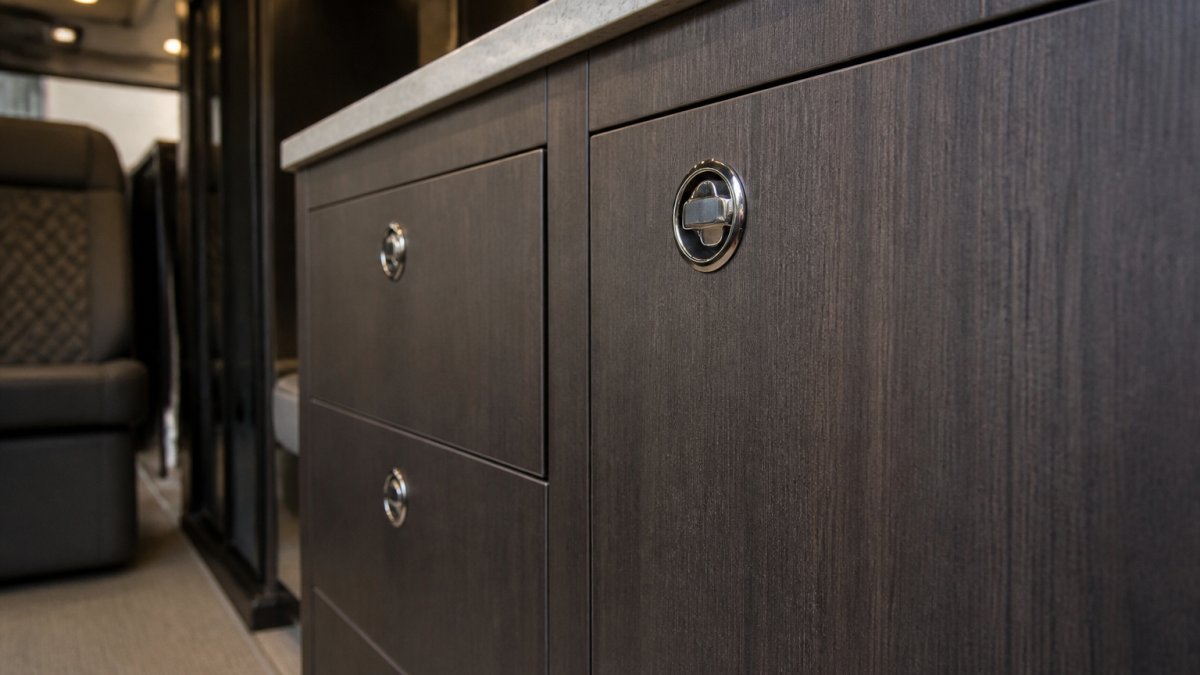
Cabinet construction reveals quality immediately. Open every cabinet door and drawer, solid cabinets make minimal sound when closed. Doors should align flush with the frame. Inside edges should be smooth and finished, not rough plywood.
Quality builds use cabinet-grade fasteners that are countersunk and filled or hidden entirely. Visible screw heads indicate expedient assembly.
Heavy-duty hinges and slides require backing plates or solid wood blocking inside the cabinet. Hardware screwed directly into thin plywood is a red flag, hinges will eventually tear through under repeated use.
Gaps, Fit, and Surface Finish
Uniform gaps between panels signal attention to detail. Professional builds maintain gaps of 1/8 inch or less, consistent throughout. Irregular gaps suggest the builder didn’t use proper jigs or alignment tools.
Finishes should be smooth, not sticky or tacky. Check for dust nibs, runs, or sag marks in painted surfaces, these indicate rushed application or poor ventilation. Stain and varnish should have even color and sheen, not blotchy spots.
Edges should be smooth and fully sealed, not splintering or peeling. Trim should be caulked where it meets other surfaces to resist moisture infiltration.
Hardware and Durability Under Use
Quality hardware performs consistently under travel stress. Open and close cabinet doors and drawers at least ten times each, they should operate smoothly without binding and close with a soft catch. Hinges and slides should feel substantial with no flex or play.
Stainless steel or powder-coated hardware resists corrosion in a van’s damp environment; cheap hardware rusts within months. Quality drawer slides extend fully and close with controlled deceleration, not free fall.
Test cabinet locks and latches. They should engage firmly and release smoothly. Loose or sticky hardware indicates inadequate installation or substandard components.
Custom Van Build Materials: What Separates Premium from Standard
Material selection determines long-term performance. Premium builds prioritize durability and moisture resistance; standard builds often substitute cheaper materials to reduce cost.
Cabinetry should use marine-grade plywood or birch, not particle board. Marine plywood resists moisture and won’t delaminate; particle board absorbs moisture, swells, and fails.
Solid surface materials like Corian or Formica resist staining and moisture. Laminate over particle board will bubble and delaminate if water penetrates.
Flooring should be marine-grade or commercial vinyl, not residential.
Upholstery and soft goods reveal quality through material weight and seam construction.
Custom Van Builder Comparison: Key Evaluation Criteria
Comparing builders requires moving beyond marketing claims to a structured evaluation framework combining workmanship assessment, materials transparency, safety compliance, and documented defect tracking.
Workmanship and Attention to Detail
The best indicator of a builder’s standards is seeing their work in person and asking specific process questions. Request a factory tour or detailed video walkthrough at multiple assembly stages. A builder confident in their workmanship welcomes scrutiny.
Ask about their assembly process in measurable terms:
- Do they use jigs and fixtures to ensure consistent gaps and alignment, or do they hand-fit each cabinet?
- What is their target gap tolerance (e.g., 1/8 inch or less between panels)?
- How many quality control checkpoints occur during assembly, and what do inspectors check at each stage?
- Do they test every cabinet, drawer, and mechanical system before delivery, and do they document results?
- What is their defect rate on delivery, and how is it tracked?
Request references from at least three clients with builds completed within the past 18 months. Ask about durability, hardware failures, warranty responsiveness, water intrusion, and finish degradation.
Builders with consistent positive feedback across multiple owners demonstrate reliable quality; mixed reviews suggest inconsistency.
Safety and Compliance of Interior Installations
Bespoke van interiors must meet safety standards that many builders treat as afterthoughts.
Ask builders to document compliance with the following:
Seating and Restraint Integration: All seating must be anchored to the vehicle frame, not just the floor. Request documentation that seating meets FMVSS 207 (seating assembly anchorage) and FMVSS 210 (seat belt assembly). Loose or improvised mounting is a liability and safety hazard.
Electrical Safety: All wiring should be properly fused and protected.
Ventilation and Carbon Monoxide Safety: Ask about roof vents, range hood ventilation, carbon monoxide detector installation, and operable windows. Poor ventilation creates dangerous conditions during cold weather.
Cabinet Securement and Crash Safety: Ask whether cabinets are bolted to the vehicle frame, appliances are secured with rated brackets, and there’s a weight distribution plan. A builder who dismisses these questions is cutting corners on safety.
Warranty, Support, and Defect Documentation
A strong warranty reflects confidence in build quality. Reputable builders offer 2-5 years coverage on structural components and hardware. Check whether it covers labor, has exclusions, specifies response timeframes, and allows repairs at authorized locations. Post-build support matters as much as the warranty, ask whether troubleshooting is available remotely and whether service locations exist.
Ask the builder for their documented defect log or quality report. Transparent builders track defects by severity and can show trends. A builder who can’t produce this data or claims “our builds are perfect” is either inexperienced or dishonest.
Materials Transparency and Specification Disclosure
Compare builders on what they actually use, not vague marketing terms. Request a detailed materials list that includes:
- Plywood grade (marine-grade, birch, or particle board?)
- Countertop material and thickness
- Flooring type and thickness
- Upholstery fabric weight and fiber content
- Hardware brand and finish (stainless steel, powder-coated, or plated?)
- Insulation type and R-value
- Sealants and adhesives used
- Paint or stain brand and sheen
Builders who provide this level of detail invite comparison. Those who say “premium materials” without specifics are hiding cost-cutting substitutions.
Custom Golf Van Features and Purpose-Built Design
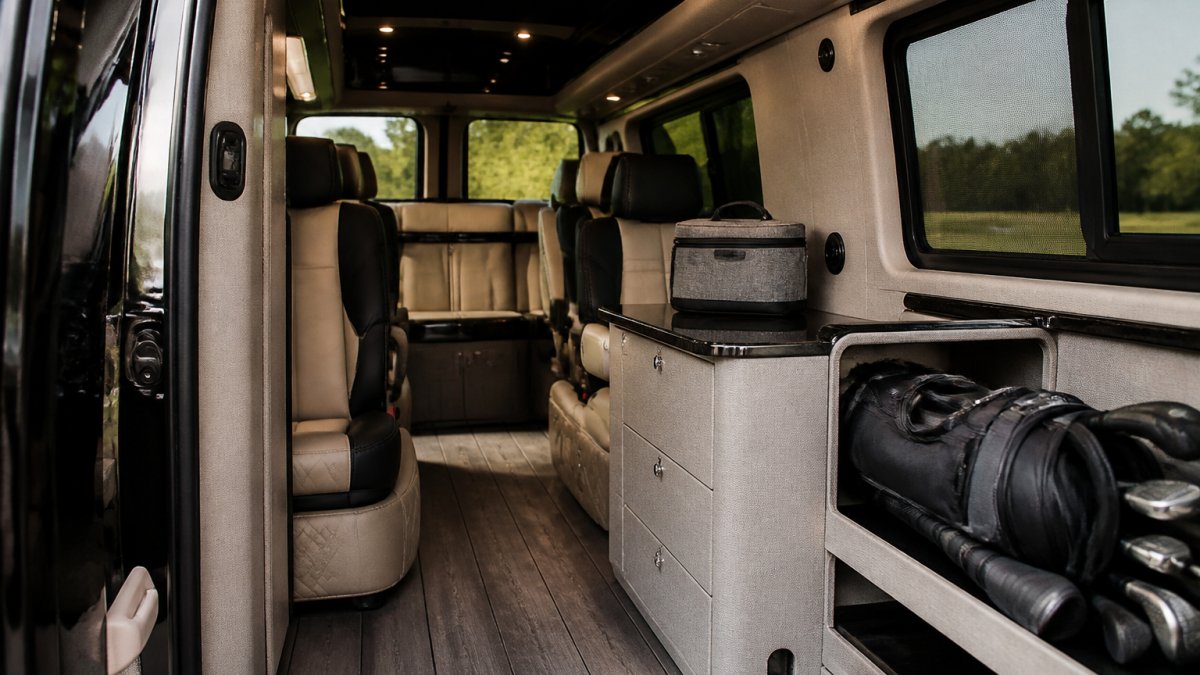
Purpose-built design separates a golf van from a generic camper conversion. GOLF Cruiser vans include golf-specific features that standard conversions lack: dedicated club storage, flexible seating layouts, and mobile command center functionality. Quality purpose-built design means every feature serves a need, cabinetry positioned for easy access, storage sized for actual equipment, and lighting bright enough for reading scorecards or working.
Long-Term Durability and Real-World Owner Experience
Bespoke van interior build quality ultimately proves itself through time and use. A well-built interior should feel solid and rattle-free after years of travel, with cabinets closing smoothly and hardware operating without binding. Evaluating long-term performance requires asking builders for specific evidence and understanding common failure modes.
Documented Durability Evidence and Failure Tracking
Ask potential builders for long-term durability data, not just testimonials.
Fleet History: Ask for data on their oldest builds still in use.
Documented Defect Categories: Common failure patterns include cabinet loosening (fasteners backing out due to vibration), water intrusion at seams (the most expensive failure), hardware corrosion in damp environments, finish degradation under temperature swings, and appliance failure.
Maintenance Cost Data: Ask owners about typical annual maintenance costs for a 5-year-old bespoke van. A well-built van should require minimal maintenance beyond normal wear. Frequent repairs or escalating costs suggest suspect build quality.
Common Failure Modes and How to Avoid Them
Understanding where bespoke van interiors typically fail helps you evaluate a builder’s design and construction choices.
Cabinet Fastening Under Vibration: Quality builders use pocket-hole joinery with glued joints, thread-locking compound, torque verification, and flexible mounting points.
Water Intrusion at Seams and Penetrations: Quality builders use marine-grade sealants, flashing that directs water away, sealed cabinet backing, and regular re-sealing as part of warranty.
Hardware Corrosion in High-Humidity Environments: Quality builders specify stainless steel or powder-coated hardware with sealed fasteners.
Finish Failure Under Temperature Swings: Quality finishes use flexible polyurethane or water-based systems, multiple thin coats, proper surface preparation, and UV-protective topcoats.
Owner Feedback and Reputation Verification
Beyond the builder’s claims, seek out independent owner feedback. Look for:
- Online reviews on RV forums and van-life communities: Search the builder’s name on platforms like iRV2, Sprinter Forum, or van-specific Facebook groups. Read both positive and negative reviews, paying attention to patterns (e.g., “multiple owners report water leaks” vs. “one person had an issue”).
- YouTube build tours and long-term reviews: Owners often post detailed walkthroughs and updates on their builds. Watch videos from owners 2-5 years into ownership, not just fresh builds. Listen for complaints about rattles, leaks, or repairs.
- Direct owner references: Ask the builder for contact information for 5-10 owners with builds 3+ years old. Call or email them and ask: “Would you buy from this builder again? What has needed repair? What surprised you about durability?”
- Warranty claim history: If possible, ask the builder how many warranty claims they’ve received and what the most common issues are. Transparency here is a green flag.
Red Flags in Durability and Support
Be wary of builders who:
- Can’t provide references with builds older than 2 years
- Dismiss durability concerns as “normal wear and tear”
- Don’t track or document defects
- Offer limited warranty (less than 2 years on structural components)
- Don’t respond to warranty claims within 30 days
- Use cheap hardware or materials without acknowledging the trade-off
- Have multiple negative reviews mentioning water intrusion, rattles, or hardware failure
- Don’t offer post-warranty support or repair services
A builder confident in their work stands behind it with strong warranty coverage, responsive support, and documented durability evidence.
Frequently Asked Questions
How can you assess the build quality of a custom van interior?
Start by inspecting cabinet construction: check for consistent gaps (no more than 1/8 inch), tight joints, and quality fasteners that don’t rattle. Run your hand over surfaces to feel for rough spots or uneven finishes. Open and close cabinet doors multiple times to ensure smooth operation without binding. Look at how edges are finished and whether materials are aligned properly. Ask the builder for a detailed materials list and warranty documentation. Request references from previous buyers and ask about any defects they’ve encountered after ownership. A reputable builder should invite thorough inspection and provide transparent documentation of craftsmanship standards.
What materials should a high-quality custom van interior use?
Premium custom van interiors typically use marine-grade plywood or solid hardwood for cabinetry rather than particle board, which warps over time. Quality builders specify stainless steel or marine-grade hardware that resists corrosion in humid environments. Flooring should be either sealed hardwood or commercial-grade vinyl designed for vehicle use. Upholstery should be automotive-grade fabric or leather rated for durability and cleanability. Countertops benefit from solid surface materials like Corian rather than laminate, which can separate. Insulation should be closed-cell foam to prevent moisture absorption. Ask builders to disclose the specific brands and grades of materials they use, transparency here signals confidence in their choices.
How do you compare custom van builders before placing an order?
Request detailed specifications from each builder: materials, construction methods, warranty coverage, and timeline. Ask for photos of completed interiors and contact information for past clients willing to discuss their experience. Visit completed builds in person if possible to inspect fit, finish, and overall attention to detail. Clarify what customization is possible and whether changes mid-build incur additional costs. Understand the warranty scope, does it cover defects in materials and workmanship for a specific period? Ask about post-build support: how are issues addressed and how quickly? Compare total cost of ownership, not just base price, including maintenance expectations. Red flags include vague material specifications, unwillingness to provide references, or pressure to commit before you’ve inspected comparable work.
What’s the difference between a bespoke van interior build and a pre-built camper van?
Bespoke builds are customized from the ground up to your exact specifications, layout preferences, and usage needs. You control material choices, storage configuration, and design details. Pre-built camper vans offer fixed layouts and standardized materials at lower cost, but offer limited customization options. Bespoke builds typically take longer to complete but result in a vehicle tailored to your priorities, whether that’s club storage for golf travel, team seating for tournament runs, or specific accessibility features. The trade-off is higher cost and longer lead times. For specialized uses like golf travel with custom equipment storage, bespoke builds generally deliver better value because they’re designed for your actual use case, not a generic camping scenario.