
Table of Contents
- Start With How You Travel, Not the Seat Catalog
- What You’ll Need Before You Configure Anything
- Step 1: Map Your Custom Van Seating Layouts
- Step 2: Weigh Captain Chairs vs. Bench Seats in a Van
- Step 3: Decide Where Swivel Captain Chairs for Vans Earn Their Space
- Step 4: Balance Golf Van Seating and Club Storage
- Step 5: Match Configurations to How You Actually Play
- Common Mistakes to Avoid With Captain Chair Configurations
- Frequently Asked Questions
Last Updated: October 6, 2026
Start With How You Travel, Not the Seat Catalog
Most golfers configure custom van captain chair configurations backwards. They open a catalog, see a plush seat, and build the interior around it. That approach produces a beautiful van that fights you every time you load four golf bags and three passengers for a weekend tournament.
Custom van captain chair configurations are the specific arrangements of individual, adjustable seats within a van’s interior, covering how many you install, where they sit, and how they move. At GOLF Cruiser, we have spent over 45 years converting full-size Chevrolet and GMC platforms, and the pattern is always the same: the golfers who plan around their travel habits end up happier than the ones who plan around upholstery samples.
So before you pick a single seat, answer three questions. How many people travel with you? How many golf bags come along? And does anyone in your group need extra room to get in and out?
Your answers decide everything that follows.
What You’ll Need Before You Configure Anything
Gather four things before you sketch a single layout. Skipping this step is how buyers end up paying for changes later.
- A realistic passenger count. Not your maximum ever, your typical group. If you usually travel with three buddies and occasionally five, plan for five.
- Your bag count and cart type. Push carts, riding carts, and staff bags take up very different footprints.
- Your tallest and least mobile passenger. Door clearance, step-in height, and aisle width matter more than seat stitching to them.
- Your parking situation. Garage height and driveway width constrain roof options and door swing.
Write these down. Every configuration decision in this guide traces back to this list.
Step 1: Map Your Custom Van Seating Layouts
The most common custom van seating layouts fall into three families: captain-chair-forward, bench-forward, and mixed. Each one solves a different problem.
Captain-chair-forward layouts put two individual seats in the second row and leave the rear open for cargo. This is the layout most golf groups settle on because it gives every passenger their own space while preserving a deep, flat cargo floor behind them.
Bench-forward layouts trade individual comfort for one extra seat. They work when you regularly carry six or more people and your cargo needs are light.
Mixed layouts combine both: captain chairs up front for the passengers who ride the most miles, a bench or fold-flat unit in the rear for overflow and gear.
Row-by-Row Planning for Golf Groups
Plan front to back, one row at a time. The front row is fixed by the chassis, so your real decisions start in row two.
- Row 2: Two captain chairs, or a bench if you need the third belt. This row gets the most use, so this is where comfort pays off.
- Row 3: Captain chairs if passengers ride here often; a fold-flat bench if this row is mostly storage.
- Rear: Leave it open. Golf bags load and unload here dozens of times per trip, and a clear floor beats a clever one every time.
Measure your longest golf bag before you finalize any row depth. A staff bag laid flat needs more length than most people estimate, and rear cargo depth is the spec that gets compromised first when buyers add a third row.
Step 2: Weigh Captain Chairs vs. Bench Seats in a Van
The captain chairs vs. bench seats in a van decision comes down to one trade: individual comfort against total capacity. Captain chairs give each passenger their own armrests, their own recline, and a clear aisle between them. Benches give you one more seat in the same footprint.
For golf travel specifically, captain chairs win more often than the raw seat count suggests. Here is why.
Golfers travel with bulky, awkward gear. A center aisle created by two captain chairs lets passengers reach the rear cargo area without climbing over anyone. On a bench, someone has to slide out at every stop.
The exception is the family van. If you routinely carry six passengers, a bench in row two keeps everyone legal and seated.
Do not remove a seatbelt-equipped bench to gain cargo space unless you have confirmed the change is legal in your state and your insurer has signed off. Removing seating positions can void coverage and create liability if a passenger rides in an unapproved spot.
Step 3: Decide Where Swivel Captain Chairs for Vans Earn Their Space
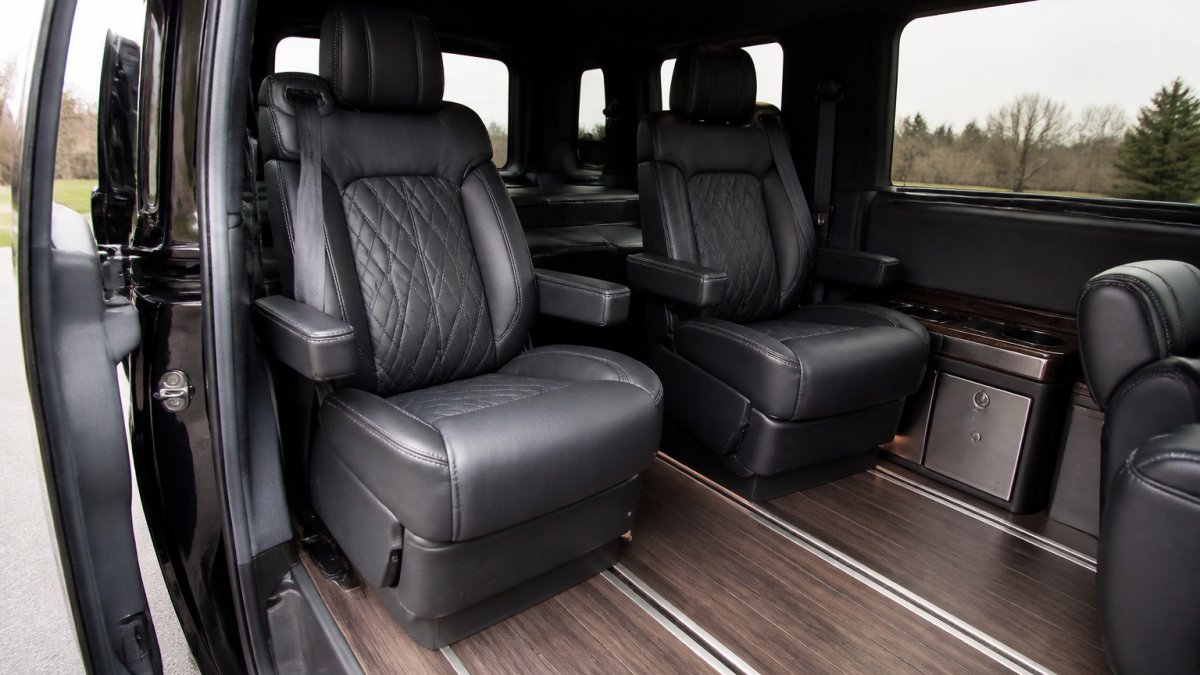
Swivel captain chairs for vans earn their place in row two, where they turn the interior into a conversation and strategy space. A swivel base lets the seat rotate to face the rear cabin, which turns a parked van into a mobile clubhouse before and after a round.
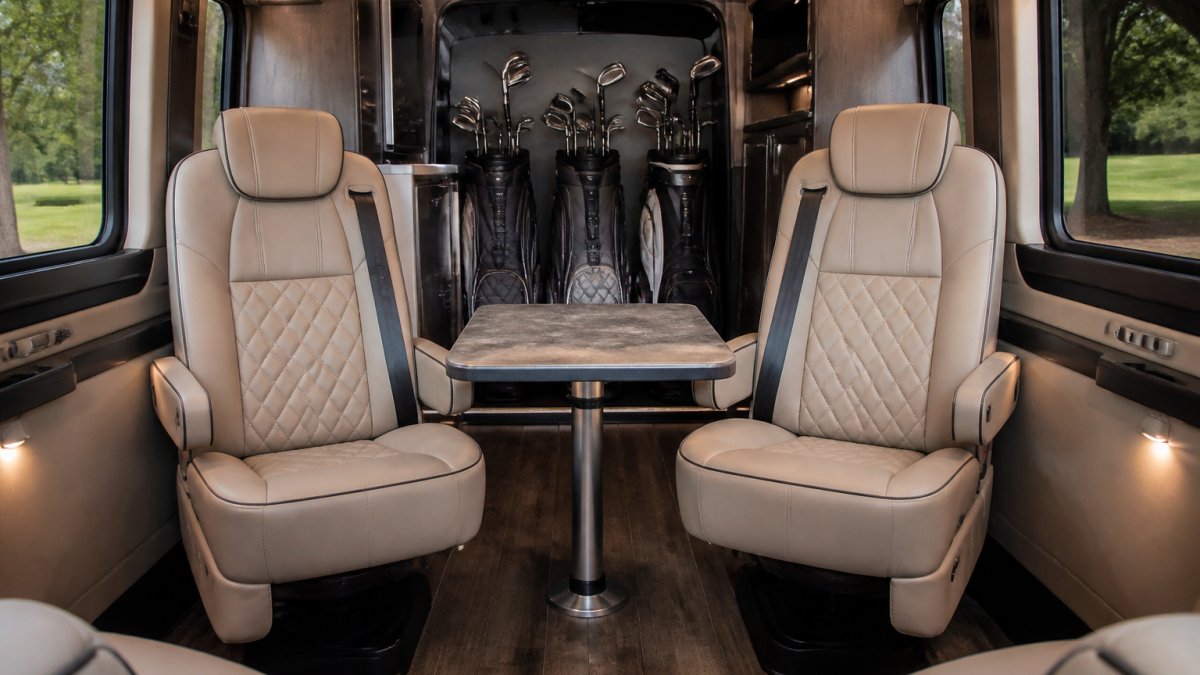
We recommend swivels on row-two seats only. Rear-row swivels add hardware, weight, and cost for seats that rarely need to turn.
Swivel Clearance and Rotation Limits
Swivel clearance and rotation limits decide whether a swivel seat is usable or decorative. A swivel needs a clear circle around the seat base, and most van interiors cannot provide a full 360 degrees.
Plan for these constraints:
- Rotation range: Most installations allow roughly 180 degrees, enough to face rearward, not a full turn.
- Table clearance: A stowed table or console in the rotation path blocks the swivel entirely.
- Seatback angle: A reclined seatback can strike the wall or window trim mid-rotation.
- Step-in height: Swivel bases add height, which changes how easy it is for a passenger with mobility limits to get in.
Test the rotation with the seat in its most reclined position, not its upright one. That is where interference shows up.
Step 4: Balance Golf Van Seating and Club Storage
Golf van seating and club storage compete for the same square footage, and storage usually loses. That is a mistake. A van that seats six but cannot swallow six bags is a van that leaves gear behind.
Set a hard rule before you configure: every seated passenger gets one bag’s worth of dedicated storage. Then design seating around whatever footprint remains.
In practice, this means:
- Group bags in a vertical rack or a flat, locking drawer rather than scattering them.
- Keep the load path from the rear doors to the rack straight and unobstructed.
- Leave a dedicated spot for shoes, push carts, and coolers so they do not migrate into the seating area.
A clean load path matters more than total cubic feet. A van with slightly less space but a straight shot from door to rack beats a bigger van you have to Tetris every bag into.
Step 5: Match Configurations to How You Actually Play
The right configuration depends on your travel pattern, not your budget. Here is how the common golfer profiles map to layouts.
| Traveler Profile | Recommended Layout | Swivel Seats | Why It Fits |
|---|---|---|---|
| Solo or pair, frequent tournaments | Two captain chairs, open rear | Row 2 only | Maximum cargo, easy solo loading |
| Group of four buddies | Four captain chairs, open rear | Row 2 only | One seat per golfer, clear aisle |
| Family plus gear | Two captain chairs, rear bench | Row 2 only | Seats the family, keeps cargo depth |
| Full team or club group | Bench in row 2, captain chairs row 3 | None | Maximum passenger count |
| Mobility-focused buyer | Two captain chairs, wide aisle | Row 2 only | Easy step-in, room to move |
Note the pattern. Swivel seats appear in almost every configuration because row-two swivels add function without stealing seat count. Full-team vans skip them because passenger capacity is the binding constraint.
If you are coming from a standard SUV, expect the van to feel dramatically easier to load. The rear doors and lower load height do most of that work.
Common Mistakes to Avoid With Captain Chair Configurations
The most expensive mistakes in captain chair configurations are made before the first cut, not after. Watch for these.
Configuring for the maximum, not the typical. A van built for eight passengers is a compromise for the four who actually ride. Build for your real group and rent or caravan for the outliers.
Ignoring the swivel arc. Buyers approve a swivel seat, then add a console or table that blocks the rotation. Lay out the full rotation path before finalizing any furniture.
Skipping the load-path test. Walk the route a golf bag takes from the ground to its rack. If it requires lifting over a seat or around a table, redesign the layout.
Forgetting the tax conversation. Many business owners ask about Section 179 write-offs for a business-use vehicle. Eligibility depends on your use, your business structure, and current IRS rules, so confirm the details with your accountant before you buy. You can review the requirements directly at IRS Section 179 deduction guidance.
Treating seat count as the only spec. Aisle width, step-in height, and cargo depth shape daily use far more than the number of belts.
The best configuration is the one that matches your typical trip, not your biggest one. Build for the group that rides every weekend, and the van stays useful for years.
Configuring a van around real trips rather than a catalog takes discipline, and it is exactly the work GOLF Cruiser has refined across more than four decades of hand-built conversions on Chevrolet and GMC platforms. Our vans ship with custom club storage, flexible layouts for families, golf buddies, or full teams, and swivel-ready seating that turns the cabin into a mobile clubhouse. When you are ready to design a layout around how you actually play, contact us and we will help you map it row by row.
Frequently Asked Questions
What captain chair configurations are available for custom vans?
Most builds use second-row captain chairs with either a third-row bench or a third-row pair of captain chairs. You can also choose a four-captain setup with two rows of two, a two-captain layout with open space behind, or a single captain chair paired with a rear bench. The right choice depends on how many passengers you carry regularly and how much room you want for golf bags and gear.
Can captain chairs swivel in a van?
Yes, swivel captain chairs for vans are a common upgrade. They rotate to face the rear cabin, which turns the second row into a lounge or meeting area. The main constraint is clearance: the chair needs enough open floor and distance from the wall or console to complete the turn. Plan the layout so the swivel path does not collide with a table, cooler, or club storage unit.
Are captain chairs better than bench seats for long trips?
Captain chairs give each passenger their own armrests, more shoulder room, and independent recline, which matters on long drives to tournaments. Bench seats carry more people in the same footprint and cost less to add. For groups of four or fewer who value comfort, captain chairs usually win. For full teams of six or more, a captain-and-bench mix often makes more sense.
Can a custom van have captain chairs and golf club storage?
Yes, and that combination is the reason many golfers choose a custom build. The usual approach is captain chairs in the second row with a dedicated club storage bay behind the third row or along one side wall. Keeping clubs in a fixed, lockable area prevents bags from sliding and protects shafts. Decide the seat count first, then size the storage around the remaining floor space.