

Table of Contents
- Waldoch vs Ultimate Toys: What Actually Separates These Luxury Conversion Vans
- Chassis and Base Vehicle Differences That Affect Performance and Comfort
- Luxury Van Interior Features Comparison: Seating, Storage, and Build Quality
- Custom Conversion Van Tax Benefits Under Section 179: What Golfers Need to Know
- Best Sprinter Van for Golf Trips: Matching the Van to Your Travel Style
- Total Cost of Ownership: Maintenance, Fuel Efficiency, and Resale Value
- Which Luxury Golf Van Fits Your Needs? A Decision Framework
- Conclusion
- Frequently Asked Questions
Last Updated: September 15, 2026
Waldoch vs Ultimate Toys: What Actually Separates These Luxury Conversion Vans
The luxury golf van market is one of the most competitive segments in vehicle conversion, with buyers weighing chassis, craftsmanship, and ownership costs before a six-figure investment. This waldoch vs ultimate toys comparison matters because both builders target the same buyer: the golfer who wants a mobile clubhouse rather than a camper. At GOLF Cruiser, we’ve spent over 45 years building hand-crafted vans on Chevrolet and GMC platforms, so we know where these approaches diverge.
Here’s the short version: Neither Waldoch nor Ultimate Toys is purpose-built for golf. That’s the gap a dedicated luxury golf van fills.
NHTSA vehicle safety ratings and recall database
The throughline: chassis choice determines driving experience, interior layout determines daily usability, and ownership costs determine whether the purchase makes sense five years out. Most buyers focus only on the second.
Chassis and Base Vehicle Differences That Affect Performance and Comfort
Chassis selection is the biggest structural decision in any conversion, shaping wheelbase and ride height.
Ultimate Toys builds almost exclusively on the Mercedes-Benz Sprinter, which offers a high-roof option and refined drivetrain performance. The Sprinter’s narrower turning circle helps in resort parking lots, but service costs run higher.
A common mistake is assuming the chassis matters less once the build-out is finished. It doesn’t: wheelbase affects maneuverability, high-roof configuration affects garage clearance, and drivetrain options affect handling under a full load.
| Factor | Domestic Chassis | Sprinter Chassis |
|---|---|---|
| Service network | Broad, lower cost | Narrower, higher cost |
| Maneuverability | Standard | Tighter turning radius |
| High-roof availability | Limited | Widely available |
| Parts pricing | Lower | Higher |
Luxury Van Interior Features Comparison: Seating, Storage, and Build Quality
Interior trim, upholstery, and seating capacity define how a conversion van feels after the first month.
Ultimate Toys prioritizes executive aesthetics: captain’s chairs, ambient lighting, and infotainment tuned for business travel. Both deliver real luxury, but neither solves the golf-specific problem of club storage.
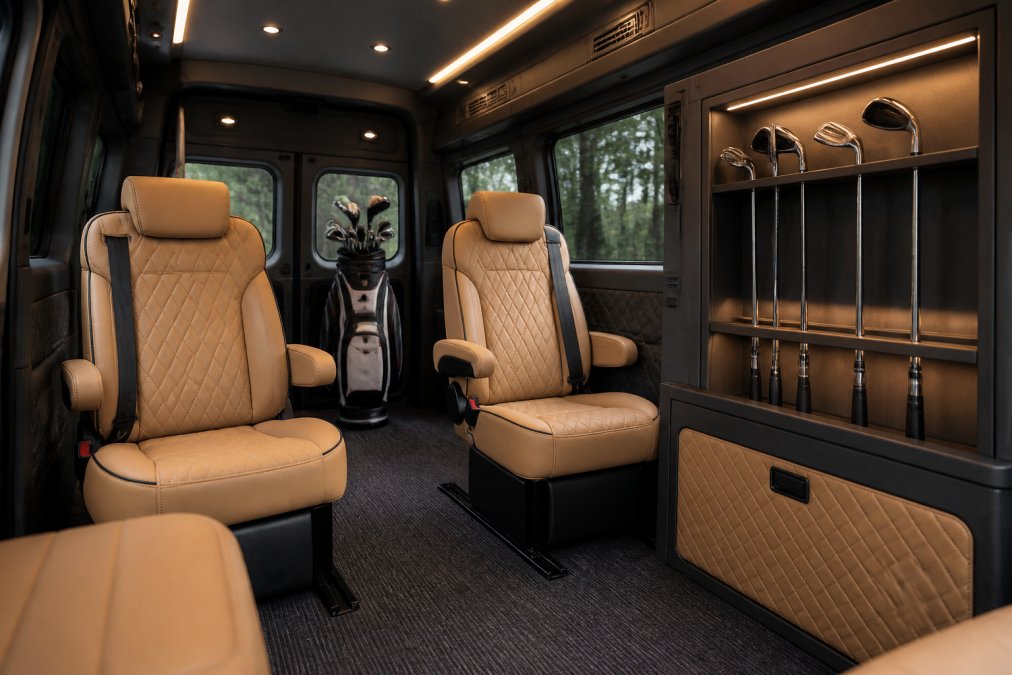
What most guides miss: a luxury van interior features comparison has to account for cargo. Golf bags are long, don’t stack well, and scuff upholstery. A camper layout with a rear bed wastes the space a foursome needs.
Measure your longest club bag before you spec any conversion. A bag with a full-length divider can run longer than a standard cargo compartment, and retrofitting storage after the build is far more expensive than planning it upfront.
Custom Conversion Van Tax Benefits Under Section 179: What Golfers Need to Know
Section 179 of the Internal Revenue Code lets a qualifying business deduct the cost of a qualifying vehicle in the year it is placed in service rather than depreciating it over several years (Instructions for Form 4562 (2025)). For a six-figure luxury conversion van, that timing difference is the entire reason the strategy exists. But the deduction is not automatic.
IRS Section 179 deduction guidance
The Two Thresholds That Decide Everything
Two numbers drive eligibility, both from the chassis:
- Gross vehicle weight rating (GVWR). Section 179 has historically applied to vehicles above a GVWR threshold, with heavier vehicles treated more favorably. A loaded luxury van on a high-roof chassis often clears the threshold a light-duty passenger platform does not. Confirm GVWR on the chassis door jamb sticker, not the brochure.
- Business use percentage. The deduction scales with the share of business use. A van used 60% for client transport and 40% personal does not get the same treatment as one used 95% for business. Mileage logs, calendars, and trip records are the evidence.
What Actually Qualifies as Business Use for a Golf Van
The IRS does not care that you play golf, it cares whether the vehicle has a genuine business purpose. Patterns that hold up include:
- Transporting clients or prospects to outings, tournaments, or off-site meetings.
- Carrying team members, equipment, or branded materials to events.
- Operating as a mobile office or meeting space for a business that genuinely uses it that way.
- Shuttling between a business location and a course as part of a documented client relationship.
What does not hold up: buying the van primarily for personal weekend rounds and retrofitting a business story afterward. Documentation must exist before the purchase, not after an audit notice.
Entity Structure Changes the Math
A sole proprietor, S-corp, LLC taxed as a partnership, and C-corp all interact with Section 179 differently, and the deduction can be limited by business income in the year of purchase. A low-profit year can cap the benefit regardless of the van’s price, which is why timing matters as much as the vehicle.
No builder, dealer, or upfitter can guarantee your deduction. Any salesperson who promises a specific refund amount is selling, not advising. Run the GVWR, the business-use percentage, and your projected income past a CPA before you sign a build sheet.
The Bonus Depreciation Overlap
Section 179 is not the only lever. Bonus depreciation rules have shifted repeatedly, and for some buyers the combination beats either alone. The right mix depends on your tax bracket, your state’s treatment, and whether the vehicle is new or used. A conversion van previously titled to another owner may still qualify, but the rules differ.
A Practical Checklist Before You Buy
- Get the GVWR in writing from the chassis manufacturer.
- Estimate your realistic business-use percentage and write down how you will document it.
- Ask your CPA whether Section 179, bonus depreciation, or a standard depreciation schedule fits your situation.
- Confirm your state follows the federal treatment, some do not.
- Keep the van titled to the business entity, not to you personally, if the entity is the one claiming the deduction.
The tax angle is real, but it is a business decision layered on a vehicle decision. Get the vehicle right first, then optimize the tax treatment.
Best Sprinter Van for Golf Trips: Matching the Van to Your Travel Style
The best Sprinter van for golf trips is configured around clubs, passengers, and luggage rather than camping gear: a high-roof chassis, flexible floor plan, and dedicated club storage instead of a rear galley.
Three travel styles dominate:
- Solo or paired travel: A shorter wheelbase with two captain’s chairs and a rear club locker.
- Foursome trips: A mid-length wheelbase with four seats plus a dedicated gear bay.
- Team or family transport: A long wheelbase with modular seating and a mobile office setup.
Total Cost of Ownership: Maintenance, Fuel Efficiency, and Resale Value
Fuel: Build Weight Is the Hidden Variable
What to ask a builder before you buy:
Service: The Chassis Dealer Is Not the Conversion Dealer
What that means in practice:
Before you buy, ask the builder three questions in writing: Who services the conversion in my state? What is the average lead time on a replacement part? Is there a loaner or mobile-service option if the van is down? The answers separate a builder with real post-purchase support from one that disappears after delivery.
Insurance: Modified Vehicles Are Priced Differently
Two things drive the premium:
Depreciation and Resale: Two Different Curves
Putting It Together
| Cost category | What drives it | What you can control |
|---|---|---|
| Fuel | Build weight, fuel grade, driving style | Layout weight, route planning |
| Chassis service | Platform, intervals, dealer network | Chassis choice |
| Conversion service | Builder footprint, parts availability | Builder selection |
| Insurance | Agreed value, modification disclosure | Policy type, carrier choice |
| Depreciation | Platform, layout breadth, condition | Platform and layout choice |
Which Luxury Golf Van Fits Your Needs? A Decision Framework
Use this framework to cut through the marketing.
| If your priority is… | Look for… | Why |
|---|---|---|
| Lowest upfront cost | Domestic chassis | Cheaper parts, wider service network |
| Executive appearance | Sprinter high-roof | Refined drivetrain, premium interior |
| Golf-specific storage | Purpose-built layout | Clubs stored without sacrificing seating |
| Business tax strategy | Section 179 eligibility | Confirm GVWR and use with your accountant |
| Long-term resale | Sprinter platform | Stronger secondary market |
Conclusion
Frequently Asked Questions
What are the primary differences between Waldoch and Ultimate Toys conversion vans?
Ultimate Toys focuses primarily on Mercedes-Benz Sprinter bases. Ultimate Toys tends to emphasize a more standardized luxury package. For golfers, the key difference is how each builder handles custom club storage and flexible seating layouts for groups.
Do these luxury vans qualify for business tax deductions under Section 179?
Many conversion vans qualify for Section 179 deductions if they meet weight and usage requirements. Vehicles over 6,000 pounds gross vehicle weight rating often qualify for full deduction in the year of purchase. Business owners should confirm with their accountant whether their specific van and business use meet IRS guidelines. Golf Cruiser vans are built on Chevrolet and GMC platforms that typically meet these thresholds.
What should I look for when comparing luxury Sprinter van manufacturers?
Focus on four factors: chassis reliability and service network, customization flexibility for your specific needs, interior build quality and materials, and post-purchase support. Ask about warranty coverage, dealer locations for maintenance, and whether the builder offers truly custom layouts or only preset packages. For golfers, prioritize club storage design, seating capacity for your typical group size, and ease of loading equipment.
Which luxury conversion van offers better customization options for golfers?
Customization depth varies significantly between builders. Some offer preset packages with limited options, while others build each van to order. GOLF Cruiser specializes in golf-specific layouts with custom club storage, flexible seating for families or teams, and mobile command center features. When comparing, ask each builder for examples of past golf-focused builds and whether they can accommodate specific storage or seating requests.
If your current setup makes tournament travel feel like a logistics problem, it’s worth exploring what a purpose-built van changes. GOLF Cruiser offers hand-built craftsmanship backed by over 45 years of experience, golf-specific storage, and layouts that flex from a solo trip to a full team. Contact us today to start designing the van that matches how you actually play.