
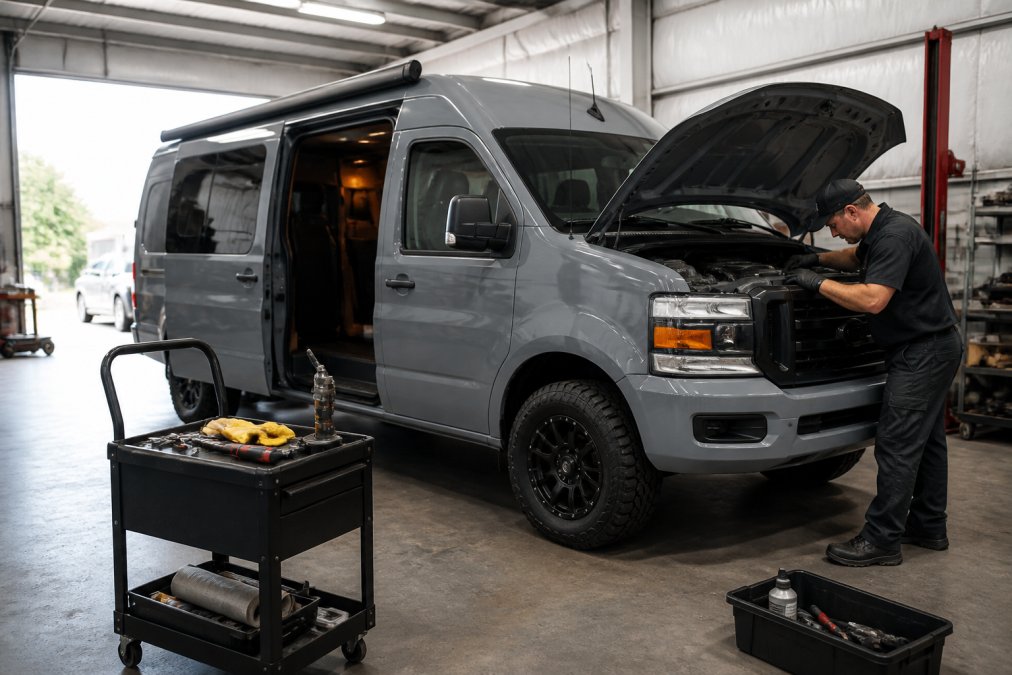
Table of Contents
- What Drives Custom Van Maintenance and Repair Costs
- The Class B RV Maintenance Schedule: What to Expect Each Year
- Annual Maintenance Budget: The 1-2% Rule and Real Numbers
- How the Section 179 Tax Deduction for Vehicles Affects Your True Cost
- DIY Repairs vs. Professional Mechanic Labor Rates
- Warranty, Insurance, and Roadside Assistance: What Covers What
- Parts Availability, Downtime, and Planning for the Unexpected
- Frequently Asked Questions
Last Updated: September 17, 2026
What Drives Custom Van Maintenance and Repair Costs
Custom van maintenance and repair costs depend on two separate systems: the chassis that Chevrolet and GMC build, and the conversion that turns that chassis into a mobile clubhouse. The GOLF Cruiser team has spent over 45 years converting full-size vans, and the single biggest budgeting mistake we see is owners treating the whole vehicle as one expense line.
A commercial cutaway chassis and a hand-built interior age at completely different rates. Your drivetrain follows standard mileage-based service intervals. Your conversion follows use patterns: how often you load clubs, run the rear climate system, or power accessories at a tailgate.
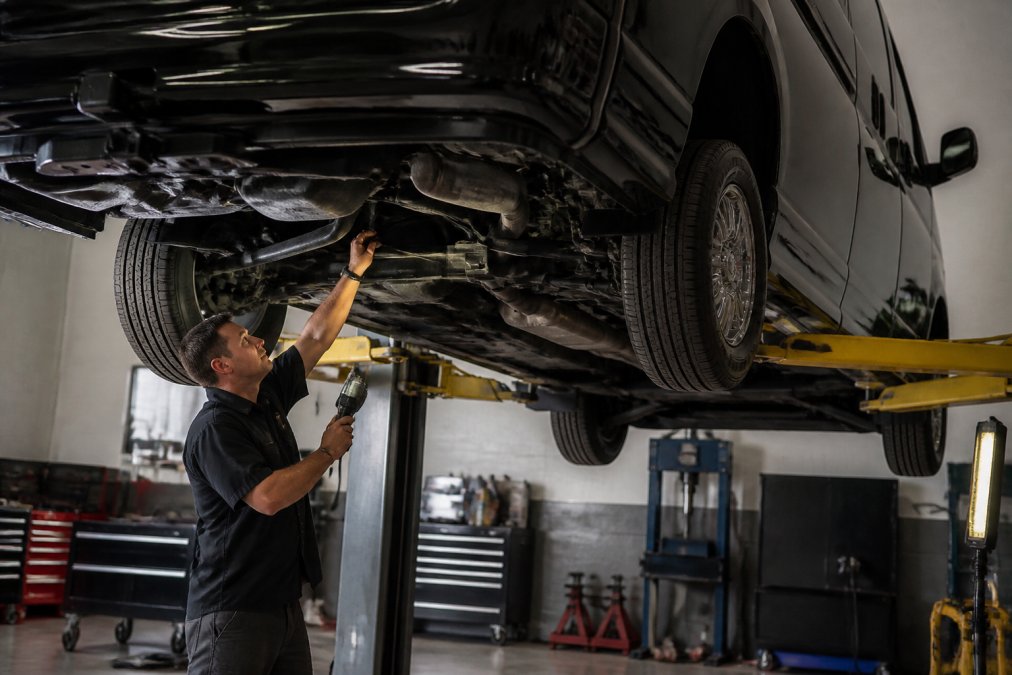
Chassis vs. Conversion: Two Different Budgets
Chassis costs are predictable. Oil changes, tire rotation, brake inspection, transmission service, and alignment follow the manufacturer’s schedule and vary little from van to van.
Conversion costs are not. Custom club storage, seating, electrical systems, and climate components experience wear and tear tied to how you actually travel. A van that sits in a garage most of the year needs different preventative maintenance than one logging 20,000 miles of tournament travel.
Budget chassis and conversion maintenance as two separate lines. Owners who blend them consistently underestimate conversion repairs because those costs arrive in clusters, not on a schedule.
The Class B RV Maintenance Schedule: What to Expect Each Year
A Class B RV maintenance schedule combines the chassis service calendar with inspection of the living space. Most owners should plan on an annual mechanical service visit plus seasonal checks of conversion systems.
The practical schedule looks like this:
| System | Service | Frequency |
|---|---|---|
| Engine oil and filter | Chassis | Every 7,500-10,000 miles |
| Tire rotation | Chassis | Every 6,000-8,000 miles |
| Brake inspection | Chassis | Annually or 12,000 miles |
| Transmission service | Chassis | Per manufacturer interval |
| Wheel alignment | Chassis | Annually or after hard impacts |
| Conversion electrical | Coach-side | Twice yearly |
| Seals and roof penetrations | Coach-side | Annually before storm season |
| Climate and appliance systems | Coach-side | Annually |
The chassis items are non-negotiable and cheap relative to what they prevent. The coach-side items are where most owners fall behind, and where small issues turn into expensive ones.
Annual Maintenance Budget: The 1-2% Rule and Real Numbers
Many owners use the 1-2% rule of thumb: set aside 1-2% of the vehicle’s purchase price each year for maintenance and repairs. For a custom luxury van, that reserve covers routine service in a typical year and absorbs a major component repair in a bad one.
The rule works because it forces you to budget against the vehicle’s value rather than against last year’s receipts. A year with no surprises builds the reserve. A year with a transmission issue draws it down.
But the rule is a starting point, not a plan. Two adjustments make it usable:
- Mileage multiplier. The 1-2% figure assumes roughly 12,000-15,000 miles per year. If you log 20,000+ miles of tournament travel, shift toward the high end of the range or above it, because tire, brake, and fluid service intervals arrive more often.
- Chassis-type adjustment. A cutaway chassis carrying a heavy conversion works harder than a lightly loaded cargo van. Heavier curb weight accelerates brake and tire wear, so the reserve should reflect the load, not just the sticker price.
A practical way to run the numbers: take your purchase price, multiply by 1.5% as a baseline annual reserve, then add a separate line for tires. A set of four tires on a full-size conversion van commonly runs into four figures installed, and most owners replace a set every three to five years depending on mileage and load.
Emergency Repair Fund: How Much to Set Aside
An emergency repair fund should sit separately from your routine maintenance budget. Routine service is planned spending; the emergency fund exists for unexpected breakdowns, failed components, and parts that take time to source.
A common approach is to hold enough to cover a major component replacement without touching operating cash. Owners who travel far from home should hold more, because downtime away from your regular mechanic costs more than the repair itself.
To size the fund, work backward from the worst realistic failure rather than a round number:
- Transmission or major drivetrain work. These are the largest single-line repairs on a full-size van and are the reason the fund exists.
- Conversion electrical or climate failure. Coach-side components are often built to order, so the repair bill includes both labor and the cost of waiting.
- On-road breakdown premium. Towing, lodging, and a rental vehicle can add substantially to the repair invoice when the failure happens far from home.
A reasonable target is to hold enough to cover the largest single repair you could face plus two weeks of travel disruption.
Treating the emergency fund as optional is the most expensive mistake in van ownership. When a major component fails on the road, the repair bill plus lodging plus a rental can dwarf the original part cost.
Use the 1-2% rule to set your routine reserve, then build a separate emergency fund sized to your worst realistic failure, not to a round number. The two accounts serve different jobs and should never be blended.
How the Section 179 Tax Deduction for Vehicles Affects Your True Cost
The Section 179 tax deduction for vehicles can change your effective cost of ownership, but only if the van genuinely qualifies for your business. The deduction allows businesses to deduct the cost of qualifying property in the year it is placed in service, subject to IRS rules and limits that change by year and vehicle weight class.
DIY Repairs vs. Professional Mechanic Labor Rates
DIY repairs make sense for a narrow set of tasks. Professional mechanic labor rates make sense for everything that touches the drivetrain, safety systems, or the conversion’s electrical work.
Here is the honest split:
- Reasonable DIY: fluid checks and top-offs, wiper blades, cabin and engine air filters, tire pressure, exterior cleaning, and basic coach-side inspections.
- Leave to a professional: brake service, transmission work, alignment, diagnostic troubleshooting, and any repair involving the conversion’s wiring or climate systems.
Keep a maintenance log from day one. When you sell or trade the van, a documented service history is one of the few things that reliably protects resale value on a custom vehicle.
Warranty, Insurance, and Roadside Assistance: What Covers What
Warranty, insurance, and roadside assistance cover three different things, and owners routinely assume one covers the others.
Parts Availability, Downtime, and Planning for the Unexpected
Parts availability is the quiet cost driver in custom van ownership. Chassis parts are widely stocked because the platform is common. Conversion-specific parts are not, and that difference determines how long your van sits.
Why Chassis and Conversion Parts Behave Differently
Chassis components, brakes, filters, belts, suspension parts, and common drivetrain items, move through a national distribution network. A dealer or independent shop can usually source them same-day or next-day. That keeps chassis repairs fast and predictable.
Quantifying the Cost of Downtime
Most owners never put a number on downtime, which is why it surprises them. A simple way to estimate it:
- Lost use value. Divide your annual cost of ownership (payment, insurance, storage, and reserve) by 52. That is roughly what each week of idle time costs you in fixed expenses alone.
- Substitute transportation. If the van is your primary travel vehicle, add the cost of a rental or a second vehicle for the duration of the repair.
- Opportunity cost. For business owners, add the value of missed client trips, events, or tournament travel that the van was meant to support.
Building a Downtime Plan Before You Need One
- Identify your parts sources before you need them, including the converter’s parts department and any authorized service locations along your regular routes.
- Ask your builder which conversion components are stocked versus made to order, and get the typical lead time in writing.
- Keep a list of authorized service locations along your regular travel routes so a breakdown does not force you into an unfamiliar shop.
- Budget for a rental or backup vehicle during major repairs, and treat that line as part of your emergency fund rather than a surprise.
- Track lead times on any part you have had to order. Patterns emerge, and they tell you which components to carry as spares.
Mechanical reliability on the chassis side is largely a function of staying current on service intervals. Conversion reliability is a function of how well you maintain the coach-side systems and how quickly you address small failures, because a small failure that becomes a parts-order failure is where downtime cost really compounds.
Frequently Asked Questions
What are the average annual maintenance costs for a custom luxury van?
Most owners should budget 1-2% of the vehicle’s purchase price annually for maintenance, which covers routine service like oil changes, tire rotations, and brake inspections. For a custom van, add conversion-specific upkeep such as checking electrical systems and interior components. Setting aside a dedicated emergency repair fund helps cover unexpected breakdowns without disrupting your travel plans.
How does the Section 179 tax deduction for vehicles apply to maintenance and ownership?
Section 179 allows business owners to deduct the full purchase price of a qualifying vehicle in the year it’s placed in service, up to the IRS limit. Maintenance and repair costs are typically deducted separately as ordinary business expenses. Consult your accountant to confirm your van meets the gross vehicle weight rating requirements and that you meet the business-use threshold.
Are Chevrolet and GMC platforms cheaper to maintain than European van models?
Chevrolet and GMC platforms have widely available parts. European models often require specialized tools and imported components. Sticking with domestic platforms can reduce downtime and keep long-term ownership costs more predictable.
What specific maintenance is required for custom interior golf storage and amenities?
Custom golf storage systems need periodic checks of latches, hinges, and sliding mechanisms to prevent wear and tear. Inspect upholstery and flooring for moisture damage, especially after tournaments in humid conditions.