

Table of Contents
- Why Teams Are Moving Beyond Auto Elite for Group Travel
- Quick Comparison: Auto Elite Alternatives for Team Travel
- Top Luxury Sprinter Van Builders for Executive Teams
- Tax Benefits of Business Vehicle Ownership for Team Travel
- Designing a Mobile Command Center for Golf Team Travel
- Total Cost of Ownership: Auto Elite Alternatives vs. Traditional Rentals
- Insurance and Liability for Group Transport
- Ergonomic Productivity and Sustainability Features
- Frequently Asked Questions
Last Updated: September 17, 2026
Why Teams Are Moving Beyond Auto Elite for Group Travel
Team travel means moving players, coaches, and equipment to tournaments as one coordinated unit, and it is where most golf organizations quietly lose time, money, and energy. A fleet of rental sedans and a booking platform do not solve the real problem: moving people and clubs together, comfortably, on the team’s schedule.
Quick Comparison: Auto Elite Alternatives for Team Travel
The best Auto Elite alternatives for team travel fall into two camps: booking software and vehicles built for the group itself.
| Option | Type | Best For | Pricing Model |
|---|---|---|---|
| GOLF Cruiser | Luxury golf van | Teams moving people + gear together | Quote on request |
| Navan | Travel platform | Policy and expense control | Subscription |
| TravelPerk | Travel platform | Flexible booking + support | Subscription |
| Concur Travel | Travel platform | Large enterprise compliance | Subscription |
Key Features at a Glance
- GOLF Cruiser: custom club storage, flexible seating, mobile command center layout
- Navan: automated policy enforcement, real-time expense tracking
- TravelPerk: wide inventory, 24/7 support, flexible cancellations
- Concur Travel: ERP integration, global inventory, deep reporting
Platforms coordinate the trip; a purpose-built van is the trip. Most teams need both, but only one keeps the clubs off the airport carousel.
Top Luxury Sprinter Van Builders for Executive Teams
Luxury Sprinter van builders convert full-size vans into premium, purpose-specific vehicles, and the category has split between golf-focused builders and general executive transport shops. For teams, the deciding factor is whether the interior was designed around clubs, gear, and strategy talk en route.
What Separates a Golf-Focused Builder From a General Upfitter
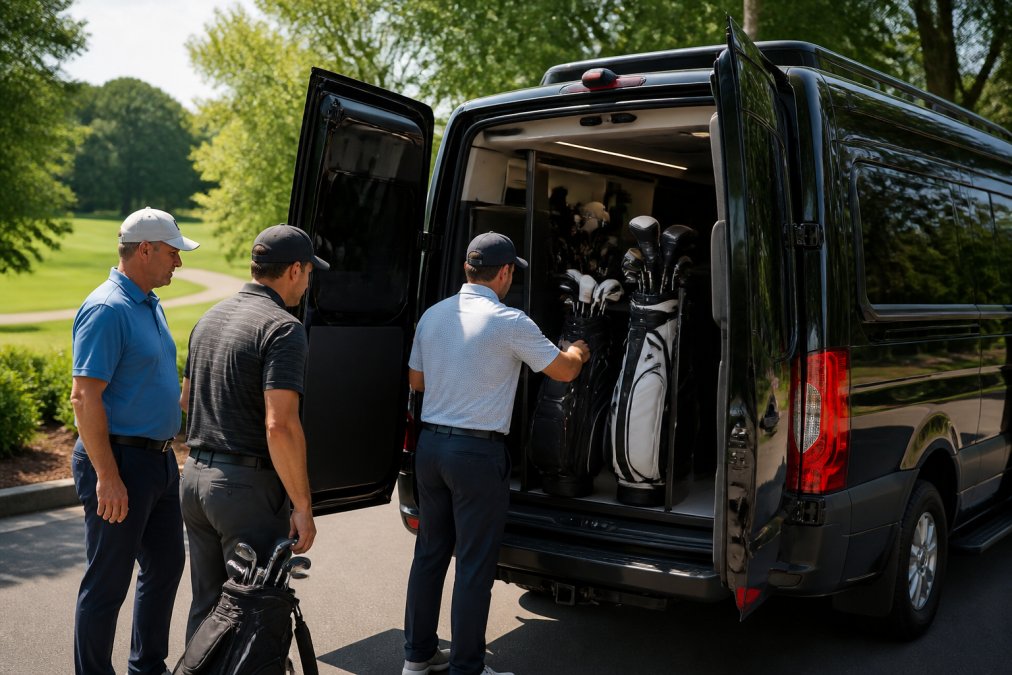
General executive transport shops optimize for a quiet cabin and a boardroom layout, the wrong brief for a golf team. A boardroom build seats six to eight in captain’s chairs with a conference table, leaving no space for eight full golf bags and no rear load floor rated for clubs, coolers, and luggage.
A golf-focused build flips the priorities:
- Rear load geometry: a raised, reinforced load floor with individual bag cradles so clubs ride upright and do not slide into each other on a highway on-ramp
- Seat-to-storage ratio: seating that reconfigures (bench, captain’s chairs, or a mix) so the same van carries a foursome on Tuesday and a full squad on Saturday
- Step-in height and grab handles: matters more than most buyers expect, because golf teams skew older than the average corporate shuttle passenger
- Exterior footprint: a standard-height roof clears most course and clubhouse parking structures; a high-roof build can be turned away at a low clearance gate
GOLF Cruiser
GOLF Cruiser is the strongest fit for golf teams specifically. These hand-built luxury vans are crafted by American experts with over 45 years of experience on reliable Chevrolet and GMC platforms. The layout is designed around the sport: custom club storage, flexible seating, and a mobile clubhouse feel that doubles as a tournament command center. It drives and parks more easily than an RV, and for business owners it may qualify for tax write-offs under Section 179.
What to Ask Any Builder Before You Sign
Most teams get burned on the spec sheet, not build quality. Get written answers to these before committing:
- How many full golf bags does the rear hold with all seats installed? Not with seats removed, with the seating you actually plan to use.
- What is the rear load floor rated for? Clubs, coolers, and luggage add up faster than people estimate.
- Is the electrical system sized for a cooler, chargers, and lighting running at once? A second battery and an inverter are the difference between a mobile clubhouse and a dead battery at the course.
- What is the warranty on the conversion versus the chassis? These are usually two separate warranties from two separate companies.
- Can you see a completed build in person before you order? Photos hide rattles and trim gaps.
Ask for the build’s payload sticker and the rear load rating in writing. A van that looks perfect in a showroom photo can be overloaded the first time eight golfers load in with clubs and coolers.
When a General Upfitter Is the Better Call
If your team flies more than it drives, or the van doubles as an executive shuttle for clients who never touch a golf club, a general executive transport builder may serve you better. The trade-off is real: a quieter, more formal cabin, but no purpose-built club storage. Teams that travel by van to tournaments most weekends almost always regret the general build.
Software Platforms Are Not Builders
It is worth separating the two categories, because search results blur them. Navan, TravelPerk, and Concur Travel are corporate travel and expense platforms, they book flights, hotels, and ground transport and enforce policy, but none build or operate a van. They solve the booking layer; a builder solves the vehicle layer.
Tax Benefits of Business Vehicle Ownership for Team Travel
Tax benefits of business vehicle ownership can be substantial, but they depend on how the vehicle is used and your situation. Work with a qualified accountant to confirm whether a vehicle qualifies for deductions like Section 179, which lets businesses deduct the cost of qualifying equipment and vehicles in the year of purchase rather than depreciating over time.
Designing a Mobile Command Center for Golf Team Travel
Mobile command center design for golf starts with one question: what does the team need to do between arriving and teeing off? A good layout answers with zones, not just seats.
- Club and gear zone: dedicated, secure storage so clubs never touch a carousel
- Strategy zone: seating arranged for face-to-face conversation and course review
- Comfort zone: climate control, quiet cabin, and space for rest between rounds
- Refreshment zone: cooler and storage access without unpacking the whole van
The mistake most teams make is designing storage last. Decide how many full golf bags you carry at peak, then build seating around what’s left. It’s far easier to add a seat than to find room for a ninth bag.
Total Cost of Ownership: Auto Elite Alternatives vs. Traditional Rentals
Total cost of ownership for team travel is where the rental math usually falls apart, but only if you run the numbers instead of trusting the per-day rate. Rent, lease, and own behave very differently once you spread cost across a season.
The Three Paths, and What Each One Actually Costs
Renting looks cheapest per trip and is the most expensive in practice. A group rental stacks a base daily rate, additional-driver fees, an insurance or damage-waiver upsell, fuel, and the labor of coordinating multiple pickups. The hidden cost is time: someone on staff becomes a part-time travel coordinator.
The Cost Factors That Actually Move the Number
| Cost Factor | Traditional Rental | Leased Van | Owned Van |
|---|---|---|---|
| Per-trip cost | Recurring, every trip | Fixed monthly payment | Fixed, spread over ownership |
| Upfront cash | Near zero | Down payment + first month | Purchase price or financed down payment |
| Insurance | Added per rental | Business policy required | Business policy required |
| Maintenance | Included | Usually capped by warranty | Owner’s responsibility after warranty |
| Mileage limits | Per-day caps | Annual cap with overage fees | None |
| Tax treatment | Expense only | Business lease payments may be deductible | Potential Section 179 deduction |
| End of term | Nothing retained | Vehicle returned | Residual value retained |
| Scheduling | Subject to availability | Always on team’s schedule | Always on team’s schedule |
| Gear handling | Repacked each trip | Permanent custom storage | Permanent custom storage |
The Break-Even Question
The useful exercise is not “is ownership cheaper” but “how many trips until it is.” Add up your realistic annual trip count, multiply by the all-in cost of a group rental (including staff time), and compare that to the annualized cost of a lease or financed purchase plus insurance and maintenance. Most practitioners find the crossover lands around one trip a month, below that, renting or leasing usually wins; above it, ownership pulls ahead.
Run the break-even at your actual trip count, not a best-case one. The teams that regret buying are almost always the ones that assumed they would travel more than they did.
The Costs Nobody Puts in the Spreadsheet
Three line items rarely appear in a rental quote but show up in an owned or leased van:
- Gear damage and replacement: clubs riding loose in a rental trunk get dinged. Purpose-built storage is a cost-avoidance feature, not a luxury.
- Staff coordination time: every rental trip consumes hours of booking, pickup, and return. That is a real payroll cost.
- Resale and residual value: an owned van retains value; a rental receipt does not.
Insurance and Liability for Group Transport
Insurance and liability for group transport is the topic most teams ignore until something goes wrong. When a group travels together, coverage questions multiply: who is the named driver, does the policy cover passenger transport, and does business use require a commercial endorsement?
Assuming a personal auto policy covers a van used for organized team transport is a costly mistake. Many policies exclude business or passenger-transport use, which can leave a team exposed after an incident.
Ergonomic Productivity and Sustainability Features
Ergonomic productivity and sustainability features are quietly becoming deciding factors for executive teams. A van that seats eight but leaves everyone stiff and unproductive for three hours is not saving time.
Frequently Asked Questions
What are the best luxury van alternatives to Auto Elite for team travel?
For team travel, consider GOLF Cruiser for a hand-built, golf-specific luxury van with custom club storage and mobile command center features. For corporate travel management, platforms like Navan, TravelPerk, and Concur Travel offer booking and expense tools. Each alternative serves different needs: GOLF Cruiser provides a physical vehicle, while the others are software solutions for logistics.
How do custom golf vans compare to standard rental SUVs for team logistics?
Custom golf vans like GOLF Cruiser offer more interior space, easier loading of clubs, and dedicated storage compared to rental SUVs. They also provide amenities such as seating for teams, on-board connectivity, and a mobile command center layout. Rental SUVs may be cheaper per trip but lack the customization and comfort for frequent group travel.
What features should a mobile command center have for tournament management?
A mobile command center for golf tournaments should include secure club storage, comfortable seating for strategy discussions, connectivity for real-time updates, and flexible layouts for gear. GOLF Cruiser vans are built on Chevrolet and GMC platforms and can be customized with specific storage and seating configurations to support team logistics.
Are custom-built luxury vans tax-deductible for professional golf teams?
Business owners may qualify for Section 179 tax deductions when purchasing a luxury van used for business purposes, such as team travel. GOLF Cruiser vans are built on Chevrolet and GMC platforms and may meet weight requirements. Consult a tax professional to confirm eligibility based on your specific use and business structure.
What are the benefits of using a mobile clubhouse for team travel?
A mobile clubhouse like GOLF Cruiser provides a dedicated space for teams to relax, strategize, and store equipment during travel. It offers more interior space than SUVs, easier maneuverability than RVs, and luxury features tailored to golfers. This can improve travel efficiency, passenger comfort, and overall team experience.