
Table of Contents
- Quick Comparison: 5 Best Vehicles for Golf Team Travel
- 1. GOLF Cruiser: The Purpose-Built Luxury Golf Van Conversion
- 2. Cadillac Escalade ESV: Maximum Cargo Capacity for Golf Bags
- 3. Chrysler Pacifica Hybrid: Fuel Efficiency and Flexible Seating
- 4. Genesis GV80: Premium Comfort for Long-Distance Travel
- 5. Toyota RAV4 Hybrid: Reliable and Efficient for Smaller Groups
- Group Golf Trip Logistics: Matching Vehicle Class to Team Size
- Golf Travel Vehicle Tax Deduction: What Qualifies Under Section 179
- Frequently Asked Questions
Last Updated: September 28, 2026
Quick Comparison: 5 Best Vehicles for Golf Team Travel
Finding the right vehicle for golf team travel comes down to one uncomfortable math problem: four golfers, four golf bags, and a vehicle never designed for either. Most SUV reviews focus on family hauling or off-road capability, not moving a team and its equipment to a tournament.
| Vehicle | Starting Price | Cargo Advantage | Best For |
|---|---|---|---|
| GOLF Cruiser | Custom quote | Purpose-built club storage | Full teams, business owners |
| Cadillac Escalade ESV | $89,595 | Extended wheelbase | Maximum luxury cargo |
| Chrysler Pacifica Hybrid | $53,000 | Stow ‘n Go seating | Fuel economy, flexibility |
| Genesis GV80 | $59,050 | Premium comfort | Long-distance pairs |
| Toyota RAV4 Hybrid | $31,725 | Compact efficiency | Small groups, daily driver |
1. GOLF Cruiser: The Purpose-Built Luxury Golf Van Conversion
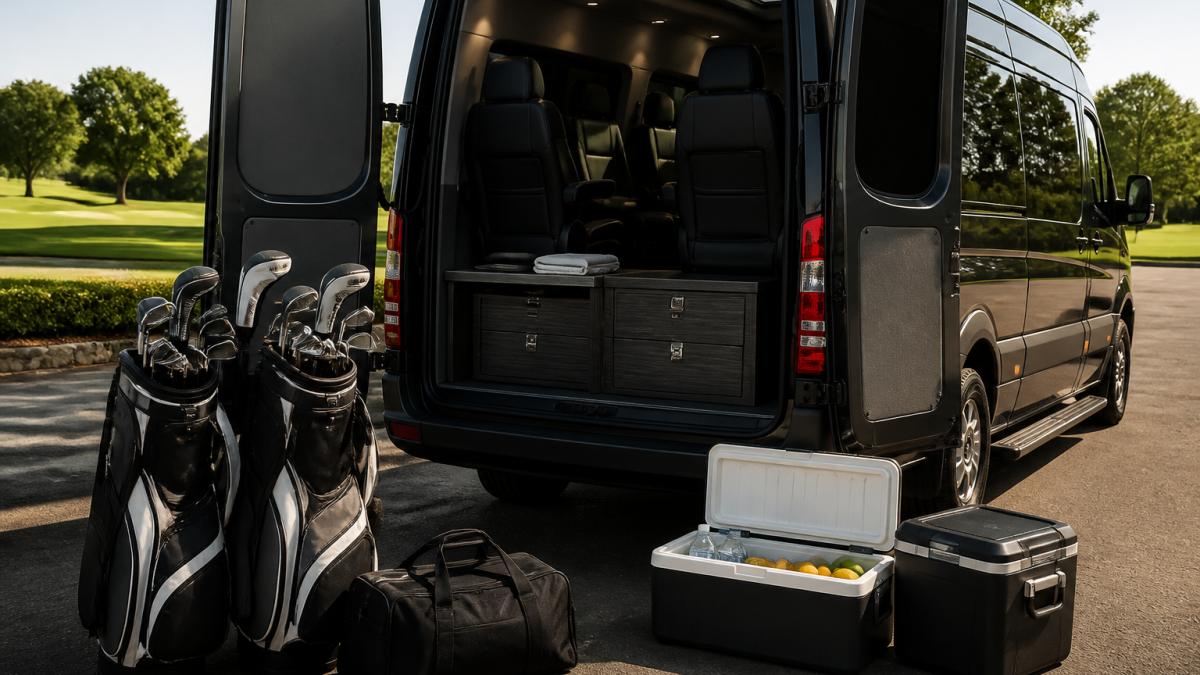
The GOLF Cruiser is the only vehicle here designed around golf bags rather than retrofitted for them. Each van is hand-built on a Chevrolet or GMC platform by craftsmen with over 45 years of conversion experience, producing a mobile clubhouse: custom club storage, flexible seating for four to six, and room for a pre-round strategy session in the parking lot.

Custom Club Storage and Mobile Clubhouse Features
Standard SUVs force you to stack bags sideways or fold seats. GOLF Cruiser’s interior is built around vertical club storage that keeps every bag accessible without unpacking the cargo area, solving upfront the common mistake of buying a luxury SUV and discovering four staff bags do not fit behind the third row.
Ask about the flexible layout options during your consultation. The interior can be configured for families, golf buddies, or a full tournament team, and changing the seating arrangement later is far more expensive than specifying it upfront.
Section 179 Tax Advantages for Business Owners
For business owners, the Section 179 deduction can offset a large portion of the purchase price in the year the vehicle is placed in service. The IRS sets annual limits, and the rules for passenger vehicles differ from those for vehicles over 6,000 pounds gross vehicle weight. Because GOLF Cruiser vans are built on full-size Chevrolet and GMC platforms, many configurations fall into the heavier category that qualifies for the full deduction.
2. Cadillac Escalade ESV: Maximum Cargo Capacity for Golf Bags
The Escalade ESV is the default choice for golfers who want maximum cargo capacity without leaving the luxury SUV category. Its extended wheelbase adds meaningful space behind the third row, enough for several golf bags with the rear seats up.
The 4-Person, 4-Bag Math
The ESV’s real advantage is that it is one of the few factory SUVs where four adults and four staff bags coexist without folding a seat. The extended wheelbase (roughly 134 inches versus about 121 on the standard Escalade) buys that room, the extra length goes almost entirely behind the second row, exactly where golf bags live.
Loading and Unloading Without Damaging the Cabin
Three practical points if you are loading a team into an ESV:
- Use the power liftgate and the adjustable cargo floor. The ESV’s load floor sits lower than a truck-based SUV’s, so a 40-pound staff bag goes in with a short lift rather than a shoulder-height hoist.
- Stagger the bags. Two upright against the third row, two laid flat in front of them, keeps the rear window clear and prevents the bags from sliding into each other on hard braking.
- Watch the third-row power fold. If you fold the third row to gain space, you lose two seats, which defeats the point of a team vehicle. Confirm your passenger count before you commit to the fold.
Fuel and Running Costs on a Tournament Run
A full-size V8 in this class typically returns mid-teens fuel economy combined, and worse on highway runs with a loaded cabin and a roof box. On a 400-mile round trip to a regional tournament, that is a meaningful fuel bill, and premium fuel is usually recommended. If your team runs several tournaments a season, the fuel delta between an ESV and a Pacifica Hybrid can exceed the monthly payment on a second vehicle, so run the math on your actual annual mileage.
Where the ESV Beats a Van Conversion
If your team values arriving in a recognizable luxury vehicle and rarely carries more than four, the ESV is simpler: it parks in a normal garage, requires no custom build timeline, and holds resale value better than a conversion. It loses when you need five or six passengers plus four bags, or club storage that does not require stacking bags.

The ESV is the best factory SUV for the 4-person, 4-bag problem, but only if you keep the third row up and load bags upright. Fold the third row and you have a two-row luxury SUV with a big trunk, which is a different vehicle entirely.
3. Chrysler Pacifica Hybrid: Fuel Efficiency and Flexible Seating
The Pacifica Hybrid is the practical answer for teams prioritizing fuel economy and easy loading. Its Stow ‘n Go seating folds flat into the floor, converting from seven passengers to a flat cargo deck in seconds.
4. Genesis GV80: Premium Comfort for Long-Distance Travel
The GV80 pairs an upscale interior with a cargo area that handles golf bags without drama.

5. Toyota RAV4 Hybrid: Reliable and Efficient for Smaller Groups
For individual golfers or pairs, the RAV4 Hybrid is the sensible pick. It returns excellent fuel economy and has a reliability reputation that makes it a low-stress long-distance companion. All-wheel drive handles varied terrain on the way to remote courses.
Group Golf Trip Logistics: Matching Vehicle Class to Team Size
Group golf trip logistics start with an honest count of people and bags, not the badge on the grille. The biggest mistake is choosing a vehicle for the drive rather than the load.
Use this matrix before you shop:
| Team Size | Bags | Vehicle Class | Why |
|---|---|---|---|
| 1-2 golfers | 2 | Compact SUV (RAV4 Hybrid) | Efficient, easy to park |
| 2-3 golfers | 3 | Midsize luxury SUV (GV80) | Comfort with adequate cargo |
| 4 golfers | 4 | Full-size SUV or minivan | Room for people and gear |
| 4+ with gear | 4+ | Luxury van conversion | Purpose-built storage |
Roof Racks and External Storage: The Gap Most Guides Skip
Every ranking article tells you to check trunk space. Almost none tell you what to do when the trunk is not enough and you are not ready to buy a van. That is where external storage earns its place.
- Hitch-mounted cargo carriers. Mounted to a Class III hitch, they add 10 to 16 cubic feet of weather-resistant space. Best for golf because a staff bag lies flat and stays accessible, you can pull one bag without unloading the rest. Trade-off: they block rear access on some vehicles and add length in tight resort lots.
- Roof cargo boxes. A typical box adds 12 to 18 cubic feet, but lifting a 40-pound staff bag to roof height is a two-person job and a back injury waiting to happen. Better for soft travel bags and shoes than hard-shell staff bags.
- Roof-mounted bag carriers. Purpose-built for clubs, these hold two to four bags upright and keep the cabin clear, but expose clubs to weather and road grime and can noticeably affect highway fuel economy.
EV Charging for Golf Trips: Plan the Route, Not Just the Vehicle
If your team is considering an EV or plug-in hybrid for tournament travel, the vehicle is only half the decision. The other half is charging.
A few practical patterns that experienced EV travelers follow:
- Charge at the course, not on the way. Many private clubs and municipal courses now have Level 2 chargers. A four-hour round on a Level 2 charger can add 20 to 30 miles of range per hour on many models, often enough to cover the return leg. Call ahead to confirm charger type and whether it is reserved for members.
- Plan the mid-route stop around a meal. A 20-to-30-minute DC fast-charge stop lines up naturally with lunch. Treat the stop as a break, not a delay.
- Check charger reliability, not just presence. Plug-sharing apps and crowd-sourced status are more current than manufacturer maps; a charger that exists on a map but is offline is worse than none.
- Account for cold-weather range loss. Range drops meaningfully in winter, turning a comfortable margin into a tight one. Build in a buffer.
Rental Vehicles: Insurance and Damage Protection for Clubs
Rental vehicles complicate this further: standard fleets rarely stock enough cargo capacity for four staff bags, and damage protection for expensive clubs is often excluded from basic coverage.
Before you load a rental:
- Photograph the interior and exterior before loading. Timestamped photos are the cheapest insurance you have against a damage dispute.
- Check whether your personal auto policy or credit card extends to sporting equipment. Many credit card rental protections exclude high-value personal property, and a set of clubs can easily exceed a thousand dollars.
- Ask about the loss damage waiver and what it actually covers. The LDW typically covers the vehicle, not your clubs. Those are two separate risks.
- Consider a personal articles policy for high-value clubs. If your team travels with custom or tournament-grade equipment, a scheduled personal property rider is often inexpensive relative to the replacement cost.
- Confirm the rental class, not just the name. A ‘full-size SUV’ reservation can yield a vehicle with a third row that eats the cargo space you were counting on. Ask for the specific model or a guaranteed class.
Build a one-page trip sheet before every tournament: passenger count, bag count, vehicle class, charging or fuel plan, and a photo of the loaded cargo area. It takes five minutes and prevents the two most common failures, a vehicle that does not fit the team and a damage claim you cannot prove.
Golf Travel Vehicle Tax Deduction: What Qualifies Under Section 179
The golf travel vehicle tax deduction is real, but narrower than most marketing suggests. Section 179 lets businesses deduct the cost of qualifying vehicles in the year they are placed in service rather than depreciating them over many years. Eligibility depends on how the vehicle is used, its gross vehicle weight, and your business structure.
Three points matter most:
- Business use percentage. The deduction applies only to the portion of use that is business-related. A vehicle used mostly for personal golf trips will not qualify for the full amount.
- Weight classification. Vehicles above the IRS threshold for heavy vehicles generally qualify for a larger deduction than standard passenger cars.
- Documentation. Mileage logs, purchase records, and a clear business purpose are essential if you are ever questioned.
Do not buy any vehicle assuming the deduction will apply. Confirm your business use percentage and the current weight threshold with your accountant first. A disallowed deduction is worse than no deduction, because it can trigger penalties on top of the tax owed.
Frequently Asked Questions
What is the best vehicle to transport golf clubs for a group?
For groups of four or more, a full-size van or extended-wheelbase SUV offers the best combination of cargo capacity and passenger comfort. The Cadillac Escalade ESV provides substantial trunk space for multiple golf bags, while the Chrysler Pacifica Hybrid offers Stow ‘n Go seating that creates flexible storage configurations. A purpose-built luxury golf van conversion like GOLF Cruiser delivers dedicated club storage and room for a full team, making it the most practical choice for golf team travel.
How much interior space is needed for four golfers and their gear?
Four golfers typically need room for four golf bags, push carts or travel covers, luggage for a multi-day trip, and personal items. That requires at least 40 cubic feet of cargo space behind the third row, or a vehicle with modular seating that can be reconfigured. Full-size vans and extended-wheelbase SUVs handle this comfortably, while compact SUVs like the Toyota RAV4 Hybrid may struggle with team-sized gear capacity.
Are custom golf vans tax-deductible for business travel?
Vehicles used primarily for business may qualify for deductions under Section 179 of the IRS tax code. A luxury golf van conversion used for client entertainment, team travel, or business-related tournament attendance could meet the requirements if it falls within the gross vehicle weight rating threshold. Consult your accountant to confirm eligibility based on your specific use case and current tax regulations, as rules and limits change annually.
How do luxury conversion vans compare to standard SUVs for golf travel?
Luxury golf van conversions offer significantly more interior space, easier loading and unloading of clubs, and layouts designed specifically for golfers rather than general passengers. Standard SUVs like the Genesis GV80 or Audi Q7 provide premium features and comfort but may lack dedicated gear organization. Vans also provide easier maneuverability than an RV and can serve as a mobile clubhouse for strategy discussions before and after rounds.
What features should a golf team look for in a travel vehicle?
Prioritize cargo capacity for golf bags, passenger comfort for long road trips, and ease of loading and unloading clubs. Look for vehicles with low lift-over height, configurable seating, and sufficient legroom for all passengers. Other considerations include fuel economy, highway performance, all-wheel drive for varied conditions, and storage configuration that keeps gear organized. For frequent travelers, vehicle reliability and maintenance costs matter as much as premium features.