

Table of Contents
- Luxury Van vs SUV for Golf: Quick Comparison
- Cargo Capacity and Golf Bag Fitment
- Custom Golf Van Interior Layouts
- Passenger Comfort and Ride Quality for Long Trips
- Section 179 Tax Deduction for Luxury Vans
- Golf Trip Vehicle Logistics: Loading, Parking, and Driving
- Maintenance and Reliability for High-Mileage Golf Trips
- Conclusion
- Frequently Asked Questions
Last Updated: September 10, 2026
Luxury Van vs SUV for Golf: Quick Comparison
The luxury van vs SUV for golf debate usually ends the same way: the SUV wins on style, the van wins once four golfers and four sets of clubs are involved. This guide from GOLF Cruiser breaks down cargo capacity, passenger comfort, tax treatment, and logistics.
A full-size luxury SUV like the Cadillac Escalade ESV offers up to 142 cubic feet of maximum cargo space, but that assumes you fold seats and sacrifice passengers (cadillac.com). A purpose-built luxury van keeps its seating capacity and gear storage at the same time.
| Factor | Luxury Van | Full-Size Luxury SUV |
|---|---|---|
| Cargo volume with full seating | Highest in class | Limited behind third row |
| Loading height | Low load floor | Higher lift-over |
| Passenger legroom, row three | Generous | Tight for adults |
| Maneuverability vs RV | Easier to park and drive | Easier still |
| Section 179 eligibility | Strong candidate | Weight-dependent |
| Custom interior layouts | Fully configurable | Factory-fixed |
Cargo Capacity and Golf Bag Fitment
A standard golf travel bag runs roughly 50 inches long, 15 inches wide, and 15 inches deep. Four of them, plus four carry bags, plus luggage for a week, is the real test. Most three-row SUVs fail it once the third row is occupied.
Cubic feet ratings mislead here: manufacturers quote maximum cargo volume with seats folded, a configuration no foursome can use. What matters is usable space behind an upright third row, where a full-size SUV gives up ground fast.
A Golf Bag Fitment Guide, Not a Guess
A single golf travel bag occupies about 11,250 cubic inches, or roughly 6.5 cubic feet, once you account for its footprint and padding. Four travel bags consume about 26 cubic feet before anyone packs a suitcase.
Now layer in the rest of a foursome’s load:
| Item | Typical volume | Four-person total |
|---|---|---|
| Golf travel bag (soft or hard case) | ~6.5 cu ft | ~26 cu ft |
| Carry or stand bag (if packed separately) | ~2 cu ft | ~8 cu ft |
| Weekender or carry-on per golfer | ~2 cu ft | ~8 cu ft |
| Pair of golf shoes per golfer | ~0.5 cu ft | ~2 cu ft |
| Cooler, range finder, extra balls, rain gear | ~3 cu ft | ~3 cu ft |
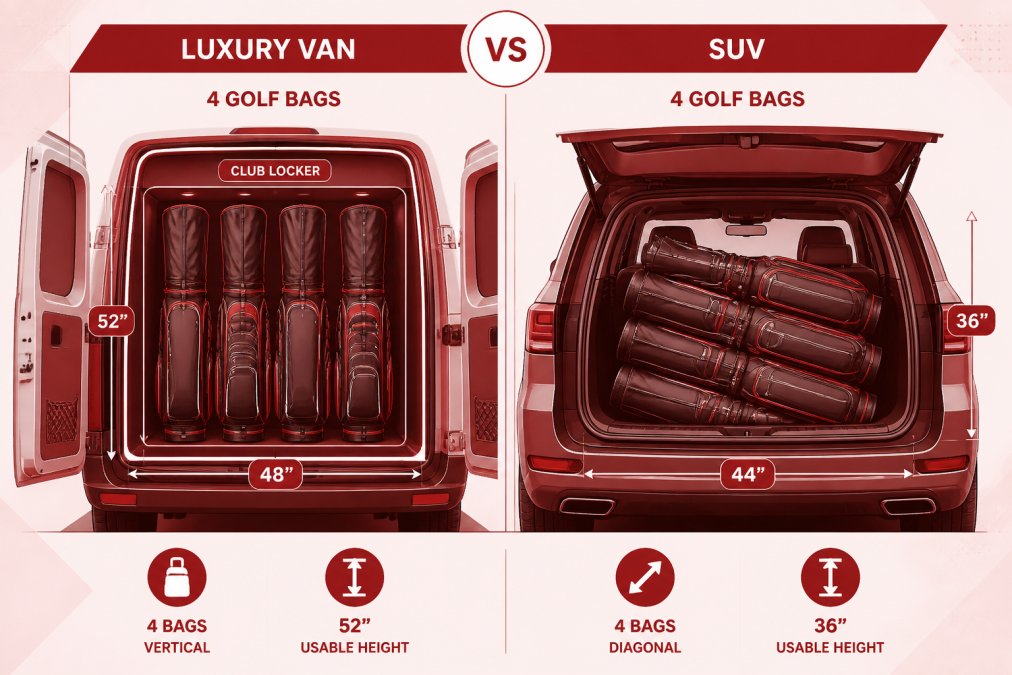
That is roughly 47 cubic feet of gear for a foursome on a multi-day trip. An SUV with 20 to 25 cubic feet behind the third row forces a choice: passengers or clubs. A luxury van with a dedicated club bay does not, because its storage is vertical and purpose-shaped rather than a leftover cavity.
Standard Bags vs Tour Bags vs Hard Cases
Fitment gets harder as the bag gets bigger:
- Standard carry or stand bag in a soft travel cover: the most forgiving option. Fits diagonally in most mid-size SUV cargo areas and slides cleanly into a van’s vertical club locker.
- Oversized cart bag in a soft travel cover: wider and heavier, often 15 to 18 inches across. It may fit an SUV cargo floor but eats into the space a second bag needs.
- Tour staff bag in a hard case: the worst case for an SUV. Hard cases run longer than soft cases, and a 2-inch difference in length is the difference between a bag that slides into a dedicated slot and one that lies diagonally across the floor, blocking everything else.
- Hard case with wheels and a telescoping handle: adds length and a rigid footprint that resists compression. Great for air travel, awkward for tight SUV cargo wells.
Measure your actual travel bag before you shop, not the carry bag. Hard cases run longer than soft cases, and a 2-inch difference in length is the difference between a bag that slides into a dedicated slot and one that has to lie diagonally across the floor. Bring a tape measure to the dealership and test-fit your real bag in the real cargo area.
Why Vertical Storage Beats a Flat Cargo Floor
A flat SUV cargo floor is a single layer: stack bags and you block the view and the third row. A van’s vertical club locker turns four bags into four narrow, independently accessible columns. That is the structural reason a van carries four golfers and four sets of clubs at once while a three-row SUV makes you choose.
Custom Golf Van Interior Layouts
Custom golf van interior layouts solve the problem SUVs cannot: separating gear from people without shrinking either. A converted van on a Chevrolet or GMC platform gives you a floor plan you design rather than one the factory fixed.
GOLF Cruiser builds these vans by hand, with over 45 years of experience in full-size vehicle conversions behind the work. Typical configurations include vertical club lockers, a rear gear bay, captain’s chairs for four to six passengers, and a lounge area.
The flexibility matters more than any single feature. A foursome heading to a regional tournament needs different space than a coach traveling with a full team, and a fixed SUV interior cannot adapt to either.
Passenger Comfort and Ride Quality for Long Trips
Passenger comfort decides which vehicle your group actually wants to ride in. Third-row legroom is the usual breaking point: adults tolerate it for twenty minutes and resent it for four hours.
Ride quality follows the same pattern. Body-on-frame SUVs transmit more road texture through the cabin, while a well-sorted van on a modern chassis absorbs highway expansion joints with less noise and motion. For a four-hour drive to a resort, that difference compounds.
The Genesis GV80 earns consistent praise for a refined, car-like ride, and it deserves it. The catch is scale: comfort for four passengers plus gear is a different engineering problem than comfort for two plus a rear cargo hold, and mid-size SUVs are built for the second scenario.
Section 179 Tax Deduction for Luxury Vans
The Section 179 tax deduction for luxury vans is the biggest financial argument in this comparison, and the most misunderstood. Section 179 lets qualifying businesses deduct the full purchase price of eligible business vehicles in the year they are placed in service, rather than depreciating them over many years.
Two limits decide whether a vehicle qualifies: it must be used more than 50 percent for business, and passenger vehicles under 6,000 pounds gross vehicle weight rating face a separate annual deduction cap, while heavier vehicles are treated far more favorably.
A full-size van built on a Chevrolet or GMC platform typically clears the 6,000-pound threshold, which is why conversions in this class are common candidates for the deduction. An SUV may or may not, depending on trim and configuration.
Do not buy a vehicle assuming the deduction applies and sort out the paperwork afterward. Confirm the gross vehicle weight rating on the specific vehicle and get written guidance from your accountant before you sign. A disallowed deduction on a six-figure purchase is an expensive surprise.
The IRS guidance on Section 179 deductions sets out the eligibility rules, weight thresholds, and business-use requirements in full. Read the primary source, then talk to a tax professional about your situation.
Golf Trip Vehicle Logistics: Loading, Parking, and Driving
Golf trip vehicle logistics come down to three moments: loading at the house, parking at the course, and driving between them. Each favors a different vehicle, so the right answer depends on your trip pattern.
Loading: Lift-Over Height Is the Hidden Cost
Loading favors anything with a low load floor. Lifting a 40-pound travel bag to chest height is a different task than sliding it into a bay at waist level, and golfers with back trouble notice on the first trip.
A full-size SUV typically presents a lift-over height around 30 to 35 inches, and the third-row seatback adds another obstacle when upright. A converted van on a Chevrolet or GMC platform keeps the load floor lower and the opening taller, so a bag slides in rather than being hoisted, a real physical difference over four bags, four times per trip.
Parking: Where the SUV Still Wins
Parking favors the SUV. A large SUV still fits a standard space, while a full-size van is taller and longer, and many older course lots were striped for sedans, not a 20-foot vehicle with a raised roof. If your regular course has a tight, low-clearance garage, measure before you commit.
Driving Dynamics: Highway vs Winding Roads
Driving dynamics favor the SUV on winding roads, though a modern van handles highway miles without complaint. Body-on-frame SUVs corner flatter than a tall van, but for the typical golf trip, mostly interstate and two-lane highway, the van’s ride comfort usually outweighs the SUV’s cornering edge.
Roof Rack vs Interior Storage Logistics
Roof racks look like the answer to cargo overflow, and for some trips they are. But the trade-offs hit golf gear specifically.
Weather and security. Roof-mounted gear sits in rain, sun, and road grime. A soft travel cover is not waterproof, and a hard case on a rack is visible to anyone in the lot. Interior storage keeps clubs secure, dry, and at a comfortable height.
Vehicle height and clearance. A roof box adds roughly 12 to 18 inches to overall height, which can push a vehicle past the clearance limit of a parking garage, hotel porte-cochere, or clubhouse overhang. It also raises the center of gravity, changing how the vehicle feels in crosswinds at highway speed.
Noise and fuel economy. A loaded roof rack adds wind noise at highway speed and increases aerodynamic drag, showing up as lower fuel economy on long drives. Interior storage avoids both.
Loading ergonomics. Reaching overhead to strap down a 40-pound travel bag is harder than sliding it into a bay at waist level, especially after a round.
The honest limitation. Interior storage only works if the vehicle was designed with it. A converted van with a purpose-built club bay outperforms a roof rack bolted to an SUV, because the storage is shaped for golf bags rather than adapted from a generic cargo box.
If you plan to use a roof rack for overflow, confirm the dynamic load rating of the rack and the vehicle’s roof, and check the total height against every garage and overhang on your regular route. A rack that fits the vehicle may not fit the places you park it.
Matching Logistics to Your Trip Pattern
- Weekly foursome to a local course: loading ergonomics and parking matter most. A van’s low load floor wins on the first, the SUV wins on the second.
- Multi-day regional tournament: cargo capacity and interior storage dominate. The van’s club bay keeps four bags accessible without folding seats.
- Airport runs with clubs and luggage: roof racks are a liability in garages; interior storage and a low load floor are assets.
- Mixed passenger and gear loads: a van’s configurable layout adapts; a fixed SUV interior forces a trade-off every trip.
The right answer depends on which of these moments you hit most often, not on which vehicle wins a single category.
Maintenance and Reliability for High-Mileage Golf Trips
Maintenance and reliability for high-mileage golf trips favor vehicles built on proven, widely serviced platforms. A conversion on a Chevrolet or GMC chassis shares its drivetrain, brakes, and suspension with millions of vehicles on the road, keeping parts availability and service costs predictable.
That is the underrated advantage of a mainstream platform over a low-volume specialty chassis: any qualified mechanic can service the mechanical systems, and only the conversion-specific elements, cabinetry, storage systems, and electrical work, require the builder’s expertise.
Routine costs track the underlying platform, not the conversion. Expect the same oil changes, tire rotations, and brake service as any comparable full-size vehicle, with occasional attention to house electrical and storage hardware. The NHTSA vehicle safety ratings database lets you check crash test results and recall history for the base platform before you buy.
The van versus SUV decision rarely turns on driving feel. It turns on whether you can carry four golfers and four sets of clubs at the same time, and whether the vehicle qualifies for the business deduction you are counting on.
Conclusion
The hardest part of this decision is that both vehicles are genuinely good, and the wrong choice only becomes obvious on trip four, when the third row is full and the clubs are still in the driveway. GOLF Cruiser builds hand-built luxury vans on Chevrolet and GMC platforms with custom club storage, flexible layouts for families and full teams, and mobile clubhouse functionality that turns travel time into prep time. If your golf schedule is regular and your business qualifies, contact GOLF Cruiser today to spec a layout around how you actually travel.
Frequently Asked Questions
How much cargo space do you need for a 4-person golf trip?
For four golfers, you need space for four golf bags (each about 4 feet tall and 1.5 feet wide), four travel bags, and personal luggage. That’s roughly 40-50 cubic feet of cargo. A full-size SUV like the Cadillac Escalade ESV offers up to 142 cubic feet with seats folded, while a luxury van provides similar or more space with easier loading. Check vehicle dimensions to ensure bags fit without stacking.
Are luxury vans more comfortable than SUVs for long-distance golf travel?
Luxury vans often provide more legroom, upright seating, and smoother ride quality due to their longer wheelbase. SUVs like the Genesis GV80 offer a car-like feel but may have less interior height. For long trips, a van’s spacious cabin reduces fatigue, and custom layouts can include reclining seats or work tables. However, some premium SUVs come with advanced air suspension for comparable comfort.
What are the benefits of a custom golf van over a standard luxury SUV?
A custom golf van, like those from GOLF Cruiser, offers dedicated club storage, flexible interior configurations, and mobile clubhouse features such as strategy tables. It provides more interior space for gear and passengers, easier maneuverability than an RV, and potential Section 179 tax write-offs for business owners. Standard SUVs may have less cargo flexibility and lack golf-specific amenities.
Can a luxury van serve as a mobile clubhouse for golf tournaments?
Yes, luxury vans can be customized with seating areas, refreshment centers, and storage for multiple golf bags, making them ideal mobile clubhouses. They allow teams to discuss strategy, store equipment securely, and travel comfortably. Features like infotainment systems and climate control enhance the experience. GOLF Cruiser vans are built on Chevrolet and GMC platforms with layouts for full teams.
Is it easier to maneuver a luxury van or a large SUV in golf course parking lots?
Luxury vans often have a tighter turning radius than full-size SUVs, making them easier to park in tight spots. However, large SUVs like the Cadillac Escalade ESV have a bigger footprint, which can be challenging. Vans also offer better visibility due to upright seating. Test driving both in similar conditions is recommended to assess maneuverability.