
Table of Contents
- Why Custom Golf Club Storage Beats a Standard Bag and Shelf
- Golf Equipment Protection: How the Right Storage Prevents Damage
- The Best Way to Store Golf Clubs in Garage Spaces
- Custom Golf Van Storage Solutions for Traveling Golfers
- Moisture Control and Climate: What Humidity Does to Your Clubs
- DIY vs. Professional Installation: What Actually Pays Off
- How Custom Storage Improves Your Daily Routine and Accessibility
- Frequently Asked Questions
Last Updated: September 25, 2026
Why Custom Golf Club Storage Beats a Standard Bag and Shelf
Custom golf club storage is a purpose-built system that holds clubs, bags, and accessories in fixed, protected positions instead of leaving them leaning in a corner. For golfers who travel to tournaments and resorts regularly, the payoff shows up in equipment condition and daily convenience.
Golf Equipment Protection: How the Right Storage Prevents Damage
The right storage prevents damage by eliminating three forces: impact, pressure, and moisture. Clubs stored upright in a fixed rack do not shift, do not lean on each other, and do not rest on wet floors.
Damage rarely comes from one dramatic event. It accumulates:
- Shaft bends from bags leaning against walls for months
- Grip deterioration from UV exposure and temperature swings
- Head dents from clubs knocking together during transport
- Rust on steel from damp concrete floors and trapped humidity
Store clubs with heads up and grips down, or fully horizontal in a fitted cradle. Storing them head-down puts constant pressure on the shaft tip, which is the weakest point of the club.
The Best Way to Store Golf Clubs in Garage Spaces
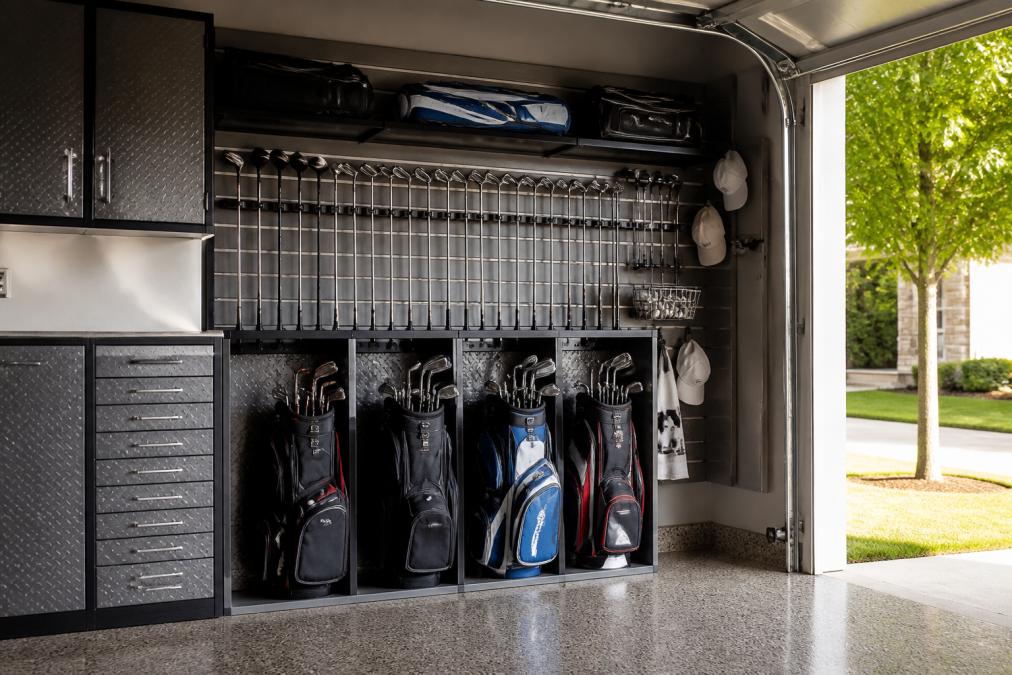
The best way to store golf clubs in garage spaces is a wall-mounted rack or a fitted cabinet raised off the floor, positioned on an interior wall away from doors, windows, and any spot where water pools. Garages are the most convenient storage space and the harshest one, and the difference between a rack that lasts a decade and one that rusts your shafts comes down to a handful of measurable choices.
Why the floor is the enemy
Concrete is porous and wicks ground moisture upward. In an unconditioned garage, the slab stays cooler than the air above it for much of the year, so airborne humidity condenses on the surface and on anything resting directly on it. A golf bag sitting on that slab acts like a sponge wick, the base fabric pulls moisture up into the clubheads and grips.
Pick the right wall
The wall shared with the driveway or the exterior of the house swings in temperature hardest, it takes the afternoon sun and the overnight cold. An interior wall (one shared with a conditioned room) stays within a narrower band year-round. If you have a choice, mount on the interior wall and keep the rack at least 18 inches from any garage door opening, floor drain, or water heater.
Three setups that work, with the trade-offs
- Wall-mounted vertical rack, best for tight spaces and single sets. Typical capacity is two to four bags on a 4-foot rail. Holds clubs vertically by the bag handle or by a fitted cradle. Trade-off: no dust protection and no room for accessories beyond a small shelf.
- Freestanding modular shelving, best for multiple bags and accessories. A 48-inch-wide, 72-inch-tall unit with four shelves holds four to six bags plus shoes, gloves, and range finders. Trade-off: footprint on the floor, and open shelves collect dust.
- Fitted cabinet with doors, best for dust control and appearance. A 60-inch-wide cabinet with two doors and an interior divider holds three to four bags and seals out the worst of the dust. Trade-off: highest cost and least flexibility if your bag count changes.
Measure before you buy
A common failure is buying a rack before measuring the longest club and the widest bag. Drivers and putters run longer than most people estimate, and a bag with a full set of headcovers is wider than the bag alone. Measure the longest club from grip end to head, add 3 to 4 inches of clearance, and measure the widest bag at its widest point with clubs loaded.
Mount the rack so the lowest bag sits at roughly hip height (about 30 to 36 inches). That keeps gear off the slab, out of the splash zone, and at a height you can lift without bending, which matters more as you get older.
A note on climate
If your garage regularly hits high humidity in summer, a rack alone will not stop rust. Pair the rack with the moisture-control steps in the next section, ventilation, a dehumidifier, or a sealed cabinet with a desiccant, or you are just moving the problem 18 inches off the floor.
Custom Golf Van Storage Solutions for Traveling Golfers
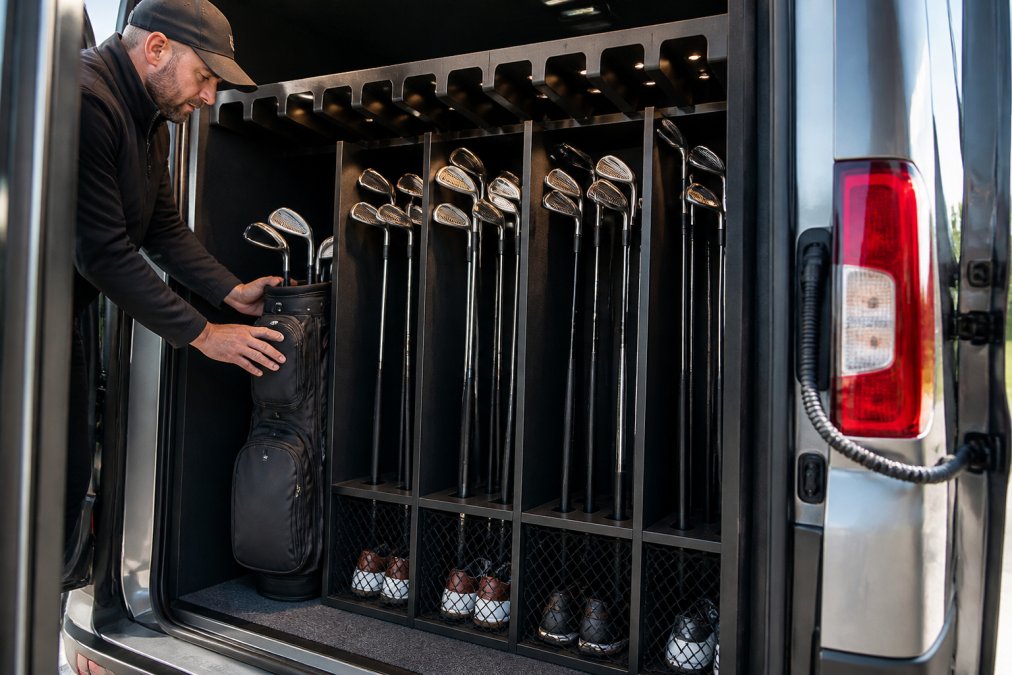
Custom golf van storage solutions solve the problem a garage rack cannot: protecting clubs while you are actually moving. A fitted van interior holds bags in fixed bays so nothing slides, tips, or stacks.
Garage storage protects clubs between rounds. Van storage protects them during travel. Serious golfers need both, and the second one is where most setups fall short.
Moisture Control and Climate: What Humidity Does to Your Clubs
Humidity is the quietest threat to golf equipment, and it does more long-term damage than any mishap on the course. Steel shafts corrode, grips harden, and leather bags grow mildew when gear sits in damp air for weeks. Most storage guides stop at “keep it dry”, this section covers the actual mechanism and the numbers that matter.
What humidity actually does
Steel shafts are typically chrome-plated carbon steel. The chrome layer is thin, and any scratch, chip, or wear point exposes bare steel. In the presence of moisture and oxygen, that exposed steel forms iron oxide, rust. The reaction accelerates above roughly 60 percent relative humidity, and it accelerates further with temperature swings, because warm air holds more moisture than cool air and releases it as condensation when the temperature drops.
The numbers to aim for
- Relative humidity: 40 to 55 percent is the safe band for clubs, grips, and leather. Above 60 percent, rust risk climbs sharply. Below 35 percent, leather and some grip compounds dry out.
- Temperature: Stable is more important than cool. A room that holds 60 to 75°F year-round beats a room that swings 30 degrees daily, even if the average is the same.
- Airflow: Moving air prevents localized pockets of high humidity. A small fan on a timer is often enough.
What works, in order of cost
- Ventilated storage so air moves around bags instead of sitting still. Open racks beat sealed cabinets in a humid garage unless the cabinet has its own moisture control.
- Raised racks that keep gear off concrete. This is the cheapest fix and the one most often skipped.
- Moisture absorbers in enclosed cabinets, rechargeable silica gel canisters or calcium chloride tubs, replaced or recharged on a schedule (typically every 30 to 60 days depending on the cabinet volume and the ambient humidity).
- A dehumidifier for the whole storage area. A small residential unit with a 20- to 30-pint daily capacity handles a typical two-car garage in most climates. Set it to 50 percent and let it run.
- A dry, climate-stable room if you have the option. An interior closet or a conditioned mudroom beats any garage setup.
What does not work
Sealing wet clubs in a closed cabinet is the worst thing you can do. If you played in rain, dry the grips and heads with a towel before they go back in, and leave the bag open overnight so air can move through it. Trapped moisture corrodes steel shafts and softens grip compound, and the damage is usually invisible until a shaft fails mid-swing.
Never store clubs in a closed cabinet or van immediately after a rainy round. Trapped moisture corrodes steel shafts and softens grip compound, and the damage is usually invisible until a shaft fails mid-swing.
Climate control is not a luxury feature, it is the difference between a set that lasts five seasons and one that lasts fifteen. If you only do one thing, get the gear off the floor and keep the air moving.
DIY vs. Professional Installation: What Actually Pays Off
Professional installation pays off when the storage has to fit a specific space or hold significant value; DIY pays off for simple wall racks in a standard garage. The decision comes down to fit, not difficulty.
| Approach | Best For | Trade-Off |
|---|---|---|
| DIY wall rack | One or two sets, standard garage wall | Limited capacity, alignment depends on your work |
| DIY modular shelving | Multiple bags, flexible layouts | Less protection from dust and moisture |
| Professional fitted cabinet | High-value sets, awkward spaces | Higher upfront cost, less flexibility later |
| Professional van build | Traveling golfers, teams | Requires planning lead time |
How Custom Storage Improves Your Daily Routine and Accessibility
Custom storage improves daily routine by removing the loading and unloading friction that wears golfers down, especially those managing back or mobility issues. Gear that has a fixed place goes back faster and gets damaged less.
What changes day to day:
- Loading takes one motion instead of a struggle
- Nothing gets left behind because every item has a slot
- Clubs stay cleaner, so less time on maintenance
- Vehicles stay organized for the next trip
Frequently Asked Questions
Is it a good idea to store golf clubs in a garage?
A garage works if you manage temperature and moisture. Unfinished garages swing from freezing to over 100°F, and that cycle stresses graphite shafts and grips. Keep clubs in a custom golf club storage rack off the concrete floor, away from the garage door, and add a dehumidifier if your area runs humid. A wall-mounted system with sealed cabinet doors gives you the convenience of garage access without exposing your investment to the worst of the elements.
How does temperature affect golf club storage?
Heat above 120°F can soften the epoxy that bonds clubheads to shafts, and repeated freeze-thaw cycles make grips brittle and cause them to crack. Graphite shafts expand and contract at different rates than steel, which can weaken the tip section over years. If your garage or shed regularly hits these extremes, move clubs indoors or into a climate-controlled custom golf van storage solution where the interior stays within a stable range.
What are the benefits of custom storage for golf travel?
Custom golf van storage solutions keep clubs locked in a fixed, padded position instead of sliding around during transit. That means no rattled shafts, no scratched clubheads, and no repacking at every stop. A dedicated rack also frees up floor space for passengers and luggage, so you can travel with your full set plus a spare bag for a buddy. For tournament players, having gear accessible and organized turns the van into a mobile command center.
How can custom storage extend the lifespan of my golf clubs?
Most club damage happens from three things: moisture, impact, and UV light. A custom rack with individual slots stops clubs from banging into each other in a crowded bag. Sealed or covered storage blocks humidity that rusts steel shafts and loosens ferrules. Keeping clubs out of direct sunlight prevents grip degradation. Combined, these protections can add years to a set that would otherwise need regripping or reshafting every couple of seasons.
Most golfers lose more equipment value to poor storage than to bad shots. Protecting clubs properly takes a fitted system, a dry location, and a vehicle built for the way you actually travel. GOLF Cruiser builds hand-built luxury vans with custom club storage, flexible layouts for families or full teams, and interiors designed as mobile clubhouses rather than camper conversions. Get started with GOLF Cruiser and arrive at every tournament with your gear exactly as you packed it.