
Table of Contents
- Step 1: Measure Every Inch Before You Buy a Single Organizer
- Step 2: Claim Vertical Space With Overhead and Ceiling Storage
- Step 3: Put Luxury Van Storage Ideas to Work Below the Shelves
- Step 4: Plan Golf Club Storage in a Van Around Real Club Dimensions
- Step 5: Choose Custom Van Layout Ideas That Convert Space
- Step 6: Apply Van Organization Tips That Keep Gear in Place
- Step 7: Check Weight, Safety, and Handling Before You Load Up
- Common Mistakes That Waste Space in Luxury Vans
- Frequently Asked Questions
Last Updated: October 17, 2026
Step 1: Measure Every Inch Before You Buy a Single Organizer
The biggest mistake we see in luxury vans storage ideas is buying bins before measuring. Every inch counts in a luxury van, and guessing leads to wasted money and wasted space. Grab a tape measure and a notebook. Record the height, width, and depth of every cabinet, shelf, and open bay. Note door swing paths and seat travel. Then mark your real limits: ceiling height, aisle width, and the space between the rear cabin walls. A simple sketch with measurements beats any shopping list. This one step decides whether your custom van layout ideas work or fail, so do it first.
Measure with the van loaded the way you actually travel. A full cooler and a passenger seat reclined change your usable numbers fast.
Step 2: Claim Vertical Space With Overhead and Ceiling Storage
Vertical space is the most overlooked zone in any van interior, and it is where luxury builds separate themselves from basic camper conversions. Ceiling storage and overhead cabinets turn dead air into real capacity, but in a premium van the goal is to add that capacity without sacrificing headroom, sightlines, or the clean look that justifies the price tag.
Start with shallow overhead cabinets above the seating area. Keep them no deeper than about 10 to 12 inches so they hold light items, hats, gloves, scorecards, rain gear, without crowding the cabin. Mount them so the bottom edge stays at least 6 feet 2 inches above the floor if your tallest regular passenger is 6 feet, or you will trade storage for bumped heads. For a finished look, choose cabinet doors that match your interior trim and use push-latch hardware instead of exposed pulls; this is the difference between a luxury van and a cargo van with shelves.
Cargo nets across the ceiling handle soft goods like jackets, blankets, and lightweight duffels. A common pattern is a 2-by-4-foot net rated for 20 to 30 pounds, anchored to ceiling ribs rather than thin paneling. Check your van’s ceiling structure before drilling: most full-size vans have reinforced ribs every 18 to 24 inches, and anchoring into those ribs is what keeps a loaded net from pulling free in a hard stop. Never hang a net over the driver or front passenger seat where it can interfere with head movement or airbag deployment.
Keep heavy gear low. Overhead storage should hold items under a few pounds so the van stays balanced and nothing becomes a hazard in a panic stop. A 30-pound duffel stored at ceiling height becomes a 300-pound force in a 10-mph collision, enough to injure an occupant. This is why luxury builders reserve overhead zones for soft, light items and put tools, coolers, and golf bags at floor level.
For a premium finish, consider a ceiling-mounted track system with removable pods. These let you add storage for a tournament weekend and strip it back to a clean ceiling for a night out. The trade-off is cost and installation complexity: a track system typically runs several hundred dollars in parts and requires anchoring into structural ribs, so measure twice and consider professional installation if you are not comfortable drilling into your van’s ceiling.
Finally, measure headroom before and after. Sit in every seat with the cabinets and nets installed. If your tallest passenger has less than 2 inches of clearance above their head, the storage is too low. The best luxury van storage disappears when not in use and never makes the cabin feel smaller.
Weigh your overhead items on a kitchen scale before they go up. If a bin weighs more than 5 pounds loaded, it belongs lower in the van.
Step 3: Put Luxury Van Storage Ideas to Work Below the Shelves
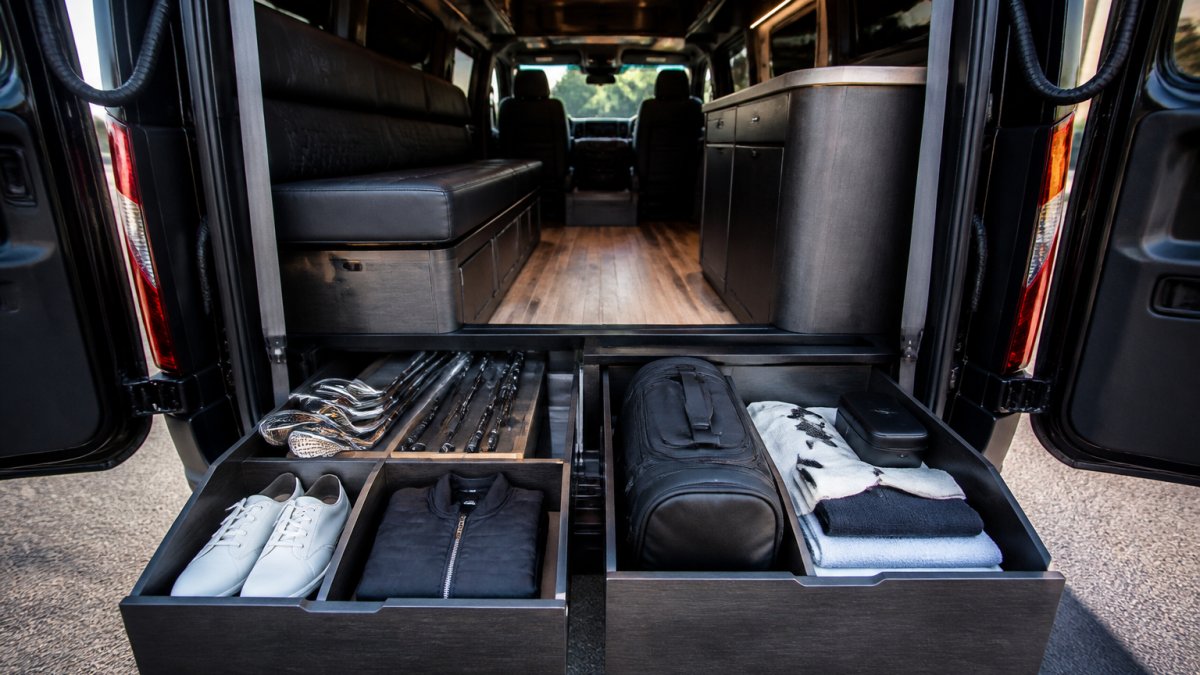
The gap under a shelf is wasted space in most builds. Under-shelf storage fixes that. Slide-out drawers fit under counters and benches and give you full access without crawling. Small containers and storage bins keep loose items from sliding around. Use low-profile bins for shoes, tools, and cleaning supplies. Add dividers so bins stay put on turns. For a cleaner look, choose modular storage you can remove when you need open floor space. These luxury van storage ideas cost little and return a lot of usable room.
Step 4: Plan Golf Club Storage in a Van Around Real Club Dimensions
Golf club storage in a van only works when it matches real club dimensions. A standard driver runs about 45 inches long, and a full staff bag stands roughly 3 feet tall. Measure your longest club and your bag before you design a single rack. Angled slide-out trays in the rear cabin let you load and unload without lifting bags over seats, which matters if your back gives you trouble. GOLF Cruiser builds custom club storage into its vans for exactly this reason, so gear rides secure instead of sliding around the floor.

Step 5: Choose Custom Van Layout Ideas That Convert Space
Convertible systems beat fixed furniture in a luxury van, but the right conversion depends on your floor plan, passenger count, and how you actually use the van. Most storage guides offer one-size-fits-all advice; this section compares approaches by layout so you can match the system to your build.
Bench-to-bed conversions. A bench that folds into a bed extension gives you sleeping space and living space in the same footprint. In a four-passenger layout, a rear bench that converts to a 6-foot-2-inch bed preserves a forward lounge area during the day.
Wall-mounted drop tables. A table that stows into a wall panel opens up larger social areas for your foursome. Look for tables that lock flush against the wall and support 30 to 50 pounds when deployed. The luxury consideration is finish: a laminate top with matching edge banding looks intentional, while a bare plywood top looks like a DIY project.
Removable pod systems. Modular storage you can lift out lets you switch between gear-heavy tournament mode and open family-trip mode in minutes. A common pattern is a set of locking pods on a floor track: load four pods for a golf weekend, remove two for a Costco run. The trade-off is floor-track hardware, which adds cost and a small lip on the floor. Choose low-profile track if you care about a clean floor line.
Passenger-count planning. A two-passenger layout can dedicate the entire rear cabin to gear and a fixed bed. A four-passenger layout needs a convertible bench and overhead storage to compensate for the seats. A six-passenger layout usually requires a rear bench plus a mid-cabin captain’s chair arrangement, which leaves less room for golf bags, plan a vertical rear locker rather than a flat floor bay. Map your typical passenger count before you choose any system.
Luxury space-planning principles. Preserve premium finishes by choosing conversion hardware that hides when not in use: flush-mount table brackets, recessed floor tracks, and bench mechanisms covered by upholstered panels. Keep sightlines open by limiting tall cabinets to the rear and sides, and use low-profile storage under benches so the cabin reads as a lounge rather than a warehouse. The goal is one van that serves as a mobile clubhouse and a comfortable cruiser without looking like a gear locker.
Measure the trade-offs. Before committing, sketch each layout to scale and mark the floor space each system consumes when deployed and when stowed. A convertible bench might add sleeping capacity but cost you 8 square feet of floor space when open. A drop table might add dining space but block a cabinet door when deployed. The best layout is the one whose deployed footprint matches how you actually live in the van.
Choose conversion systems by layout and passenger count, not by catalog photos. Measure deployed and stowed footprints, and hide the hardware to keep the luxury look.
Step 6: Apply Van Organization Tips That Keep Gear in Place
Good van organization tips start with compartmentalizing gear by size and use. Keep clubs in one zone, clothing in another, and food and drinks in a third. Label bins so anyone can find items fast. Use cargo nets and straps to secure loose gear. Pack heavy items low and toward the center of the van. A place for everything means nothing slides, rattles, or gets lost. Smart packing also cuts load and unload time at the course, which your playing partners will appreciate.
Step 7: Check Weight, Safety, and Handling Before You Load Up
Payload limits and load placement affect how any van drives. Check your van’s gross vehicle weight rating and keep the total load under it. Distribute weight evenly and keep the center of gravity low. Secure every cabinet and drawer so nothing shifts in a turn or a panic stop. Overloading hurts braking, steering, and tire wear. A well-planned luxury van build respects these limits, so measure your loaded weight once and adjust from there.
Never block the rear doors or side exits with storage. In an emergency, a jammed exit is a serious safety risk, and no amount of extra capacity is worth it.
Common Mistakes That Waste Space in Luxury Vans
The costliest errors are easy to avoid. Here are the ones we see most:
| Mistake | Why It Hurts | Fix |
|---|---|---|
| Buying bins before measuring | Bins don’t fit; space is lost | Measure every bay first |
| Ignoring vertical space | Ceiling and overhead zones sit empty | Add overhead cabinets and nets |
| Fixed furniture only | One layout for every trip | Use convertible, removable systems |
| Loose gear | Sliding, rattling, safety risk | Compartmentalize and strap down |
| Overloading | Poor handling and braking | Check payload and keep weight low |
| Blocking exits | Safety hazard | Keep doors and aisles clear |
Fix these and your van gains usable room without a single new purchase.
Frequently Asked Questions
How do you maximize storage space in a van?
Start by measuring every interior surface, then build upward. Overhead cabinets, ceiling racks, and cargo nets turn unused air space into storage. Add slide-out drawers under benches and shelves so you reach items without unpacking everything. Group gear by use, not by size, so tournament equipment stays in one zone and personal items in another. In luxury vans, custom cabinetry fitted to your exact layout usually recovers more usable space than generic bins because nothing rattles loose or blocks a walkway.
How should you store golf clubs in a van?
Store clubs in a dedicated, secured bay rather than loose in the cabin. A slide-out tray or angled rack keeps bags upright, protects shafts from rolling, and lets you load without lifting bags over seats. Measure your longest club plus the bag height before specifying the bay. Keep shoes and gloves in ventilated drawers nearby so moisture does not sit against the clubs. For golfers with back issues, a low-load floor height and a tray that extends toward you make the biggest difference.
What should you consider when choosing a custom van layout?
Decide how many people and bags travel at once, then map seating, sleeping, and storage zones around that number. Convertible benches and multi-functional furniture let one area serve two purposes, which matters in a van with limited floor space. Leave clear walkways and confirm that every drawer or bed extension can open fully. Also weigh the layout against payload capacity, because heavy cabinetry and full water tanks reduce the weight you can safely carry.
How do you keep a van interior uncluttered on a long trip?
Give every item a fixed home and use compartments, bins, and cargo nets so nothing slides during driving. Small containers for tees, balls, and chargers prevent loose items from collecting on counters. Do a quick reset each evening: return gear to its zone and wipe surfaces. Removable storage that lifts out for cleaning helps, and modular pieces let you reconfigure when your passenger count changes. A five-minute daily routine keeps a luxury van feeling like a clubhouse rather than a locker room.
Space in a luxury van is won in the planning, not the shopping. Measure first, use vertical zones, secure everything, and respect your weight limits. If you want a van built around that plan from day one, GOLF Cruiser hand-builds premium vans on Chevrolet and GMC platforms with custom club storage, flexible layouts for families or full teams, and easier handling than an RV. Contact us today to start your build.