
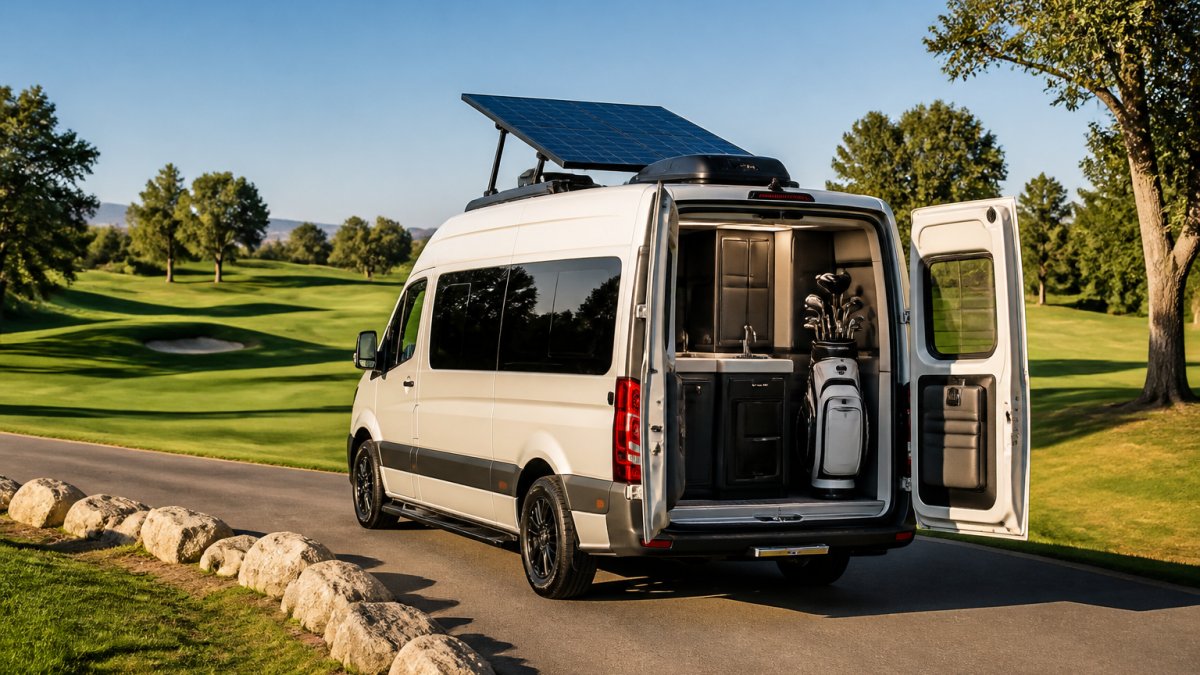
Last Updated: October 22, 2026
Quick Summary
Solar power golf vans use roof-mounted panels to convert sunlight into electrical energy, charging an auxiliary battery system that powers refrigeration, lighting, and device charging without engine idling. A 300-watt system generates 1.2-1.5 kilowatt-hours daily in good sunlight, providing genuine convenience and fuel savings during extended course visits.
- Most golf vans benefit from 200-400 watts of installed solar capacity to offset auxiliary battery drain
- A complete solar setup with panels, charge controller, wiring, and installation costs thousands of dollars
- Solar panels last 25-30 years with minimal maintenance and produce power at zero marginal cost
- Cloudy weather cuts solar output by 50-70% compared to full sun, requiring realistic worst-case planning
- Refrigeration is the most practical van appliance for solar power, drawing only 40-60 watts continuously
Table of Contents
- How Solar Panels Work on Golf Vans
- How Much Solar Power Does a Van Need
- Van Solar Power Pros and Cons
- Solar Power for Van Appliances and Systems
- Auxiliary Battery for a Van: Integration With Solar
- Range Extension and Daily Energy Generation
- Installation, Compatibility, and Realistic Expectations
- Frequently Asked Questions
How Solar Panels Work on Golf Vans
Solar panels convert sunlight into electrical energy through photovoltaic cells, which generate direct current (DC) power when exposed to light (How Does Solar Energy Work?). Solar power golf vans use roof-mounted panels that capture available sunlight throughout the day and feed that power into a battery system or directly to onboard appliances.
The basic principle is straightforward: sunlight hits the panels, electrons are knocked loose from silicon atoms, and that movement creates electrical current. An inverter converts DC power into alternating current (AC) for standard household appliances like refrigerators, microwaves, or charging stations.
Most golf vans use monocrystalline or polycrystalline panels mounted on the roof, where they have unobstructed access to sunlight. The panels connect to a charge controller, which regulates voltage and prevents overcharging of the auxiliary battery system. This integration means your van can generate power passively while parked at the course or during travel.
The efficiency of solar power for golf vans depends on several factors: panel wattage (typically 100-400 watts per panel), roof space available, sun exposure, and weather conditions. A van with 400 watts of panel capacity in ideal conditions might generate 1.5 to 2 kilowatt-hours per day, enough to power basic auxiliary systems without draining the primary engine battery.
The most common mistake is assuming your van’s roof has enough unobstructed space for high-wattage panels. Many custom golf vans have roof racks, air conditioning units, or storage boxes that limit available surface area. Measure your actual roof space before committing to a solar setup.
How Much Solar Power Does a Van Need
The amount of solar power your van needs depends entirely on what you’re powering and how long you’re parked without driving. A van used for weekend golf trips has very different energy demands than one used for extended tournaments or mobile living.
Start by calculating your daily energy consumption. A small refrigerator draws 40-60 watts continuously; a microwave uses 1,000-1,500 watts when running; LED lighting uses 5-10 watts per fixture. If you’re running a fridge for 8 hours per day, that’s roughly 320-480 watt-hours.
Most golf vans benefit from 200-400 watts of installed solar capacity. This provides enough generation on a sunny day to offset auxiliary battery drain and keep you independent from shore power or the engine alternator for basic needs.
The practical reality is that solar power golf vans work best as a supplementary system, not a complete replacement for engine charging. Your van still has an alternator that charges the auxiliary battery when driving, and many golf trips involve regular driving between courses.
Weather matters significantly. A cloudy day cuts solar output by 50-70% compared to full sun. Winter months produce less power than summer. If your golf schedule includes frequent trips to regions with variable weather, account for this reduced output when sizing your system.
Van Solar Power Pros and Cons
Pros:
Solar power for golf vans offers genuine advantages for golfers who value independence and operational efficiency.
The system operates silently and requires no fuel or grid connection. For golfers traveling to remote courses or tournament venues, this independence is meaningful.
Solar panels add minimal weight compared to traditional generators and take up roof space that’s often unused.
Long-term, the system is durable. Quality solar panels last 25-30 years with minimal maintenance, and once installed, they produce power at zero marginal cost.
Cons:
The upfront cost is substantial. A complete solar setup with panels, charge controller, wiring, and installation runs into thousands of dollars.
Solar power is intermittent. Cloudy weather, seasonal variation, and nighttime all reduce or eliminate power generation.
Roof-mounted panels reduce available roof space for other equipment. Many golf vans benefit from roof racks for additional storage, and solar panels compete for that real estate.
The system requires proper maintenance. Panel surfaces need occasional cleaning, wiring connections need inspection, and battery systems require monitoring to prevent damage from overcharging or deep discharge cycles.
Installation complexity can be high, especially on custom vehicles. Improper installation creates fire hazards, electrical faults, or water leaks that damage the van’s interior.
The biggest mistake is installing solar panels without upgrading your auxiliary battery system. Panels alone don’t store power, they need a strong battery bank to capture and hold the energy they generate. Without adequate battery capacity, your panels sit idle on sunny days while your fridge runs on engine charging.
Solar Power for Van Appliances and Systems
Not all van appliances benefit equally from solar power. Understanding which systems work well with solar helps you design a practical setup.
Refrigeration is the most common and practical use for solar power on golf vans. A small 12V or 24V compressor fridge draws 40-60 watts continuously and runs intermittently throughout the day.
Lighting and charging are natural fits. LED lighting draws minimal power, and USB charging ports for phones, tablets, and golf rangefinders pull only 5-10 watts.
Air conditioning is impractical on solar alone. Roof-mounted AC units draw 1,500-3,000 watts and would require massive panel arrays and battery banks to operate independently.
Microwave ovens require 1,000+ watts and are not realistic for solar-powered vans without an enormous system. Most van owners with microwaves rely on engine charging or shore power.
Water heating varies by type. An on-demand tankless water heater draws significant power, but a small solar shower bag or a passive roof-mounted solar heater works well with solar systems.
The practical approach is to prioritize essential loads: refrigeration, lighting, device charging, and water heating. These create genuine value and are achievable with a reasonably-sized solar system. Avoid expecting solar to power high-draw appliances like microwaves or air conditioning.
Auxiliary Battery for a Van: Integration With Solar
The auxiliary battery is the critical component that makes solar power useful. Without proper battery capacity, your panels generate power that goes nowhere.
Most golf vans use a secondary deep-cycle battery separate from the engine starting battery. This auxiliary battery powers all onboard systems and is charged by both the engine alternator (when driving) and the solar panels (when parked).
Lithium iron phosphate (LiFePO4) batteries are increasingly popular for van solar systems. They’re lighter, more efficient, and last longer than traditional lead-acid batteries, though they cost more upfront.
Lead-acid AGM (absorbed glass mat) batteries are a more budget-friendly option. A 200-amp-hour AGM battery costs less than lithium but weighs significantly more and provides lower usable capacity due to the 50% discharge limit for longevity.
The integration is straightforward: solar panels feed power to a charge controller, which charges the auxiliary battery. The battery then powers onboard systems. When you drive, the engine alternator also charges the auxiliary battery, and the charge controller prevents conflicts between the two charging sources.
Proper battery sizing is essential. If your solar system generates 1.5 kilowatt-hours daily but your battery only stores 1 kilowatt-hour, you’re wasting solar potential. Conversely, oversizing the battery adds weight and cost without proportional benefit.
The auxiliary battery is where solar power becomes practical. Without it, solar panels are just generating power that dissipates as heat. A well-sized battery bank turns intermittent solar generation into usable, on-demand power for your van systems.
Range Extension and Daily Energy Generation
Solar power for golf vans extends driving range indirectly by reducing engine runtime needed to charge auxiliary systems. This matters most during extended trips where you’re parked for long periods between driving legs.
Consider a realistic scenario: you’re driving to a tournament 200 miles away, parking for a full day at the course, then driving 200 miles home. Without solar, your engine alternator must charge the auxiliary battery while driving, adding engine load and fuel consumption.
With a 300-watt solar system and a 100-amp-hour lithium battery, you generate roughly 1.2-1.5 kilowatt-hours on a sunny day while parked. This covers refrigeration, lighting, and device charging without running the engine. Over a full day, this saves 30-60 minutes of engine idling, reducing fuel consumption by 0.5-1 gallon depending on engine size and efficiency.
On a 3-day tournament trip with two days parked at courses, you might save 2-3 gallons of fuel. The savings are modest but real, and they accumulate over many trips.
Daily energy generation varies dramatically by season and weather. In summer with clear skies, a 300-watt system generates 1.5-2 kilowatt-hours daily. In winter or cloudy conditions, expect 0.5-1 kilowatt-hour. Plan your power consumption around worst-case scenarios, not ideal conditions.
The honest assessment is that solar extends operational convenience more than driving range. You can park comfortably without running the engine, which matters for your own comfort and for courtesy to other golfers. The fuel savings are secondary but meaningful over time.
Installation, Compatibility, and Realistic Expectations
Installing solar panels on a golf van requires careful planning and professional execution. The process involves structural assessment, electrical design, and integration with existing systems.
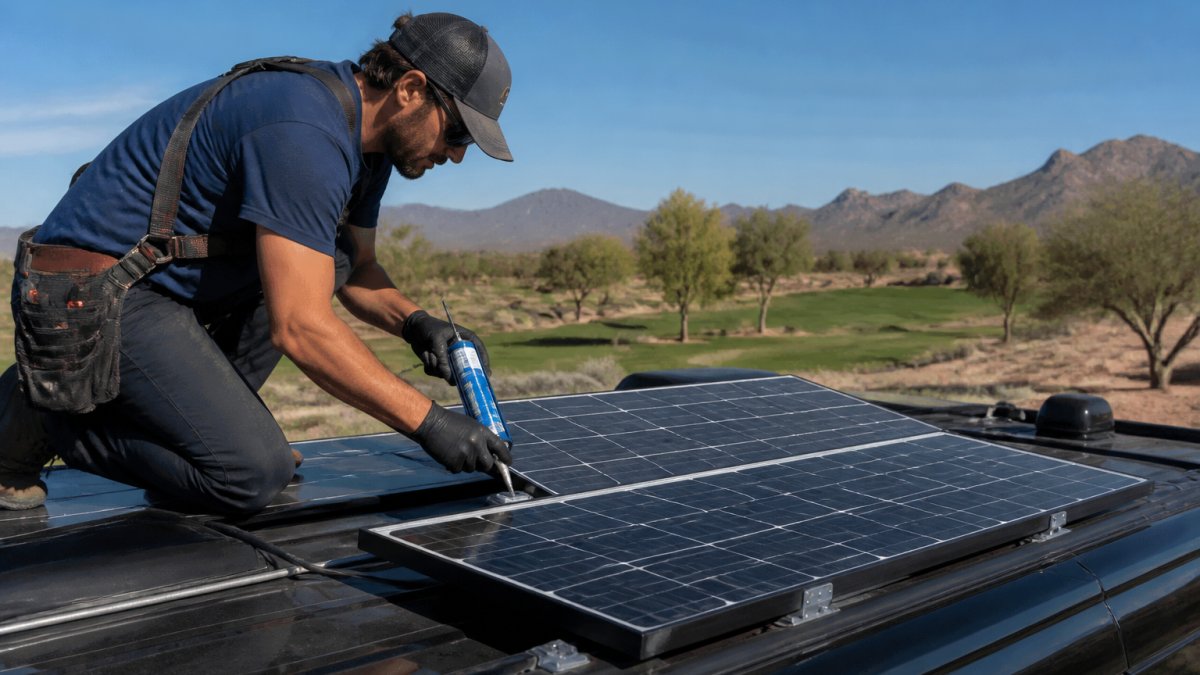
Roof assessment is the first step. Your van’s roof must support the weight of panels (roughly 3-4 pounds per 100 watts), mounting hardware, and wiring.
Electrical compatibility is critical. Your van’s electrical system must accommodate a charge controller, solar wiring, and potentially a new auxiliary battery.
Professional installation is strongly recommended. Improper installation creates water leaks through roof penetrations, electrical faults that damage systems, or fire hazards from undersized wiring or faulty connections.
Compatibility with GOLF Cruiser vans is straightforward. Our hand-built luxury vans use Chevrolet and GMC platforms with strong electrical systems designed for custom integration.
Realistic expectations matter most. Solar power for golf vans is a supplementary system, not a complete solution.
Weather and season significantly impact performance. A sunny day in summer generates three times more power than a cloudy day in winter.
The payback timeline is long. A complete solar setup costs thousands, and fuel savings alone won’t recoup that investment in 5-10 years.
Solar power for golf vans addresses a genuine need: keeping your mobile clubhouse comfortable and independent while parked at courses without wasting fuel on engine idling.
Frequently Asked Questions
Can solar panels actually power a golf van’s main battery?
Solar panels can supplement your van’s main battery and extend driving range, but they cannot fully power most electric golf vans or provide enough energy to replace grid charging entirely. For golf vans used primarily for travel between courses and tournaments, solar functions best as a supplementary charging source that reduces grid electricity dependence and extends time between full charges.
How much solar power does a van need for practical off-grid operation?
Most golf vans benefit from installed solar capacity paired with a robust auxiliary battery system. Your actual needs depend on daily energy consumption, climate, and how often you camp off-grid. Calculate your needs by totaling wattage of appliances you’ll run simultaneously, then work backward to determine panel size. Consulting with a solar installer ensures your system matches your specific travel patterns and golf schedule.
What are the main downsides of adding solar panels to a golf van?
Solar panels add upfront cost, require roof space, and depend heavily on weather and season. Cloudy conditions or winter travel significantly reduce energy generation. Installation complexity, potential roof penetration, and weight (typically 200-400 pounds for a complete system) are practical concerns. Solar also cannot generate power at night, so you’ll still need grid access or a substantial battery reserve for evening operation. For golfers who travel primarily during sunny seasons and have access to charging infrastructure, these tradeoffs are manageable; frequent winter travelers may find solar less worthwhile.
Which van appliances can solar panels realistically run?
Solar panels excel at powering low-draw appliances: LED lighting, fans, water pumps, refrigerators, and phone or laptop chargers. They can support climate control and microwave use during peak sun hours but struggle to run air conditioning, electric heaters, or high-power cooking equipment continuously. A 600-watt solar system with a 200 amp-hour battery can run a refrigerator and lights all day, but adding a microwave or space heater will quickly drain reserves. For golf vans used as mobile clubhouses during daytime tournaments, solar handles comfort and communication devices well; overnight comfort systems require either grid backup or oversized battery capacity.
