
Table of Contents
- Why a Custom Golf Van Beats Flying or Renting
- Custom Golf Van Pricing: What Drives the Cost
- Luxury Golf Travel Van Interior Layouts That Work
- Custom Golf Club Storage Solutions for Vans
- Key Features That Define a Purpose-Built Golf Van
- Custom Van Financing and Tax Deductions: Section 179 Explained
- Resale Value, Maintenance, and Total Cost of Ownership
- Is a Custom Golf Van Worth the Investment?
- Frequently Asked Questions
Last Updated: September 4, 2026
Why a Custom Golf Van Beats Flying or Renting
Flying to a tournament usually ends with you wrestling a 50-pound travel bag through baggage claim, hoping the airline didn’t snap your driver shaft. A custom golf van eliminates that equation by putting your clubs, your group, and your comfort in one vehicle you control from driveway to clubhouse.
At GOLF Cruiser, we’ve spent over 45 years hand-building full-size vehicle conversions. When you tally flights, rental SUVs, baggage fees, and equipment wear across a season, the economics shift dramatically. A purpose-built van also solves logistics renting never addresses: clubs stay loaded, your group travels together, and you arrive relaxed rather than drained.
The real advantage is what the U.S. Bureau of Transportation Statistics data on leisure travel trends shows about group travel patterns: the more people you move together, the more sense private transport makes. Below, we’ll walk through what drives custom golf van pricing and features, what layouts actually work, and how the numbers stack up against the alternatives.
Custom Golf Van Pricing: What Drives the Cost
A custom golf van is not a single product with a sticker price. It is a build assembled around your priorities, and the final figure depends on three variables: the base vehicle, the complexity of the interior build, and the materials you select.
Base Vehicle Choice: Chevrolet vs. GMC Platforms
The foundation of most luxury conversions is a full-size van chassis, and the choice between Chevrolet and GMC platforms matters. Both offer the wheelbase options, ground clearance, and load capacity ideal for conversion work. Your decision affects everything downstream, from towing capability to transmission specs.
The most common starting points are the Chevrolet Express 3500 and the GMC Savana 3500. These workhorses are preferred for their robust ladder-frame chassis and proven V8 powertrains. The 3500 series has a Gross Vehicle Weight Rating (GVWR) of up to 9,600 pounds, which comfortably handles a heavy interior build, six passengers, and full golf bags, and exceeds the 6,000-pound threshold that qualifies for Section 179 deductions, detailed later.
A key trade-off is the standard 155-inch wheelbase versus the extended 177-inch version. The extended adds roughly 22 inches of cargo length, often the difference between a cramped layout and a true lounge area behind the second row. However, it reduces turning radius and complicates parking. Most builds for groups of four or more use the extended wheelbase because the interior flexibility outweighs the driving trade-offs.
Build Complexity and Materials
This is where the range in custom golf van pricing becomes apparent. A basic passenger configuration with upgraded seating costs far less than a bespoke interior with leather, ambient lighting, and integrated multimedia. The scope of your vision determines the investment.
To help you frame your budget, the market generally segments into three tiers, each with a distinct price range based on the level of customization:
Request a detailed quote from GOLF Cruiser rather than assuming a single price point. Every build is quoted individually based on layout, materials, and features, so an honest conversation about your budget early in the process yields the most accurate picture. When you call, be ready to discuss the number of passengers, the types of bags you use, and whether you plan to use the van for business purposes.
Beyond the tier, the single largest cost driver is labor. A full custom interior build involves hundreds of hours of skilled carpentry, upholstery, and electrical work. The difference between a $5,000 storage rack and a $20,000 system is not just materials, it is the engineering time to make it fit perfectly and look factory-built. This is why a reputable converter like GOLF Cruiser quotes based on a detailed specification sheet, not a per-square-foot price.
Luxury Golf Travel Van Interior Layouts That Work
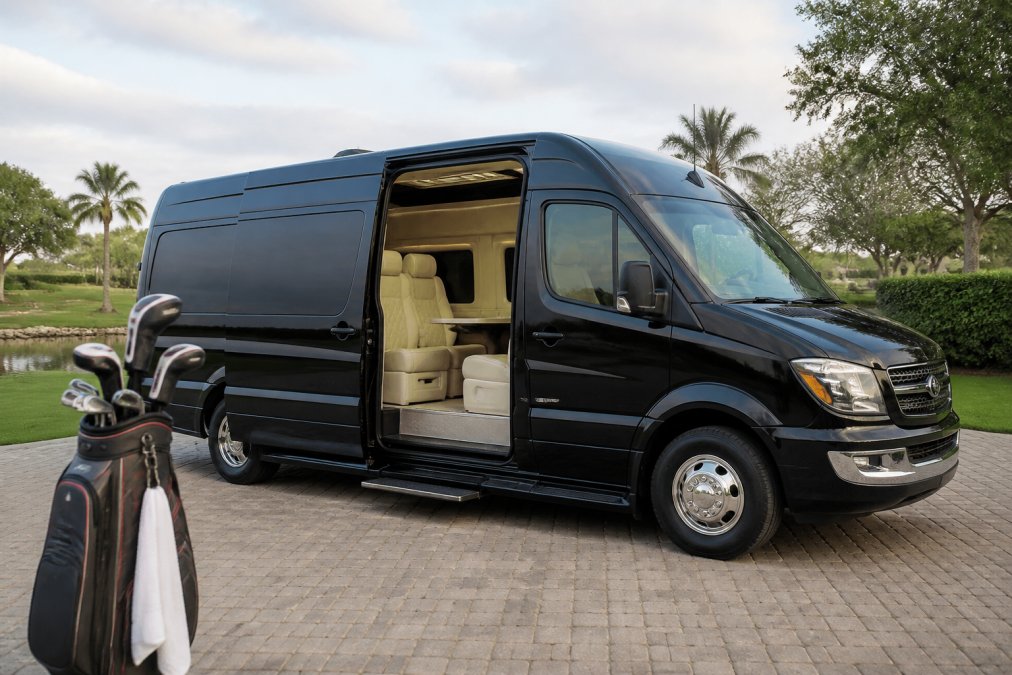
The best luxury golf travel van interior layouts balance passenger comfort with equipment capacity, and most buyers choose between two proven approaches. The first prioritizes captain’s chairs and lounge-style seating for four to six people. The second configures the cabin around team travel, with bench seating that accommodates a full foursome plus gear.
What separates a successful layout from a frustrating one is the transition zone between people and cargo space. A thoughtful design uses a bulkhead or divider so clubs, shoes, and bags stay separated from seating, preventing the “everything slides forward when you brake” problem. A common mistake is over-prioritizing seating and forgetting that golfers travel with coolers, push carts, and rain gear.
Custom Golf Club Storage Solutions for Vans
Custom golf club storage solutions for vans have evolved well beyond simple racks bolted to the floor. The best systems protect equipment during transit while making loading and unloading nearly effortless, especially for anyone with back trouble or limited mobility.
A premium setup typically includes vertically secured golf bag racks with padded cradles that hold each bag firmly, preventing clubs from rattling on rough roads. Many owners add slide-out trays that bring bags to tailgate height, eliminating deep reaches into the cargo area. The configuration should accommodate everything from staff bags to lightweight carry options, with adjustable spacing so nothing shifts mid-drive.

The real test of a storage system is the tournament morning routine. If you can open the rear doors, slide out your clubs, and be on the first tee in under five minutes without bending or straining, the design has done its job. This is also where the National Highway Traffic Safety Administration guidelines on cargo securement become relevant, since properly secured loads protect both your equipment and your passengers in the event of sudden stops.
Key Features That Define a Purpose-Built Golf Van
A true golf van is distinct from a generic conversion because every feature serves the golfer’s routine. The essential list starts with a club storage system designed for travel rigors, then builds outward to seating that supports long drives and climate control that keeps passengers and equipment comfortable in any season.
The Golf Storage System: The Heart of the Build
The storage system is the most critical differentiator. A generic van might have tie-downs, but a purpose-built golf van has a system engineered around golf bag dimensions. The best systems use a vertical rack that holds bags by the handle, not the base, preventing clubs from shifting. The rack should feature individual, padded cradles with quick-release straps, accommodating both a 10-inch staff bag and a slimmer carry bag without tool adjustments. A premium system includes a slide-out tray rated for at least 150 pounds, letting you pull the entire set out to the rear bumper without leaning in.
Seating and Ergonomics for Long Drives
For a six-passenger layout, seating is a major cost and comfort driver. The industry standard is a swiveling captain’s chair with integrated seat belts, typically sourced from commercial RV suppliers, featuring 12-way power adjustment, lumbar support, and heating/ventilation. These must be mounted on a reinforced sub-frame bolted directly to the chassis, not the sheet metal floor, to prevent fatigue and ensure seat belt anchor points meet Federal Motor Vehicle Safety Standards (FMVSS) 208 and 209. For the rear bench, a fold-down sofa bed adds versatility but is heavier and reduces cargo space; a simpler two-person bench with a flip-up seat bottom offers under-seat storage for shoes or rain gear.
Climate Control: Protecting Equipment and Passengers
Interior climate control deserves special attention because extreme temperatures degrade grips and can affect club performance. A standard front HVAC system is insufficient for the rear cargo area. A purpose-built van should include a second, rear-mounted HVAC unit with its own evaporator and heater core, a factory option on many Chevrolet Express and GMC Savana models (RPO code C69 for rear heater, C60 for rear air conditioning). Confirm the rear unit is ducted to the cargo zone, not just the second-row seating, so on a 95-degree day the van, and your clubs, stays below 80 degrees.
Technology and Connectivity: The Mobile Command Center
Modern golf vans are as much about connectivity as comfort. The baseline for a premium build is a touchscreen infotainment system with Apple CarPlay and Android Auto for navigation apps like Golf GPS. A rear-seat entertainment system with HDMI inputs and a 4G LTE Wi-Fi hotspot allows live streaming of tournaments on the drive home. A highly valued, often overlooked feature is a 110-volt power inverter with pure sine wave output, rated at a minimum of 1,000 watts, to charge a lithium-ion push cart battery or run a small compressor for tires.
Safety and Driving Dynamics
The added weight of a custom interior, often 1,500 to 2,000 pounds, significantly alters handling. A standard suspension will feel wallowy. A purpose-built van should include an upgraded rear suspension package, typically heavier-duty leaf springs or an air suspension system with an onboard compressor. Air suspension is superior because it allows ride-height adjustment for load leveling and can lower the van to ease entry and exit for passengers with mobility issues. A supplemental braking system controller is essential if you plan to tow a trailer with a golf cart; the factory tow package on the 3500 series is rated to tow up to 10,000 pounds, but only with a weight-distributing hitch and trailer brake controller.
When comparing features, focus on the systems that are integrated into the vehicle’s engineering, rear HVAC, reinforced seating mounts, upgraded suspension, rather than bolt-on accessories. These integrated features are what differentiate a safe, durable, and comfortable golf van from a van with a few golf bags thrown in the back.
The distinction between a purpose-built golf van and a general-purpose conversion comes down to these details. A generic conversion gives you a nice vehicle; a golf-specific build gives you a mobile clubhouse planned around how you use the space on tournament weekends.
Custom Van Financing and Tax Deductions: Section 179 Explained
Custom van financing is more accessible than many buyers assume, but the tax angle often matters more. Section 179 of the Internal Revenue Code allows businesses to deduct the full purchase price of qualifying vehicles in the year they are placed in service, rather than depreciating them over several years.
The qualification rules are specific. The vehicle must be used more than 50% for business purposes, and the deduction applies to vehicles with a gross vehicle weight rating above 6,000 pounds, which most full-size van conversions exceed. For a golf coach, club professional, or business owner who hosts clients on the course, this can turn a significant portion of the purchase into a tax write-off. The IRS Section 179 deduction guidelines spell out the requirements clearly, and your accountant should confirm your specific situation qualifies before you commit.
Do not assume your vehicle automatically qualifies. The IRS requires that business use exceed 50%, and you must maintain records substantiating that usage. Work with a tax professional before purchase to structure the transaction correctly.
Resale Value, Maintenance, and Total Cost of Ownership
The total cost of ownership for a custom golf van extends well beyond the initial purchase, and smart buyers think in terms of five to ten years. Maintenance on a Chevrolet or GMC platform is straightforward because these are proven, widely serviced vehicles with accessible parts and knowledgeable mechanics nationwide, avoiding the specialized service network RV ownership demands.
Resale value depends on how well the conversion holds up and whether the build appeals to future buyers. A well-executed golf-specific conversion with quality materials tends to retain value better than a generic conversion because it serves a defined market of enthusiasts who cannot easily replicate the build. Regular maintenance, documented service history, and careful interior care protect your resale position.
The comparison that matters is against the true alternatives: flying with clubs, renting vehicles at each destination, or maintaining a motorhome. When you factor in baggage fees, rental costs, and the value of your time, the annual cost of van ownership often compares favorably for anyone making more than a handful of golf trips per year. The American Automobile Association cost of ownership research provides a useful framework for estimating the fixed and variable costs of vehicle ownership over time.
Is a Custom Golf Van Worth the Investment?
For the right buyer, the answer is a clear yes, and the decision comes down to how you travel. If you take six or more golf trips annually with friends, family, or clients, a custom golf van pays for itself in convenience, comfort, and eliminated travel friction. If you fly commercially and rent cars, you are already spending thousands annually on an experience that leaves your clubs at the mercy of baggage handlers.
The deeper value is the transformation of the entire trip. The van becomes part of the ritual: the drive to the course, the strategy session on the way home, the camaraderie in transit rather than in an airport terminal. For golfers with mobility concerns, the low step-in height and organized storage make the difference between an exhausting travel day and a manageable one.
GOLF Cruiser builds these vans with a singular focus: creating a luxury travel machine tailored to golfers rather than adapting camper vans for a different purpose. With over 45 years of experience in full-size vehicle conversions, hand-built quality on reliable Chevrolet and GMC platforms, and flexible layouts, the result is a vehicle that serves as both mobile clubhouse and tournament command center.
The decision to invest in a custom golf van deserves careful research, honest conversations about how you travel, and a clear picture of long-term costs and benefits. GOLF Cruiser brings four and a half decades of conversion expertise to every build, offering custom club storage, flexible interior layouts, and the potential for Section 179 tax advantages for qualifying business owners. Contact us today to discuss your ideal configuration and receive a detailed quote tailored to how you play.
Frequently Asked Questions
How much does a custom golf van cost compared to a standard conversion van?
Custom golf van pricing depends heavily on the base chassis, interior layout, and level of finish. A golf-specific build includes tailored club storage, seating configurations, and technology that generic conversion vans lack. Because each unit is hand-built to order, pricing varies significantly. Contact GOLF Cruiser directly for a quote based on your preferred Chevrolet or GMC platform and custom specifications.
What are the essential features for a golf-specific conversion van?
The essentials are secure custom golf club storage, seating that converts for passengers or cargo, and easy loading access. Look for lockable club racks, climate control to protect equipment, and durable flooring. Luxury upgrades like leather upholstery, ambient lighting, and multimedia systems enhance the travel experience. The right build turns the van into a mobile clubhouse for tournament days.
Can I claim a Section 179 tax deduction on a custom golf van for my business?
Yes, if the van is used primarily for business purposes, such as transporting clients, team travel, or equipment logistics. Section 179 allows qualifying businesses to deduct the full purchase price in the year the vehicle is placed into service, subject to IRS limits. The van must meet weight requirements, typically exceeding 6,000 pounds gross vehicle weight. Your accountant can confirm eligibility based on your specific usage.
How does a custom golf van compare to a standard RV for tournament travel?
A custom golf van is easier to drive, park, and maintain than a typical RV. It offers more interior space than an SUV while fitting in standard parking spots and garages. The focus is on passenger comfort and gear storage, not camping amenities. This makes it a practical choice for golfers who want luxury travel without the complications of a larger motorhome.