
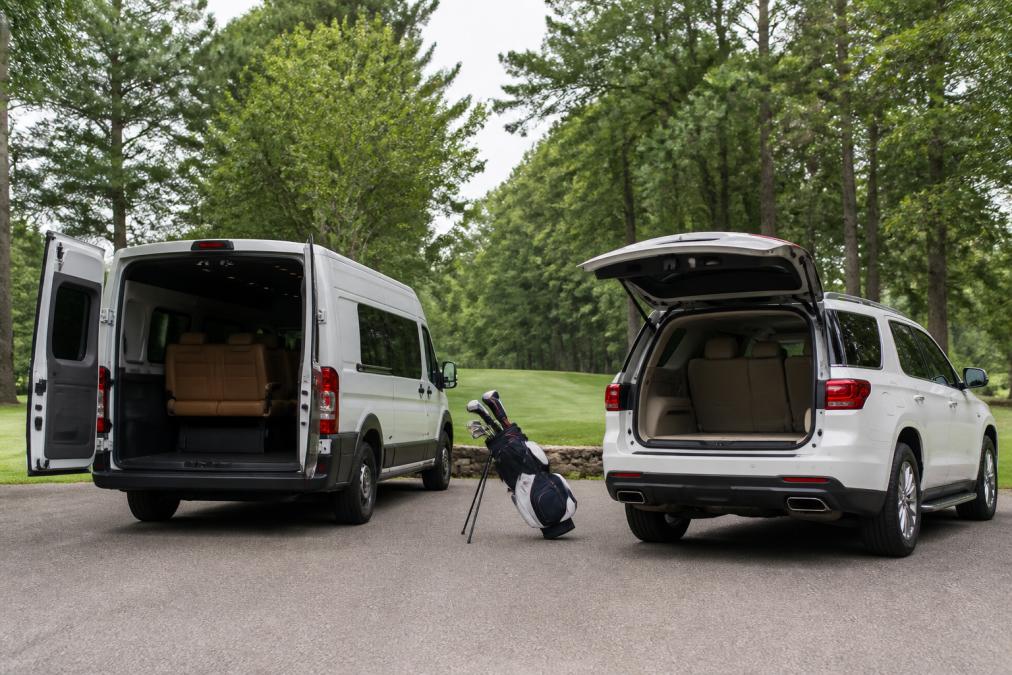
Table of Contents
- Custom Van vs SUV for Golfers: The Core Trade-Off
- SUV Cargo Capacity for Golf Clubs: Where SUVs Fall Short
- Passenger Comfort and Interior Space Compared
- Parking, Maneuverability, and Everyday Drivability
- Golf Trip Logistics Planning: Loading Gear and Moving a Foursome
- Section 179 Tax Deduction for Vehicles: A Financial Advantage
- Total Cost of Ownership and Long-Term Value
- Which Vehicle Wins for Your Golf Group?
- Frequently Asked Questions
Last Updated: September 5, 2026
Custom Van vs SUV for Golfers: The Core Trade-Off
The custom van vs SUV for golfers debate starts with a simple question: how many bags and buddies are you hauling? An SUV handles a solo round or twosome, but the math breaks down when a fourth player joins. A custom van trades sporty handling for interior volume, standing headroom, and gear storage no SUV can match. At GOLF Cruiser, we build these vehicles on Chevrolet and GMC platforms with over 45 years of conversion experience.
The real distinction is intent. If you need a daily commuter that occasionally carries clubs, an SUV makes sense. If your calendar is full of tournaments, resort trips, and buddy golf weekends, the van wins.
SUV Cargo Capacity for Golf Clubs: Where SUVs Fall Short
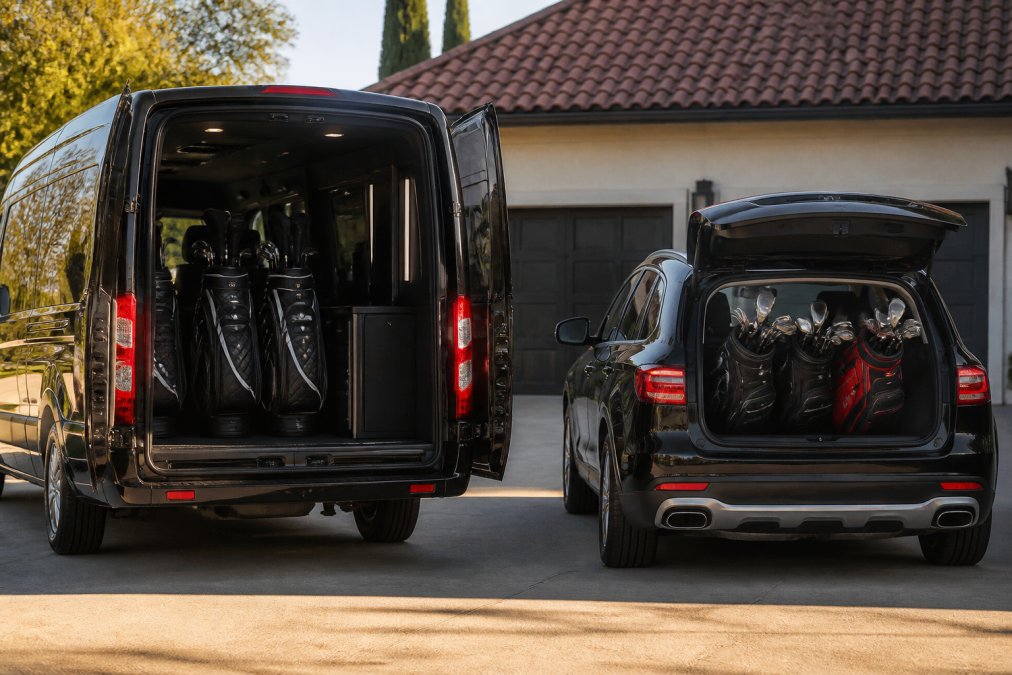
Most SUVs lack the cargo capacity for golf clubs when four players travel together. A typical golf bag stands about 48 inches tall, and once you add push carts, coolers, and luggage, the trunk fills fast. With rear seats folded, a midsize SUV can swallow two bags stacked diagonally, but the third and fourth bags often require creative positioning that risks damaging graphite shafts.
The issue is vertical space. SUVs have shallow cargo floors and sloped rear hatches that eat into usable height. A van’s boxy profile provides a full-height opening: you stand upright, slide bags in on their wheels, and secure them without bending or twisting. For golfers with back issues, this difference alone justifies the switch.
| Vehicle Type | Typical Bag Capacity | Loading Position | Passenger Comfort |
|---|---|---|---|
| Compact SUV | 1-2 bags | Bent over, angled | Tight for 4 adults |
| Midsize SUV | 2-3 bags | Bent over, angled | OK for 4 adults |
| Full-size SUV | 3-4 bags | Bent over, angled | Good for 4-5 adults |
| Custom van | 4-8 bags | Standing upright | Excellent for 4-8 adults |
The Chrysler Pacifica Hybrid, a minivan often recommended for golf trips, shows the value of interior volume with its Stow ‘n Go seating and lower entry height. But a custom van takes that concept further with dedicated club storage and flexible layouts designed around golf equipment, not family hauling. On every practical metric, the van wins.
Passenger Comfort and Interior Space Compared
A van’s advantage extends beyond the cargo area. Four golfers in an SUV means three hours of shoulder contact and limited legroom, especially for taller passengers in the middle seat. The Genesis GV80 offers a quiet cabin and high-end materials, and it remains a comfortable luxury SUV for a foursome. But a van provides something no SUV can replicate: the ability to stand up, walk to your seat, and stretch out during a long drive.
Custom vans convert that space into lounge-style seating with swivel chairs, a rear bench, and a table for strategy sessions or card games between rounds, transforming the vehicle into a mobile clubhouse. Players can change shoes, review course notes, or relax in a proper seat rather than wedged between bags and door panels. For multi-hour drives to regional tournaments, this comfort differential is significant.
The defining advantage of a custom van is the ability to move around the cabin. An SUV confines you to your seat; a van gives you a space to live in during the journey.
Parking, Maneuverability, and Everyday Drivability
Let’s put real numbers on the parking objection. A full-size conversion van on a Chevrolet Express or GMC Savana platform measures approximately 224 inches long and 79 inches wide, with a turning radius of about 42 feet. A full-size SUV like the Chevrolet Suburban stretches about 225 inches long and 81 inches wide, with a similar turning radius. The surprise is that a conversion van and a full-size SUV are nearly identical in footprint. The difference is height: a van stands about 82 inches tall versus the Suburban’s 75 inches, which matters only in parking garages with posted clearances below 6 feet 8 inches.
The van genuinely struggles in older downtown lots, underground garages with spiral ramps, and valet situations. A midsize SUV such as the Honda Passport (190 inches long, 78 inches wide) or the Ford Edge (189 inches long, 76 inches wide) slips into spaces a van cannot. If your regular rotation includes tight urban lots, that is a legitimate consideration.
Here is the angle most golf-focused comparisons miss: the loading zone advantage. At a course, the van pulls up to the bag drop, opens its full-height side or rear door, and golfers step out directly onto the curb. An SUV requires passengers to exit into traffic or squeeze between parked cars. For a foursome at a busy public course on a Saturday morning, that curb-side access eliminates the awkward dance of unloading clubs while cars wait behind you.
Daily drivability also favors the van in one specific way: the seating position. The van’s upright, bus-like seating places your hips above your heels, reducing lower back strain on long drives. An SUV’s car-like seating keeps your knees bent and spine more flexed. Golfers with lumbar issues often report less fatigue after a three-hour drive in a van. The trade-off is that the van’s taller body catches more crosswind on exposed highways, requiring slight steering corrections an SUV does not need.
Check clearance before entering any parking structure. A conversion van’s roof height (typically 82-84 inches) exceeds the 6-foot-8-inch limit found in many older garages. When in doubt, park in surface lots or use the van’s rear camera to monitor overhead clearance.
The honest verdict: if your golf travel is 90% highway and surface lots, the van’s size is a non-issue. If you regularly navigate dense city streets and underground parking, a midsize SUV remains the better daily companion. The decision should hinge on your specific course rotation, not a vague fear of parking lots.
Golf Trip Logistics Planning: Loading Gear and Moving a Foursome
Golf trip logistics planning becomes dramatically simpler with a van. For a typical tournament weekend, four players arrive with clubs, travel bags, suitcases, and possibly a cooler. An SUV requires a choreographed loading routine: fold seats, position bags in a specific order, squeeze luggage into remaining gaps, and hope nothing shifts. Unloading at the hotel repeats the process in reverse.
A van eliminates the puzzle. Walk to the rear, open the full-height door, and slide bags into dedicated storage. Flexible layouts let you configure the interior for your group size, whether that is four players with generous luggage space or eight players in a team configuration. One person can handle the entire loading process without assistance, which matters for golfers with mobility issues or injuries.
The vehicle also serves as a staging area at the course. Instead of leaving clubs in a hot trunk, you can keep them organized in the van, change shoes in the cabin, and store outer layers between rounds. For tournament organizers, this mobile command center supports team coordination and equipment management throughout the event.
Section 179 Tax Deduction for Vehicles: A Financial Advantage
The Section 179 tax deduction for vehicles can substantially reduce the net cost of a van for business owners. Under Internal Revenue Service rules, Section 179 allows qualifying businesses to deduct the full purchase price of eligible equipment, including certain vehicles, in the year they are placed in service rather than depreciating it over several years. The IRS guidelines on Section 179 deductions outline specific weight and use requirements that heavy vehicles like vans must meet to qualify.
A van used more than 50% for business purposes may qualify for this deduction, which means a golf professional, coach, or business owner who uses the vehicle for client entertainment, team travel, or corporate events could write off a significant portion of the purchase price. The exact deduction depends on your tax situation, so IRS Publication 946 on depreciation and a qualified accountant are essential references. This financial advantage does not apply to most SUVs, which fall under different passenger vehicle limits.
Consult a CPA before purchase to confirm your specific vehicle configuration meets Section 179 requirements. The deduction hinges on business use percentage and vehicle weight, so documentation matters from day one.
Total Cost of Ownership and Long-Term Value
The total cost of ownership (TCO) analysis for a custom van versus an SUV is rarely laid out with real numbers, which is why most golfers default to the cheaper upfront option. TCO includes purchase price, depreciation, insurance, fuel, maintenance, and opportunity cost. Here is how the math typically plays out over five years.
Purchase price and depreciation. A new full-size SUV such as a Chevrolet Tahoe starts around $58,000. A conversion van on a Chevrolet Express passenger platform, with a custom interior, typically lands between $75,000 and $95,000 depending on the upfitter. The SUV depreciates roughly 45-50% over five years, leaving a resale value near $30,000. The conversion van depreciates at a similar percentage, but the custom interior holds value better because the conversion market is small and buyers seek out finished vehicles. A well-maintained conversion van can retain 55-60% of its value after five years, especially if the upfitter is a recognized brand. That narrows the gap significantly.
Insurance. A conversion van is classified as a passenger van, not a commercial vehicle, so premiums are comparable to a full-size SUV. The custom interior adds value that must be insured, but the cost is modest, typically $15 to $30 per month more than a standard SUV policy. However, standard auto policies do not cover clubs left in the vehicle overnight. A separate inland marine or personal articles policy for golf gear costs roughly $100 to $200 per year for $5,000 of coverage, regardless of vehicle type.
Fuel. The EPA rates the Chevrolet Express with a 4.3L V6 at 15 mpg city and 20 mpg highway. A Tahoe with the 5.3L V8 gets 16 city and 21 highway. The difference is negligible, roughly $150 per year at 12,000 miles with gas at $3.50 per gallon. The van’s boxy shape creates more wind resistance, but the penalty is smaller than most assume.
Maintenance. Both vehicles share General Motors architecture, so parts and labor costs are nearly identical. The van’s rear-wheel-drive layout and simpler suspension mean fewer repairs than an independent rear suspension found on many SUVs. Brake pads, tires, and oil changes run the same. The custom interior requires no mechanical upkeep. Over five years, budget $4,000 to $6,000 for routine maintenance on either vehicle.
The opportunity cost angle competitors ignore. If you fly to golf destinations with a foursome, add up the real costs: four round-trip airline tickets at $300 each, baggage fees for golf clubs at $35 per bag each way, and a rental SUV at $80 per day for a long weekend. That is roughly $1,700 per trip. Six trips per year totals over $10,000 annually. A van that replaces those flights pays for its premium over an SUV in about two years. Even if you drive instead of fly, the van eliminates the need for a second vehicle at the destination.
Run your own TCO spreadsheet before buying. The van’s higher sticker price is offset by better resale retention, negligible fuel penalties, and the elimination of airfare and rental costs for group travel. For golfers taking four or more trips per year with three or more players, the van breaks even within 24 to 36 months.
The Volkswagen Tiguan or Honda CR-V offers a lower entry price, but neither can carry a foursome with bags. The comparison is not between a van and a compact SUV, it is between a van and a full-size SUV, and once you run the numbers, the van’s long-term value becomes far more defensible than the upfront price suggests.
Which Vehicle Wins for Your Golf Group?
The answer depends entirely on your travel patterns. For solo golfers or pairs who play locally and rarely carry more than two bags, a compact or midsize SUV remains the practical choice. The MINI Countryman and Volkswagen Tiguan offer efficiency and maneuverability at a lower price point, and they serve well as daily drivers.
For golfers who regularly travel with a foursome, carry full equipment sets, or organize team events, the custom van is the superior choice. The interior space, standing headroom, and dedicated club storage solve problems that no SUV can address, regardless of price. The National Highway Traffic Safety Administration safety ratings for full-size vans also reflect their solid construction and protective structure for passengers and gear alike.
:::verdict
Winner: Custom van for golfers who travel with three or more players, carry full equipment, or want a mobile clubhouse experience. Choose an SUV if you primarily drive solo or as a pair and rarely need to transport more than two sets of clubs.
:::
GOLF Cruiser represents the purpose-built end of this spectrum, offering hand-built luxury vans with custom club storage and flexible layouts for families, buddies, or full teams. The vehicles deliver more interior space, easier maneuverability than an RV, and potential tax write-offs under Section 179 for qualifying business owners. If your golf travel has outgrown the SUV’s limits, a custom van removes every logistical constraint between your driveway and the first tee.
Frequently Asked Questions
How many golf bags can a custom van hold compared to a large SUV?
A typical full-size SUV with the rear seats folded can hold four golf bags, but they often stack awkwardly or require removing driver heads. A custom van with dedicated club storage holds four to eight bags upright in individual compartments, so clubs stay protected and accessible. The van’s vertical walls and open floor plan let you use the full cargo area without the angled roofline that wastes space in an SUV.
Is a custom conversion van more comfortable than a luxury SUV for golf travel?
Yes, for groups of three or more. A custom van offers walk-in headroom, captain’s chairs with more recline, and a flat floor that lets passengers move around during stops. Luxury SUVs like the Genesis GV80 deliver a quiet, smooth ride, but rear passengers still sit in standard automotive seats. On a multi-hour drive to a resort, the van’s lounge-style seating and table options make the trip part of the experience rather than something to endure.
What are the tax advantages of using a custom van for golf business travel?
If you use the van for business purposes, the Section 179 tax deduction for vehicles may let you deduct a portion of the purchase price in the year you buy it. Vehicles with a gross vehicle weight rating over 6,000 pounds qualify for higher deduction limits than standard passenger cars. You must use the van more than 50% for business, and your accountant should confirm the exact amount based on your usage and tax situation.
Are custom vans easier to maneuver than RVs for golf course parking?
Yes. A custom van fits in a standard parking space, which an RV cannot do. It has a shorter wheelbase than most Class B or Class C motorhomes, so turning around in cul-de-sacs and navigating narrow resort entrances is simpler. You also avoid the height and weight restrictions that limit where RVs can go. The van parks like a large passenger vehicle, not like a motorhome.
Is a van better than an SUV for a long-distance golf trip?
For groups of four or more with full golf bags, a van is better. The biggest limitation on a golf road trip is cargo space for clubs, travel bags, and luggage. A custom van stores clubs in secured compartments and still leaves room for four people’s luggage. An SUV forces you to choose between passenger space and gear space. For a foursome, the van eliminates that compromise entirely.
Choosing between a custom van and an SUV for golfers comes down to how you actually travel. If you are tired of wrestling bags into a trunk and squeezing four players into a cramped cabin, GOLF Cruiser builds the solution with over 45 years of American craftsmanship on reliable Chevrolet and GMC platforms. Contact us today to discuss a layout tailored to your group, your gear, and your tournaments.