
Last Updated: October 25, 2026
Quick Summary
To insure custom conversion vehicle coverage, you need a specialized policy that accounts for custom components, professional workmanship, and the vehicle’s true value, not a standard auto policy. Specialty conversion programs, RV policies, or commercial auto with agreed-value coverage recognize the thousands in custom equipment and labor that standard policies exclude.
- Specialty conversion insurance accepts agreed value and covers custom parts, equipment, and professional labor that standard auto policies exclude.
- Three policy types apply: commercial auto for business use, RV or motorhome for personal travel with living features, and specialty conversion for high-value custom builds.
- Provide complete documentation including conversion receipts, detailed photos, equipment inventory with values, and professional appraisals to establish agreed value upfront.
- Confirm in writing the custom-equipment sublimit, personal-effects limit, whether labor is included in agreed value, and repair-shop requirements before binding.
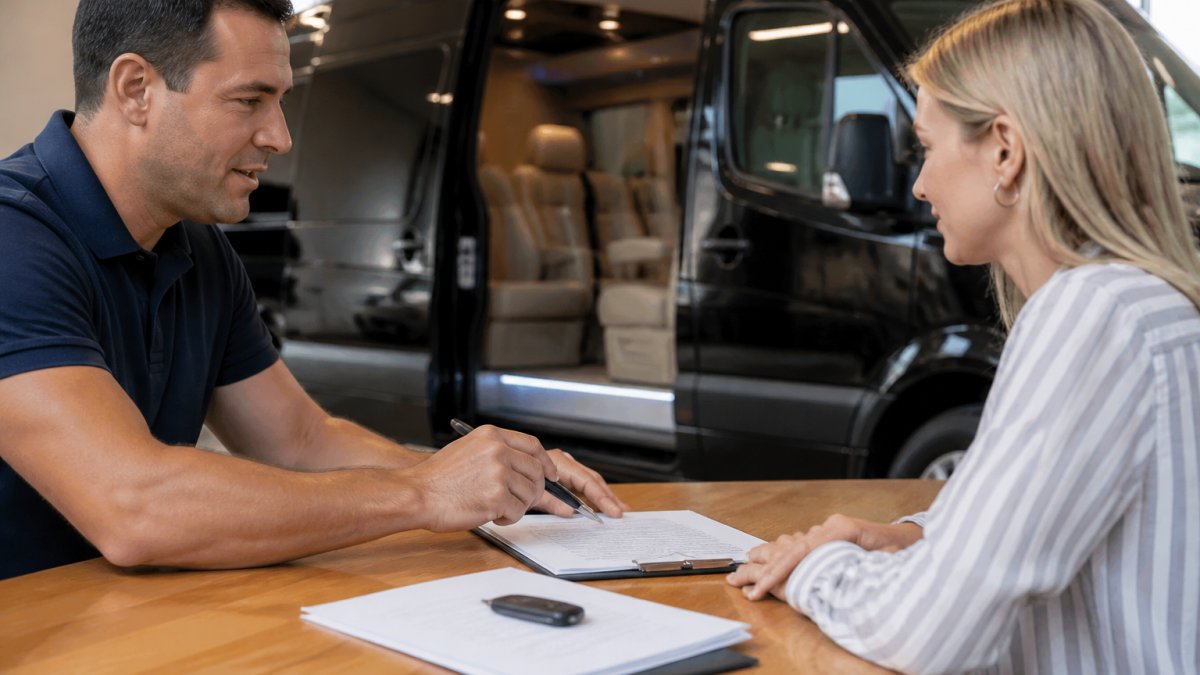
- Many traditional insurers decline custom vehicles; contact specialists in converted vehicles or high-value custom builds and expect an in-person inspection.
Table of Contents
- Understanding Converted Van Insurance Requirements
- Converted Van Insurance vs. Standard Auto Coverage
- Choosing Between Commercial vs. RV Insurance for Converted Vans
- Documenting Your Custom Vehicle for Insurance Purposes
- Securing Agreed-Value Insurance for Custom Vehicles
- Coverage for Custom Parts, Equipment, and Workmanship
- Getting Your Conversion Vehicle Insured and Protected
- Frequently Asked Questions
Understanding Converted Van Insurance Requirements
When you insure custom conversion vehicle coverage, it isn’t like buying insurance for a standard SUV. Your custom-built van sits in a gray area between passenger vehicles and recreational equipment.
The core challenge is classification. A converted van built on a Chevrolet or GMC platform might be classified as a commercial vehicle, a camper van, an RV, or even a motorhome depending on its features and how you use it.
At GOLF Cruiser, we work with owners who’ve invested heavily in their conversions. The vehicles we build are hand-crafted over months, with custom club storage, flexible seating layouts, and premium finishes.
Before you shop for coverage, you need to understand what makes it different to insure custom conversion vehicle policies.
Converted Van Insurance vs. Standard Auto Coverage
Standard auto insurance treats your converted van as a vehicle with a standard interior and basic features. The policy covers the base vehicle value, liability, and physical damage. But it doesn’t cover the custom parts you’ve installed.
A converted van insurance policy, by contrast, accounts for these custom elements. It recognizes that your vehicle’s actual value is much higher than the base platform. It can include coverage for:
- Custom parts and installed equipment
- Professional conversion workmanship
- Personal property stored inside the van
- Specialized components specific to your build
The cost difference between standard auto coverage and proper converted van insurance usually reflects this additional protection. Standard policies are cheaper because they cover less.
Choosing Between Commercial vs. RV Insurance for Converted Vans
Your vehicle’s classification drives everything: which policy forms are available, what limits apply, and what you pay.
Commercial auto insurance. Commercial auto is built for vehicles used in business.
RV and motorhome insurance. RV policies are written for vehicles that function as living quarters.
Specialty conversion vehicle insurance. Specialty programs are written for exactly this gray area. They underwrite the base chassis and the conversion as a single risk, accept agreed value, and are more likely to recognize professional workmanship and custom equipment.
How to decide, in practice:
- Usage test. Personal, non-commercial travel points to RV or specialty. Any business use, hauling for a team, mobile office, demo vehicle, rental, points to commercial, often layered with a specialty physical-damage policy.
- Titling test. Check how the vehicle is titled and registered. A van titled as a passenger vehicle may not be eligible for an RV policy until it is retitled as a motorhome, and some states require specific equipment to retitle.
- Build test. A professionally completed conversion with documented living features fits RV or specialty programs. A partial or DIY conversion is more likely to be declined by RV carriers and pushed toward specialty or commercial.
- Value test. If the build value is well above the base chassis, insist on a policy form that supports agreed value; commercial and standard RV forms often will not.
Do not assume a personal auto policy will follow the vehicle if you later use it for business. Business use is a common exclusion, and a claim denied for business use can leave the entire build uninsured.
A practical approach is to get quotes from at least one commercial carrier and one specialty conversion program, then compare not just premium but the valuation method, custom-equipment limits, and business-use exclusions. The cheapest quote is frequently the one that leaves the conversion unprotected.
The right insurance policy depends on how your vehicle is used, titled, and built.
| Policy Type | Best For | Key Consideration |
|---|---|---|
| Commercial auto | Business use, revenue-generating activity | Higher liability limits; usually actual cash value only |
| RV or motorhome | Personal travel with living features | May exclude custom components not from original coach |
| Specialty conversion | Custom builds with high value | Accepts agreed value; requires build documentation |
Documenting Your Custom Vehicle for Insurance Purposes
Insurers need proof of what you own and what it’s worth. This documentation becomes critical when you file a claim. Without proper records, you’ll struggle to recover the full value of your custom components.
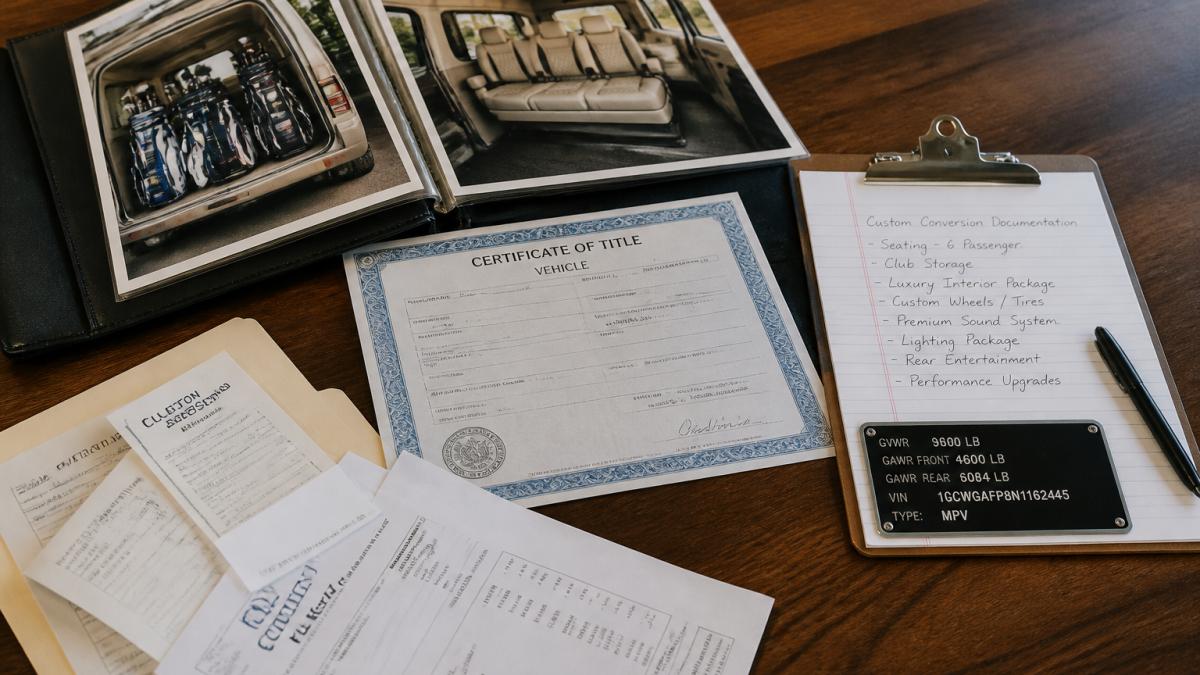
Start by gathering your vehicle’s basic information: the VIN, model year, make, and the original purchase price of the base vehicle. Learn about the luxury custom van build process to understand what documentation your converter should provide. You’ll also need documentation of the conversion work itself. This includes:
- Receipts from the conversion manufacturer showing labor costs and parts installed
- Detailed photos of the completed interior from multiple angles
- A list of all installed equipment with individual values
- Any custom specifications or modifications made during the build process
- The total conversion cost broken down by component
The National Highway Traffic Safety Administration guidelines on vehicle documentation emphasize that detailed records protect your investment. Photographs should show the custom club storage, seating arrangements, cabinetry, appliances, and any specialized features that add value.
If you purchased your vehicle from GOLF Cruiser, we provide documentation of the build specifications and conversion work. Keep these records organized and accessible.
Securing Agreed-Value Insurance for Custom Vehicles
Agreed-value coverage is what protects high-end custom conversions.
This matters because standard insurance policies use “actual cash value,” which depreciates your vehicle annually. A custom conversion vehicle doesn’t depreciate like a standard car.
To establish agreed value, you’ll need to provide evidence supporting your vehicle’s worth:
- The original purchase price of the base vehicle
- Complete itemization of conversion costs
- Receipts for all custom components and labor
- Professional appraisals if your vehicle’s value exceeds standard thresholds
- Photos documenting the finished product
Many specialty insurers will send an adjuster to inspect your vehicle in person before agreeing on a value. This protects both you and the insurer.
Agreed-value policies typically cost more than actual cash value coverage, but for a high-end custom conversion vehicle, the extra cost is worth it. You’re paying for certainty.
Coverage for Custom Parts, Equipment, and Workmanship
A high-end conversion contains three distinct kinds of value, and each is handled differently at claim time: the base chassis, the installed custom parts and equipment, and the professional labor that built them. Most coverage disputes on custom vans come from conflating these three.
The base chassis. The chassis, the Chevrolet or GMC platform, for example, is valued like any vehicle, typically at actual cash value unless the policy provides agreed value. This is usually the smallest part of a high-end build’s value and the easiest to settle.
Installed custom parts and equipment. Cabinetry, club storage, seating, appliances, electrical systems, and finishes are “custom equipment.” How they are covered depends on the policy form:
- Included within the policy limit. Some specialty policies cover custom equipment as part of the overall insured value, with no separate schedule. This is simplest but can leave you underinsured if the limit was set on the base vehicle rather than the completed build.
- Scheduled equipment. High-value items can be listed individually with stated values. Scheduled items are typically paid up to the scheduled amount, which avoids a dispute over depreciation but requires you to keep the schedule current as the build changes.
- Sublimits. Many policies cap custom equipment, personal effects, or awnings and accessories at a fixed dollar amount or percentage of the policy limit. A sublimit that looks generous on a standard van can be far too low for a six-figure build. Ask for the specific dollar figure, not a percentage.
Workmanship and custom labor. This is where high-end builds most often fall short. Standard policies pay to replace damaged parts, not to recreate custom fabrication. If a cabinet or electrical system is damaged, the insurer may pay for a comparable component rather than the original custom work. Some specialty programs address this by agreeing on a value that includes labor, or by allowing repair at a qualified conversion shop. Confirm in writing:
- Whether the agreed value includes conversion labor, or only materials.
- Whether repairs must be performed at a shop of the insurer’s choosing or whether you can use a conversion specialist.
- Whether replacement cost or actual cash value applies to custom components, and how depreciation is calculated on fabricated items.
Common exclusions to check. Wear and tear, mechanical breakdown, and manufacturer defects are typically excluded. Damage from improper installation or from the conversion itself may be excluded. Personal property inside the van is often subject to a low sublimit unless separately scheduled.
For a high-end build, the number that matters is not the total policy limit but the custom-equipment sublimit and whether labor is included in the agreed value. Get both in writing before you bind.
When you are evaluating a policy, ask the insurer to confirm in the declarations or an endorsement: the custom-equipment limit, the personal-effects limit, the valuation method for fabricated components, and the repair-shop requirements. Those four items determine what you actually recover after a loss.
Getting Your Conversion Vehicle Insured and Protected
Finding an insurer willing to cover a custom conversion vehicle requires a different approach than shopping for standard auto insurance.
When you how to plan a bespoke van conversion: 7-step guide, you’re building a vehicle that requires specialized insurance.
Provide your complete documentation upfront. Transparency about your vehicle’s value and construction helps insurers make faster decisions.
Compare quotes carefully, but don’t choose based on price alone. The cheapest policy might exclude crucial components or offer inadequate coverage limits. Look for policies that specifically address:
- Custom parts and equipment coverage
- Agreed-value or replacement-cost protection
- Professional conversion workmanship
- Personal property inside the vehicle
- Coverage that extends to luxury conversion van maintenance costs 2026
Once you secure coverage, maintain detailed records of all maintenance and repairs. Keep receipts organized.
Your custom conversion vehicle represents a significant investment.
Frequently Asked Questions
Does standard auto insurance cover custom van conversions?
No. Standard auto insurance typically excludes or severely limits coverage for custom modifications, installed equipment, and conversion-specific components. A converted van requires specialized coverage that accounts for the vehicle’s unique value, custom interior upgrades, and built-in features like golf storage, cabinetry, and electrical systems. Specialist insurers understand the conversion market and can provide appropriate liability, comprehensive, and collision coverage tailored to your build.
What documentation do insurers need for a custom conversion vehicle?
Insurers require comprehensive documentation including the original vehicle VIN and title, detailed photos of the completed conversion (interior and exterior), receipts and invoices for all conversion work and parts, a list of installed equipment with costs, the conversion manufacturer’s information, and proof of the total investment. For high-end builds, provide a professional valuation or appraisal. This documentation supports underwriting decisions and ensures agreed-value coverage reflects your actual investment.
Should a converted van be insured as a commercial vehicle or an RV?
It depends on how you use and classify the vehicle. If you operate it for business purposes, such as a mobile command center for golf tournaments or team management, commercial vehicle insurance may apply and could offer tax advantages under Section 179. If it’s primarily for personal use and travel, RV or specialty conversion insurance is more appropriate. Discuss your specific use case with a specialist insurer to determine the best classification and coverage structure for your situation.
How should a custom-built vehicle be valued for insurance?
Custom-built vehicles should be valued using agreed-value coverage, which locks in a specific amount at policy inception rather than relying on depreciated market value. Provide your insurer with the original purchase price of the donor vehicle, itemized conversion costs, receipts for all installed equipment and upgrades, and professional photos documenting the build quality and custom features. For high-end builds, consider obtaining an independent appraisal. This approach ensures your policy reflects the true replacement cost if your conversion is damaged or totaled.
Protecting a high-end custom conversion vehicle requires more than a standard auto policy. Work with an insurer who understands specialty vehicles and agreed-value coverage. Contact GOLF Cruiser today to discuss how our hand-built conversion vehicles can be properly insured, and let us connect you with coverage options designed for custom builds.
