
Table of Contents
- 2026 Luxury Van Market Trends: Why Custom Is the New Standard
- The Custom Van Build Process: From Chassis to Delivery
- 48V Electrical Systems and Plug-and-Play Power Integration
- Custom Van Conversion Timeline 2026: What to Expect
- Budgeting Your Luxury Build: Materials, Labor, and Finishes
- Section 179 Tax Deduction for Vehicles: How It Applies
- Resale Value, Insurance, and Post-Build Support
- Final Thoughts on Your 2026 Luxury Van Build
- Frequently Asked Questions
Last Updated: September 7, 2026
The 2026 conversion van market has shifted decisively toward fully bespoke builds. A luxury custom van build process 2026 involves chassis selection, structural modification, 48V electrical architecture, and interior cabinetry, coordinated into one turnkey conversion. GOLF Cruiser has over 45 years of experience hand-building these vehicles on Chevrolet and GMC platforms.
A true custom van build treats the van as raw material. Walls are insulated and paneled, weight distribution is calculated against the chassis rating, and every system is specified before the first tool touches the vehicle.
2026 Luxury Van Market Trends: Why Custom Is the New Standard
Demand for expedition-grade capability has grown, with buyers requesting off-road editions, upgraded HVAC systems, and lithium battery banks that support weeks of independent travel. Buyers now expect the interior craftsmanship found in high-end motor yachts.
Production conversions compete on price; custom builders compete on fit, finish, and the ability to execute a specific vision.
The Custom Van Build Process: From Chassis to Delivery
A custom van build follows a disciplined sequence: consultation to define the layout, chassis preparation, structural work, systems installation, and interior finishing.
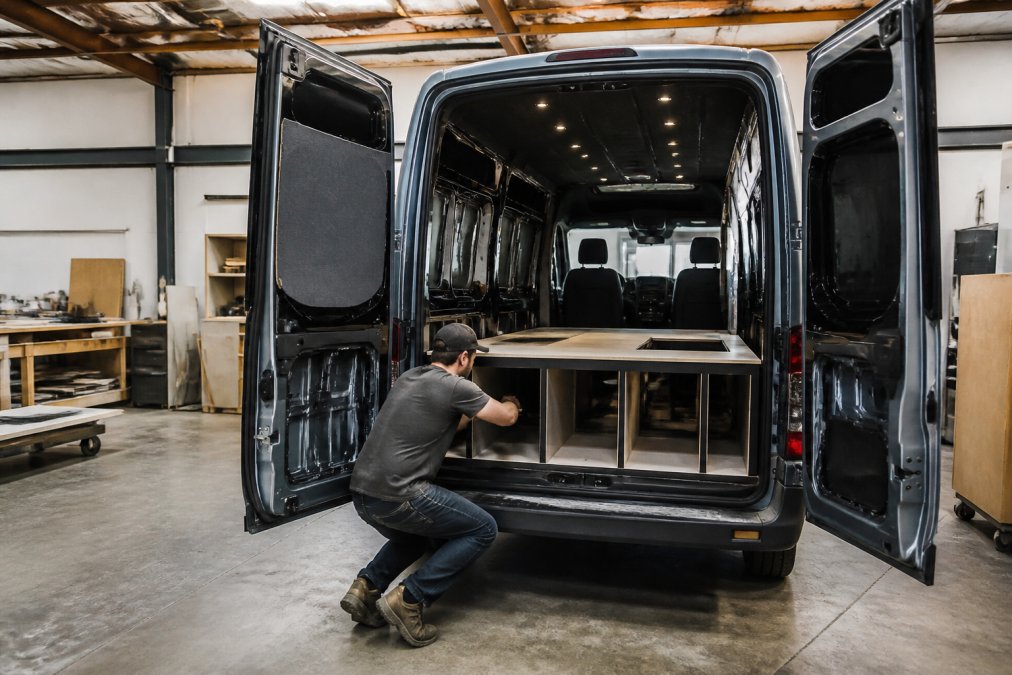
The first decision is the base vehicle, because everything else depends on its dimensions, payload, and drivetrain. The build then proceeds in a logical order: insulation and sound deadening, electrical and plumbing rough-ins, then cabinetry, upholstery, and final trim.
Choosing the Right Base Vehicle: Chevrolet vs. GMC Platforms
Chevrolet and GMC offer essentially the same underlying platform, so the choice comes down to dealer network, trim availability, and aesthetic preference. Both support the GVWR necessary for a full luxury interior without exceeding legal limits.
A common mistake is selecting a base vehicle based on price alone, then discovering the payload is insufficient for a 48V battery bank, water tanks, and hardwood cabinetry. Calculate your expected loaded weight before you commit; this decision affects certification, handling, and resale value more than any other.
Modular Interior Design and Structural Work
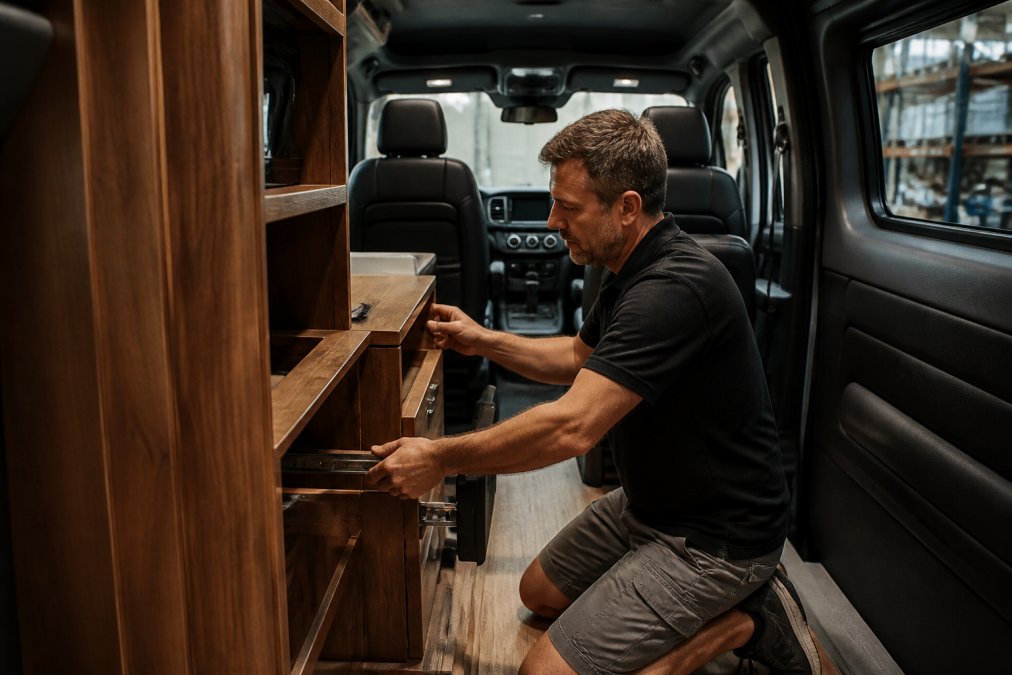
Modern luxury builds favor modular interiors, allowing the layout to adapt over time, whether you need seating for six golfers one month and a two-person expedition setup the next. This requires reinforced floor mounting points and frame-attached cabinetry.
The structural phase installs thermal insulation, sound deadening, and window treatments, and balances weight distribution. Cabinetry is then built to spec, often using lightweight composites and high-end upholstery.
48V Electrical Systems and Plug-and-Play Power Integration
The shift from 12V to 48V is a complete architectural change affecting wiring gauge, inverter selection, battery management, and safety protocols. A 48V system delivers the same power with a quarter of the amperage of a 12V system (energy.gov). For example, a 3,000W inverter drawing 250A at 12V requires thick 4/0 AWG welding cable; the same inverter at 48V draws only 62.5A, allowing for a much more manageable 6 AWG wire.
The primary power source is a lithium iron phosphate (LiFePO4) battery bank, typically configured as a 48V nominal system (51.2V fully charged). Unlike lead-acid, LiFePO4 cells deliver consistent voltage until nearly depleted, which is essential for sensitive electronics. A Battery Management System (BMS) monitors cell voltage, temperature, and state of charge, handles balancing, and links to the display panel for real-time power consumption.
Charging requires a multi-source approach. A dedicated 48V alternator, such as those from Nations or Mean Green, is the most efficient way to charge while driving. For solar, a Maximum Power Point Tracking (MPPT) charge controller, like those from Victron Energy or EPEver, converts raw solar panel voltage into a clean 48V charging profile. The inverter-charger inverts 48V DC to 120V AC for appliances and uses shore power to charge the bank at a high rate.
When reviewing a builder’s electrical specification, ask for the specific model numbers of the BMS, inverter, and charge controllers. A reputable builder will not hesitate to provide these. If they only say “lithium system” or “3,000W inverter,” they are likely using generic components that may not have the same safety certifications or support network as established brands like Victron, Mastervolt, or Xantrex.
The 48V DC circuit must be isolated from the vehicle’s 12V chassis system. Though considered low-voltage, it can cause arcing and fire hazards if not properly fused. Every circuit from the battery bank must have a Class-T or ANL fuse within 7 inches of the battery terminal, and the system should be fully isolated from the steel chassis to prevent galvanic corrosion and electrolysis.
A plug-and-play system, like those from Battle Born or Volta Power Systems, uses pre-terminated cables and standardized connectors, speeding installation and making troubleshooting easier. If a component fails in a remote location, you can often swap it out with a standard tool set rather than requiring a certified electrician.
Custom Van Conversion Timeline 2026: What to Expect
A realistic custom van conversion timeline 2026 spans several distinct phases. The base vehicle order itself can take weeks, depending on factory availability and trim levels. Once the chassis arrives, the build typically proceeds in this order:
- Teardown and prep (1-2 weeks): Stripping the interior, sound deadening, and insulation.
- Structural work (2-4 weeks): Flooring, wall panels, roof modifications, and window installation.
- Systems installation (3-5 weeks): 48V electrical, plumbing, water filtration, and HVAC.
- Interior finishing (3-6 weeks): Cabinetry, upholstery, lighting, and smart home integration.
- Quality control and delivery (1-2 weeks): Full system testing, road testing, and final detailing.
Build lead times vary, but a full luxury conversion rarely completes in under three months and often stretches to six. Custom layouts with unique seating or specialized storage take longer because each component is fabricated to order. Plan your build around your travel season.
| Build Phase | Typical Duration | Key Decisions |
|---|---|---|
| Chassis Order | 2-6 weeks | Trim level, drivetrain, payload |
| Teardown and Prep | 1-2 weeks | Insulation type, sound deadening |
| Structural Work | 2-4 weeks | Window layout, roof modifications |
| Systems Installation | 3-5 weeks | 48V bank size, solar capacity |
| Interior Finishing | 3-6 weeks | Cabinetry, upholstery, layout |
| QC and Delivery | 1-2 weeks | System testing, detailing |
Budgeting Your Luxury Build: Materials, Labor, and Finishes
Budgeting requires separating the cost of the base vehicle from the conversion itself. Materials drive a significant portion: hardwood cabinetry, high-end upholstery, and premium appliances cost multiples of their standard counterparts. Labor is the other major factor, as handcrafted work takes more hours than production assembly.
Define your must-have systems first, then allocate remaining budget to finishes. Electrical and HVAC upgrades are expensive to retrofit later, so prioritize them upfront. Aesthetic choices can be adjusted more easily, but structural decisions cannot.
Do not let a builder quote you a flat price without a detailed specification sheet. If the contract does not list every appliance, every electrical component, and the exact grade of upholstery, you will face change orders later. These add-ons are where budgets collapse.
Regarding the IRS guidelines on vehicle deductions, a custom van may qualify for tax advantages if used for business purposes. The rules governing heavy vehicle deductions are specific, and eligibility depends on gross vehicle weight and actual business use. Consult a tax professional before assuming your build qualifies.
Section 179 Tax Deduction for Vehicles: How It Applies
The Section 179 tax deduction for vehicles allows businesses to deduct the cost of qualifying equipment in the year it is placed in service. For a van used in your business, this can mean deducting a substantial portion of the purchase price in the first year, provided the vehicle meets weight and usage requirements.
The key distinction is between passenger automobiles and heavier vehicles. The IRS sets different deduction limits based on gross vehicle weight rating, and vehicles above a certain threshold are treated more favorably under the IRS Section 179 rules. A van that exceeds the passenger vehicle weight limit may qualify for the full Section 179 deduction, while lighter vehicles face annual caps.
The vehicle must be used more than 50% for business, and you must have taxable income to offset. Golf course owners, coaches, and tournament organizers often qualify, but the documentation must be clean. Track mileage, maintain a usage log, and have your accountant review the classification before you commit.
Resale Value, Insurance, and Post-Build Support
The financial and legal life of a custom van extends far beyond the final invoice. Decisions about classification, insurance, and maintenance will determine whether your investment appreciates or becomes a liability.
The Legal Classification Trap: RV vs. Van
The most impactful legal decision is vehicle classification. A van with a GVWR under 10,000 lbs is typically titled as a passenger or cargo van, not as an RV. To be legally classified as an RV in most states, the vehicle must have permanent sleeping, cooking, and bathroom facilities. If your build lacks a permanent toilet and shower, it will be registered as a van, subjecting it to different (often higher) insurance rates and restricted overnight parking.
Insurance: Agreed Value vs. Stated Value
Standard auto insurance policies use Actual Cash Value (ACV), which depreciates your vehicle from the moment you drive it off the lot. For a custom build where the conversion cost often exceeds the base vehicle price, ACV is a disaster: if totaled, the insurer pays the depreciated value of the base chassis, not the custom interior.
The correct approach is an Agreed Value policy, which requires a professional appraisal documenting the full replacement cost. The insurer and you agree on this value upfront, and in a total loss you are paid that exact amount with no depreciation. Companies like Hagerty, Grundy, and American Modern specialize in these policies. Expect to pay a premium of 10-20% over a standard policy. A stated value policy is weaker; it caps the payout but still allows depreciation.
Before you sign an insurance policy, ask the agent to confirm in writing that the policy covers the full agreed value of the conversion, including the 48V electrical system, custom cabinetry, and any permanent appliances. A verbal assurance is not binding. If the insurer does not understand the difference between a conversion and a factory RV, find another insurer.
Resale Value: The Documentation Premium
The resale market for custom vans is thin but discerning. Buyers pay a premium for a well-documented build because it reduces their risk. A complete build file should include:
- Wiring schematics for the 48V system, showing every circuit and fuse.
- Component warranties for the battery bank, inverter, and solar panels.
- Weight certificates showing the final loaded weight and axle weights.
- Service records for both the base chassis and the conversion systems.
A van with this documentation can command a 10-15% higher resale price than an identical build without it. A van with no documentation is a red flag; buyers will assume the electrical system was installed incorrectly.
Post-Build Support: The 48V Service Gap
The most common failure point in a custom van is the electrical system. A standard automotive mechanic cannot diagnose a 48V system, lacking the training and tools for LiFePO4 battery management systems or MPPT charge controllers. This creates a service gap for owners who travel far from their builder’s home base.
Before finalizing your build, ask the builder for a list of certified service centers in the regions you plan to travel. Some builders offer remote diagnostics, connecting to your van’s BMS via a cellular modem to troubleshoot over the phone. Also confirm the builder stocks spare parts; a warranty is only useful if they can ship a replacement inverter or BMS within days, not weeks.
The true cost of a luxury custom van is not the build price; it is the cost of ownership. A van that is legally misclassified, underinsured, or undocumented will lose value quickly and become a financial burden. A van that is properly classified, insured for agreed value, and backed by a builder with a real service network will hold its value and provide years of reliable service.
For owners who plan to keep their van for a decade or more, set aside a maintenance fund equal to 1-2% of the build cost per year. This covers the eventual replacement of the lithium battery bank (typically 8-10 years), inverter servicing, and upholstery reconditioning.
Final Thoughts on Your 2026 Luxury Van Build
The decision to commission a luxury custom van build process 2026 is an investment in how you travel, compete, and spend time with the people who matter. The process demands patience, a clear vision, and an experienced builder, but the result is a vehicle that serves you for years.
For golfers seeking a purpose-built solution, GOLF Cruiser delivers hand-built luxury vans crafted by American experts with over 45 years of experience. Built on reliable Chevrolet and GMC platforms, these vehicles function as mobile clubhouses and tournament command centers, offering custom club storage and flexible layouts for families, golf buddies, or full teams. With more interior space than an SUV and easier maneuverability than an RV, a GOLF Cruiser is the sophisticated alternative for arriving at the course in style.
Frequently Asked Questions
How long does a luxury custom van build take in 2026?
A full custom van conversion timeline in 2026 typically spans 12 to 20 weeks, depending on complexity. Base vehicle availability, custom cabinetry work, and 48V electrical system integration are the main factors. A standard layout with premium finishes may take closer to 12 weeks, while a fully bespoke design with expedition features or advanced HVAC systems can push lead times toward 5 months. Always confirm the builder’s current queue, as demand for handcrafted conversions continues to stretch schedules.
How does the Section 179 tax deduction for vehicles apply to a custom van?
The Section 179 tax deduction for vehicles allows business owners to deduct the full purchase price of qualifying equipment, including a van used more than 50% for business. A custom van with a GVWR over 6,000 lbs often qualifies for the full deduction, up to annual IRS limits. Your van must be placed in service during the tax year. Work with a CPA to confirm your business use percentage and keep mileage logs to substantiate the deduction.
What base vehicle is best for a luxury custom van build?
For a 2026 luxury build, the choice is usually between Chevrolet and GMC platforms, both offering robust chassis selection and strong payload capacity. The decision comes down to dealer network preference and specific safety tech packages. GOLF Cruiser, with over 45 years of experience, will guide you on weight distribution and thermal insulation needs. Avoid choosing a chassis before discussing your layout, since heavy features like lithium battery banks affect rear axle weight limits.
What makes a 48V electrical system better than standard 12V for vanlife?
A 48V electrical system delivers more power with thinner wiring, reducing weight and improving safety. It charges a lithium battery bank faster, especially with solar integration, and supports high-draw appliances like induction cooking and HVAC systems. Plug-and-play 48V components also simplify future upgrades. While 12V systems remain common, 2026 luxury builds favor 48V for its efficiency and ability to run a full mobile command center without generator noise.
How do I protect my investment after the custom van conversion is complete?
Protecting a six-figure custom van build starts with proper insurance. Standard auto policies often undervalue conversion work, so you need a policy that covers the full agreed value, including custom interior cabinetry and electrical systems. Document the build with photos and receipts. Regular maintenance on the base vehicle and the house systems, such as battery checks and water filtration filter changes, prevents costly repairs. Ask your builder about post-build support and warranty terms before delivery.
Planning a 2026 build means balancing timeline, budget, and the details that make a van feel like yours. The GOLF Cruiser team handles the entire custom van build, from chassis selection to final interior cabinetry, with the craftsmanship that comes from over four decades of full-size vehicle conversions. Contact us today to discuss your custom layout and begin your build.