
Last Updated: October 26, 2026
Quick Summary
To pack golf clubs for travel, empty the bag of loose items, wrap every club head in a towel, sock, or padded cover, and slide a stiff arm or support rod down the middle to support the shafts. Fill gaps with rolled clothing, pack shoes separately, and use a TSA-approved lock on a hard case or sturdy travel bag.
- Club heads take the hardest hits, so wrap them or cover them before packing.
- Hard cases weigh 10-15 lb, while soft travel bags weigh 4-8 lb.
- Most carriers cap golf bags at 50 pounds, and overweight bags cost more.
- Photograph the packed bag and each club before you fly and keep the baggage claim tag.
- File a damage report at the airport before you leave and keep copies of everything.
Table of Contents
- How to Protect Golf Clubs When Traveling: The Basics
- How to Pack Golf Clubs in a Travel Bag, Step by Step
- Hard Case vs Soft Golf Travel Bag: Which Protects Better?
- Flying With Golf Clubs: Airline Fees and Baggage Rules
- Packing for Different Golf Trips: Resorts, Tournaments, and Road Travel
- Final Packing Checklist and Damage Claim Documentation
- Loading Your Gear for the Drive: What to Look For in a Golf Travel Vehicle
- Frequently Asked Questions
How to Protect Golf Clubs When Traveling: The Basics
According to the TSA guidelines for traveling with sports equipment, your clubs must ride in a hard-sided case or a sturdy travel bag with proper padding. That single rule explains most damage claims. At GOLF Cruiser, we’ve spent decades building vehicles around gear that has to arrive in one piece, and the principles are the same whether your clubs fly or ride in a van.
Club protection comes down to three jobs: stop movement, cushion impact, and keep weight off the shafts.
Here is what matters most:
- Club heads take the hardest hits. Wrap them or cover them.
- Shafts bend and snap when bags get thrown flat. Support them.
- Loose items become projectiles. Remove them before packing.
- The bag itself needs a stiff frame or a hard shell.
How to Pack Golf Clubs in a Travel Bag, Step by Step
The sequence matters more than the products you buy.
Step 1: Prep the Bag and Remove Loose Items
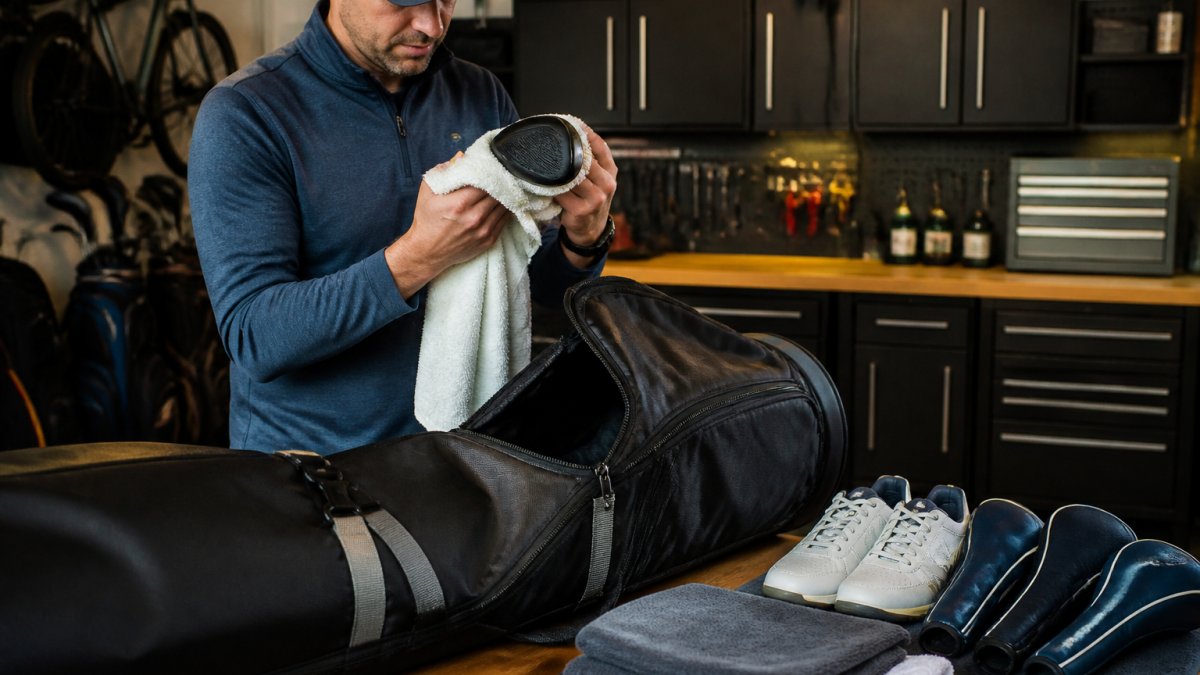
Start with an empty bag. Pull out balls, tees, rangefinders, gloves, and snacks. Every loose item becomes a missile in transit.
Check the pockets for a GPS device or phone you don’t want crushed. Remove valuables entirely and carry them with you.
Inspect the bag’s dividers and zippers. See the benefits of custom golf club storage for how a dedicated setup protects your gear and cuts down on loose-item damage.
Step 2: Wrap Heads, Pad Shafts, and Stop the Rattle
Club heads are heavy, and they swing on the end of long shafts.
Wrap each head in a golf towel, a sock, or a head cover with real padding. Iron covers help here too.
Then support the shafts. Group clubs tightly so they can’t flex, and slide a stiff arm or a rigid support rod down the middle of the bag. That rod takes the compression when the bag lands on its end.
Step 3: Pack Shoes, Clothing, and Accessories
Golf shoes go in a separate shoe bag, soles facing away from club heads. Stuff socks and soft clothing into gaps to soak up vibration.
Roll clothing rather than folding it. Rolled clothes fill dead space and add another layer of padding around the bag’s edges.
Keep the total weight reasonable.
For a fuller gear checklist, see our packing guide for golf road trips to make sure nothing gets left behind.
Hard Case vs Soft Golf Travel Bag: Which Protects Better?
Here is how the two compare on the factors that actually decide the purchase:
| Feature | Hard Case | Soft Travel Bag |
|---|---|---|
| Impact protection | Excellent; shell absorbs and spreads force | Good only with padding and a stiff arm |
| Empty weight | 10-15 lb | 4-8 lb |
| Storage at home | Bulky; needs floor or rack space | Folds flat; fits on a shelf |
| Storage at destination | Takes up hotel room or trunk space | Folds into a corner |
| Price range | Higher | Lower |
| Packing effort | Minimal; shell does the work | High; you build the structure |
| Rental car fit | Tight in small trunks | Easy |
| Best for | Frequent flyers with expensive clubs | Drivers and occasional flyers |
Flying With Golf Clubs: Airline Fees and Baggage Rules
The rules are not uniform, so verify the applicable baggage rules with your specific airline before you book.
Next, understand the fee structure. Airlines handle golf bags in one of two ways. Some count the golf bag as one standard checked bag and charge the normal first- or second-bag fee. Others classify it as a sporting-goods item and charge a flat special-item fee, which may be higher or lower than the standard bag fee depending on the carrier and route. Fare class matters too: a basic-economy ticket may not include a checked bag at all, so the golf bag fee stacks on top of a bag fee you didn’t expect. The U.S. Department of Transportation airline baggage rules require carriers to publish their fees and liability limits clearly, so the airline’s own baggage page is the authoritative source.
Liability is the third number. When an airline damages or loses a checked bag, its liability is capped by federal rules, and that cap may not cover the full replacement cost of a set of clubs. The practical response is documentation: photograph the packed bag, the clubs inside, and the closed case before you fly, and keep the baggage claim tag. If a club arrives broken, file a damage report at the airport before you leave and keep copies of everything. The DOT guide to resolving baggage problems explains the claim process and your rights.
A few rules apply almost everywhere:
- Clubs must be in a travel case or bag designed for them.
- Most carriers cap golf bags at 50 pounds; overweight bags cost more.
- Some airlines count the golf bag as one checked bag; others charge a flat sporting-goods fee.
- Liability for damaged or lost bags is capped, so document everything.
Don’t lock a soft bag with a lock the TSA can’t open. Security may cut it off during screening. Use a TSA-approved lock instead, and keep the key or combination with you rather than in the bag.
Before you fly, check your airline’s baggage information.
Packing for Different Golf Trips: Resorts, Tournaments, and Road Travel
For teams traveling together, a van with dedicated club storage keeps every bag secure and organized between rounds. If you’re mapping out a road-trip outing, our guide to planning a luxury golf road trip covers the whole itinerary, not just the bag.
Final Packing Checklist and Damage Claim Documentation
Run this checklist before every trip:
- Empty all pockets and remove loose items
- Wrap every club head in a towel, sock, or padded cover
- Fit iron covers on forged irons
- Slide a stiff arm or support rod into the bag
- Pack shoes in a separate bag
- Fill gaps with rolled clothing
- Weigh the bag against your airline’s limit
- Use a TSA-approved lock
- Photograph the packed bag and each club
- Keep your baggage claim tag
File a damage report at the airport before you leave, and keep copies of everything. The DOT guide to resolving baggage problems explains your rights and the claim process.
Loading Your Gear for the Drive: What to Look For in a Golf Travel Vehicle
Look for these features:
- Vertical club storage so bags stand upright and shafts stay straight
- Secure tie-downs to stop bags sliding on turns
- Easy load height for anyone with back or mobility issues
- Separate gear zones for shoes, coolers, and luggage
Our hand-built luxury vans, crafted by American experts with over 45 years of experience, offer custom club storage and flexible layouts for families, golf buddies, or full teams.
When you’re ready to browse, see our lineup of custom vans for golf trips.
Frequently Asked Questions
How much does it cost to take golf clubs on an airplane?
Check your specific airline’s baggage policy before booking.
Should you use a hard case or a soft travel bag for golf clubs?
A hard case offers the most impact protection and is the safer choice for frequent flyers or expensive clubs. Soft bags are lighter, easier to store, and often fit into rental cars more easily, but they need extra padding and a stiff arm to prevent club heads from being crushed. If you fly several times a year, a hard case is generally worth the investment; for occasional road trips, a well-padded soft bag works fine.
Should you remove the heads from your golf clubs before flying?
If your driver or fairway woods have adjustable, removable heads, unscrewing them and packing the heads separately in your carry-on or a padded pocket reduces the chance of the shaft snapping at the hosel. Keep the screws and wrench in a labeled bag. For fixed-head clubs, wrap the heads in towels or head covers and pack them low in the bag so they do not bear weight.
Can you bring golf balls and golf shoes in your golf travel bag?
Yes. Golf balls, shoes, gloves, and clothing can all go inside your golf travel bag, and using them as padding around club heads is a smart way to save space. Place shoes at the bottom or around the perimeter, and tuck socks or shirts between irons to stop rattling. Just keep the total weight under your airline’s limit, usually 50 pounds, to avoid overweight fees.
Your clubs cost real money, and a cracked driver head or a bent shaft can wreck a trip before it starts. GOLF Cruiser builds vehicles that protect your gear and make loading simple, with custom club storage, flexible layouts for full teams, and a cabin designed around golfers. Get started with GOLF Cruiser and arrive at the course with your clubs exactly as you packed them.
