
Table of Contents
- What You’ll Need Before You Pack
- Step 1: Pick the Right Golf Travel Bag for Air Travel
- Step 2: Prep Your Clubs for the Trip
- Step 3: Pack Your Bag for Balance and Shock Absorption
- Step 4: Fly Smart With Airline Policies and Tracking
- Step 5: Protecting Golf Clubs in a Vehicle
- Step 6: Choose the Best Custom Vans for Golf Trips
- Common Mistakes to Avoid
- Frequently Asked Questions
Last Updated: September 16, 2026
What You’ll Need Before You Pack
When you transport golf clubs safely, it starts with the right gear, most damage happens because clubs go into a bag never built for airline handling. This guide covers how to transport golf clubs safely by air, by vehicle, and by shipping service.
Before you pack anything, gather these essentials:
- A hard-shell travel case or a well-padded soft-sided bag with a stiff arm
- Club headcovers and a stiff arm rod
- Towels or foam padding for the club heads and shafts
- A luggage tracking device
- A small roll of tape for securing loose items
Step 1: Pick the Right Golf Travel Bag for Air Travel
The best golf travel bags for air travel balance protection, weight, and portability: hard-shell wins on impact resistance, soft-sided on flexibility.
Hard-Shell vs. Soft-Sided: Which Protects Better
Hard-shell cases protect better against crushing and impact; soft-sided bags handle vibration and fit tighter spaces. Choose hard-shell if you fly often, soft-sided if you need a lighter bag.
| Feature | Hard-Shell Case | Soft-Sided Bag |
|---|---|---|
| Impact protection | High | Moderate |
| Weight | Heavier | Lighter |
| Storage between trips | Bulky | Folds flat |
| Best for | Frequent flyers | Occasional travelers |
Step 2: Prep Your Clubs for the Trip
Club preparation is where most damage originates. Remove adjustable driver and fairway wood heads before packing, two minutes with the wrench eliminates the most vulnerable point.
Remove Heads, Add Stiff Arms, Cushion the Shafts
A stiff arm is a telescoping rod that runs the length of the bag and holds the top open under pressure. Place it above the club heads so luggage weight transfers to the rod, not your shafts.
Photograph your packed bag before you close it. If a club goes missing or arrives bent, that photo speeds up the airline damage claim and gives you a record of how everything was arranged.
Step 3: Pack Your Bag for Balance and Shock Absorption
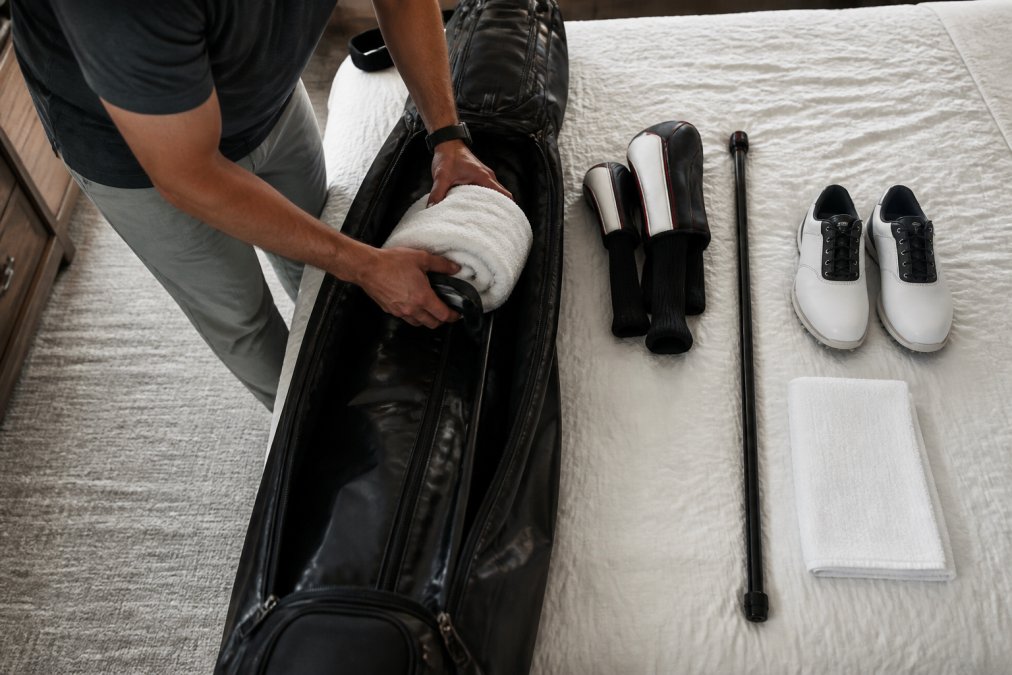
Balance and cushioning decide whether your bag survives a rough baggage handler. Distribute weight so the bag sits flat and pad wherever clubs touch the case.
Step 4: Fly Smart With Airline Policies and Tracking
Airline policy for golf clubs is not uniform, but the mechanics are predictable. Almost every domestic carrier classifies a golf travel bag as a single checked item and prices it as oversized because its length exceeds the standard 62-linear-inch limit (length + width + height). A golf bag typically measures 50 to 54 inches, so it clears the linear rule but still triggers the oversized fee.
What the Rules Actually Say
The TSA guidance on traveling with sporting equipment confirms golf clubs must travel as checked baggage and cannot go through a checkpoint as a carry-on. That means your clubs are subject to checked-baggage liability rules, not carry-on rules. Under the Montreal Convention, which governs most international itineraries involving the United States, carrier liability for checked baggage is capped at roughly 1,288 Special Drawing Rights per passenger, a figure that fluctuates with exchange rates and is well below the replacement cost of a full premium set.
Lithium Batteries and Electric Carts
This is the rule most guides skip, and it gets golfers turned away at the counter. If you travel with an electric trolley or battery-powered rangefinder, the battery is regulated as a hazardous material. Under FAA rules, lithium-ion batteries installed in a device are generally permitted in checked baggage only if the device is powered off and protected against accidental activation.
Tracking and Claim Mechanics
A Bluetooth tracker inside the bag tells you whether it made the flight and where it stopped if it did not. Put it in an interior pocket so it does not get separated. When you file a claim, the airline will ask for the bag tag number, your boarding pass, and a damage description, keep all three.
Never pack loose lithium batteries, aerosol sunscreen, or valuables in your golf bag. TSA inspection may open the bag, and prohibited items trigger delays or confiscation at the checkpoint. Spare lithium batteries belong in your carry-on, not your golf bag.
The Rental-vs-Transport Math
Before you commit to flying with your clubs, run the numbers. A round-trip oversized baggage fee on a domestic carrier commonly runs $75 to $150 each way, so $150 to $300 round trip, plus a rental car large enough to hold the bag. Rental clubs at a destination course typically run $40 to $75 per round.
Weigh your packed bag at home, photograph the contents, and screenshot your carrier’s oversized baggage fee page before you fly. If a fee is charged incorrectly at the counter, that screenshot is your evidence for a refund.
Step 5: Protecting Golf Clubs in a Vehicle
Protecting golf clubs in a vehicle is a different problem from protecting them on a plane. There is no baggage handler or oversized fee, but there is heat, UV, humidity, and the slow grind of vibration over a long drive. Most car damage happens over weeks, not minutes.
Heat Is the Real Threat
The interior of a closed vehicle parked in direct sun can reach 130 to 170 degrees Fahrenheit within an hour. That matters because the adhesives holding grips and club heads are heat-sensitive: a grip at 150 degrees for hours can loosen at the tape layer, and a club head epoxied to a graphite shaft can shift if the epoxy softens.
Secure the Bag So It Cannot Move
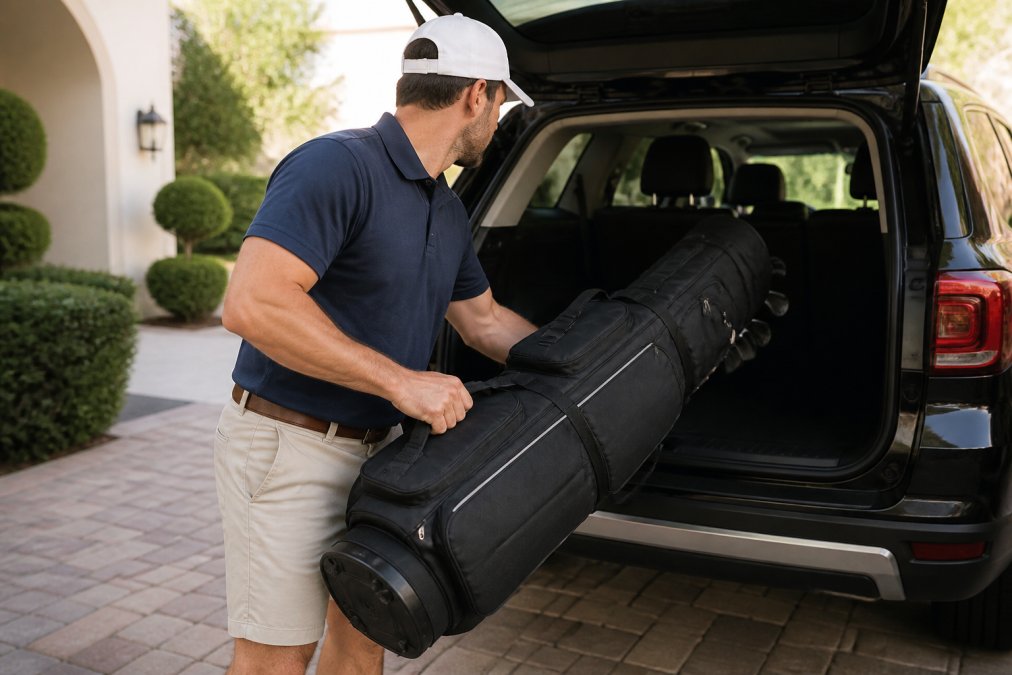
Lay the bag flat rather than standing it upright, a standing bag tips on turns and the club heads take the impact. Lay it along the trunk or cargo area floor and wedge it with a cooler, duffel, or cargo block so it cannot slide. If you carry multiple bags, separate them with a towel so the club heads do not knock together.
DIY Protection That Costs Almost Nothing
You do not need a $300 hard case to protect clubs in a car. A length of PVC pipe cut to the length of your longest club, capped at both ends, and dropped into the bag alongside the shafts absorbs impact and prevents bending. A pool noodle slit lengthwise over the top of the irons does the same job for a fraction of the cost, and a rolled towel taped around the club heads adds cushioning at the most vulnerable point.
If you use a PVC pipe stiffener, cut it one inch shorter than your longest club so it does not poke through the top of the bag, and cap both ends so it does not scratch the shafts.
Long-Term Storage Between Trips
If your clubs sit in a garage or vehicle for months between rounds, treat storage as part of transport. Clean and dry the grips first, because moisture trapped under a grip causes the tape to fail. Store the bag upright in a climate-controlled space, and loosen the straps so the bag does not take a permanent set.
When a Vehicle Is the Wrong Answer
If you are moving clubs across the country, driving is not always the safest or cheapest option. Shipping through a carrier that specializes in golf equipment often costs less than the fuel and hotel nights of a long drive, and it removes the heat and vibration exposure entirely. The trade-off is giving up control of the bag for several days and taking on the same carrier liability limits as checked airline baggage.
The car is the safest place for your clubs when you control the temperature and secure the bag. The danger is not the drive, it is the parking lot.
Step 6: Choose the Best Custom Vans for Golf Trips
The best custom vans for golf trips solve the transport problem at the source. Instead of wrestling bags into a trunk or strapping them to a roof rack, a purpose-built van keeps clubs secure, upright, and easy to load.
Common Mistakes to Avoid
The most common mistake is treating a golf bag like ordinary luggage. Clubs are long, top-heavy, and fragile at the hosel, and standard checked luggage handling wasn’t designed for them.
Other mistakes that cost golfers their equipment:
- Skipping the stiff arm because the bag “feels sturdy enough”
- Leaving adjustable heads on the shafts
- Packing the bag loose so clubs shift in transit
- Ignoring the airline weight limit and paying a higher oversized fee
- Storing clubs in a hot vehicle between rounds
Frequently Asked Questions
What is the best way to protect golf clubs during travel?
Start with a travel bag that matches your trip: a hard-shell case for checked flights, a padded soft-sided bag for vehicle travel. Remove adjustable club heads, thread a stiff arm or club protector rod down the middle, wrap heads in towels or club headcovers, and pack shoes and apparel around the perimeter to absorb shock. If you transport golf clubs by air, add a tracking device inside the bag so you can monitor it through baggage claim.
Should I remove the driver head before flying with golf clubs?
Yes. Most modern drivers have adjustable hosels, and the connection point is the weakest part of the club. Unscrew the head, store it in your carry-on or a padded pocket inside the travel bag, and place the headcover back over the shaft tip. This single step prevents the most common and most expensive damage claim on golf travel bags for air travel.
Do I need a hard-shell or soft-shell golf travel bag?
Hard-shell cases win on checked flights because the rigid shell resists crushing and the “upside down” tosses that happen during luggage handling. Soft-sided bags are lighter, easier to fold into a vehicle, and fine for road trips where you control how the bag is loaded. Many frequent flyers keep both: a hard case for air travel and a soft-sided bag for driving to regional tournaments.
How do I secure golf clubs in a custom luxury van?
Look for a van with a dedicated club storage bay or locking vertical rack rather than tossing bags loose in the cargo area. Strap bags to anchor points so they cannot slide during turns, keep headcovers on to prevent metal-on-metal contact, and store shoes and rangefinders in separate compartments. Purpose-built layouts, like those in GOLF Cruiser vans, keep equipment secure and double as a mobile base for strategy talks before a round.
Transporting golf clubs safely takes the right case, proper prep, and a vehicle that treats your equipment like it matters. GOLF Cruiser builds hand-built luxury vans with custom club storage, flexible layouts for teams and families, and the maneuverability of a standard van rather than an RV. If you’re tired of wrestling bags through airports and rental car lots, a purpose-built golf van changes the entire trip. Contact GOLF Cruiser today to design a van around how you actually travel.