
Table of Contents
- Why a Luxury Golf Van Beats an SUV for Business Travel
- Section 179 Tax Deduction for Business Vehicles: What Owners Need to Know
- Custom Golf Van Pricing and Features: What Drives the Investment
- Mobile Office and Connectivity: Turning Travel Time Into Work Time
- Comfort, Seating, and Ergonomics for Long-Distance Golf Trips
- Maintenance, Insurance, and Resale: The Long-Term Ownership Picture
- Conclusion: Is a Luxury Golf Van Right for Your Business?
- Frequently Asked Questions
Last Updated: September 21, 2026
Why a Luxury Golf Van Beats an SUV for Business Travel
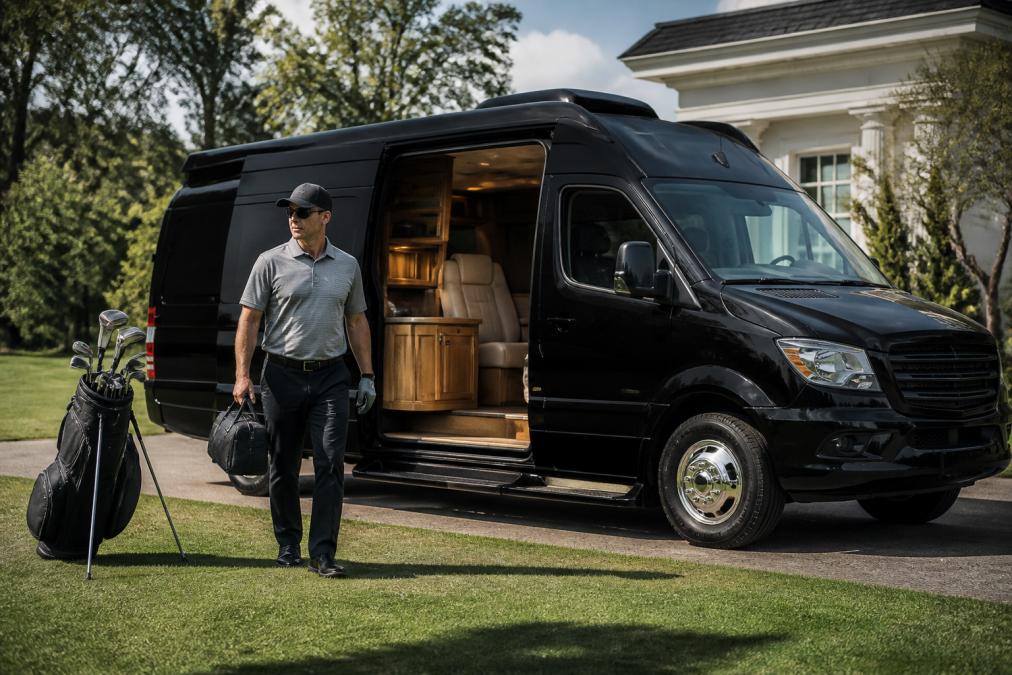
A luxury golf van combines premium passenger comfort with dedicated equipment storage, mobile workspace capability, and commercial vehicle tax advantages. For business owners who travel frequently to tournaments and client outings, it solves problems an SUV cannot.
Three practical advantages stand out:
- Gear security: Lockable, purpose-built club storage keeps equipment protected and organized. No more bags sliding around the cargo area.
- Passenger capacity: Flexible seating lets you configure for four golfers with full gear or up to seven passengers for client entertainment.
- Maneuverability: A van drives and parks more easily than an RV while offering significantly more interior space than a standard SUV.
Section 179 Tax Deduction for Business Vehicles: What Owners Need to Know
Section 179 of the Internal Revenue Code lets businesses deduct the full purchase price of qualifying vehicles in the year they are placed in service rather than depreciating it over several years, substantially reducing the effective cost of ownership for a vehicle that also serves as a mobile office and client entertainment asset.
Qualifying Your Golf Van for the Deduction
Not every vehicle qualifies; the IRS sets specific weight and use requirements.
Working With Your Accountant
Bring your accountant in before you buy, not after. They can confirm whether your configuration qualifies, how the deduction interacts with your tax situation, and whether bonus depreciation adds benefit.
Do not assume a vehicle qualifies simply because it is large. The GVWR must exceed the threshold, and business use must be documented. Buying first and asking your accountant later can cost you the deduction entirely.
Custom Golf Van Pricing and Features: What Drives the Investment
Custom golf van pricing depends on the base platform, interior layout complexity, materials, and technology integrations. There is no single sticker price because every build is configured to the buyer’s requirements, and for a business owner evaluating the purchase as a capital asset, what matters is total cost of ownership across the years you keep the vehicle.
Core Features That Matter for Golf Travel
The features that justify the investment are the ones you use every trip:
| Feature Category | What It Does | Why It Matters |
|---|---|---|
| Club storage system | Dedicated, lockable compartments sized for full bags | Protects equipment, eliminates loading frustration |
| Flexible seating | Captain’s chairs, benches, or removable configurations | Adapts from four golfers to seven business passengers |
| Mobile office setup | Fold-out desk, power outlets, connectivity suite | Converts travel hours into productive work time |
| Climate control | Rear-zone on-board climate control | Keeps passengers and equipment comfortable in any weather |
| Premium upholstery | High-end leather or performance fabric | Durability plus the executive feel clients expect |
How Customization Affects Cost
Every customization decision compounds. A standard layout with core golf features costs less than a fully bespoke interior with custom cabinetry, entertainment systems, and branded finishes. The variables that move price most:
- Base platform selection: Chevrolet and GMC configurations vary in cost, and the base chassis is typically the single largest line item in any build.
- Interior materials: High-end upholstery and custom trim add cost but improve resale.
- Technology packages: Connectivity suites, entertainment systems, and power management.
- Layout complexity: Custom storage solutions and seating arrangements require more fabrication time, and fabrication labor, not parts, is often the largest swing factor in a bespoke build.
Total Cost of Ownership: The Numbers Business Owners Actually Need
Purchase price is the entry point, not the cost. A useful TCO model for a luxury golf van has five components:
- Acquisition cost, base platform plus conversion, plus any state sales tax and registration fees.
- Financing cost, interest over the loan term. Many owners finance through a commercial vehicle lender rather than a personal auto loan, because the vehicle is titled to the business.
- Insurance, commercial coverage typically runs higher than a personal auto policy on a comparable vehicle because liability exposure is greater. Get a quote before committing to a build.
- Maintenance and repairs, Chevrolet and GMC base platforms have broad service networks, keeping mechanical maintenance predictable. The conversion side differs: interior systems, power management, and custom components may need manufacturer-specific support with longer lead times.
- Resale or residual value, what the van is worth when you sell or trade it. This is the line most buyers ignore, and it is the one that most changes the true cost of ownership.
Depreciating Asset or Business Investment?
A custom van is not a pure depreciating asset the way a standard passenger car is. Two forces work in your favor:
- Build quality holds value. A well-documented, well-maintained conversion with a popular layout attracts motivated buyers in the golf-travel niche. Niche demand is thinner than the mass market, but the buyers who exist are willing to pay for a van that already fits their use case.
- Tax treatment changes the effective cost. If the vehicle qualifies under Section 179, the deduction reduces the after-tax cost of acquisition in the year it is placed in service, which is a different economic picture than depreciating the full price over several years.
Mobile Office and Connectivity: Turning Travel Time Into Work Time
A mobile office setup transforms a four-hour drive to a tournament into four hours of productive work, the operational argument for connectivity features, and one business owners consistently undervalue before they own one. But a genuine mobile office is not a USB port and a folding tray; it is a system, and the parts have to work together.
What a Functional Mobile Office Actually Requires
- Reliable internet: A cellular hotspot or dedicated mobile router keeps you connected. For a team van, a multi-carrier router with automatic failover is the difference between a working call and a dropped one.
- Power access: Multiple AC outlets and USB-C ports at each seating position. Laptops, phones, tablets, and a router all draw at once; a single 12-volt socket will not carry the load.
- Workspace surface: A fold-out desk or table for a laptop and documents, stable at highway speed, anchored to the vehicle structure, not cantilevered off a seat back.
- Noise management: Sound deadening in the floor, doors, and ceiling, plus a properly positioned microphone, separates a usable call from one the other party endures.
- Power management: A house battery or inverter lets the office run without idling the engine, expensive and, in many jurisdictions, restricted.
The Operational Realities Competitors Do Not Mention
The difference between a van with a USB port and a genuine mobile office is whether you can take a video call at highway speed without the other party hearing road noise. Three realities owners discover after purchase:
- Coverage gaps are the norm. Rural routes between cities and golf resorts routinely drop signal. A signal booster or multi-carrier router is the baseline for anyone taking client calls from the road.
- Power draw adds up fast. A laptop, phone, tablet, and router running at once can exceed a factory 12-volt system. Plan the electrical system around peak load, not average load.
- Heat and cold affect electronics. A van parked in the sun with the engine off can reach temperatures that stress batteries and laptops. Climate control running on the house battery, not just the engine, matters more than most buyers expect.
Team Travel: The Van as a Strategy Room
For team travel, connectivity matters even more: tournament organizers and coaches use the van as a strategy room on wheels, reviewing course notes and coordinating logistics between stops. A suite with a dedicated router and signal booster keeps everyone online. In practice, that means:
- One primary router with a backup carrier, so a single network outage does not take the whole team offline.
- A shared display or screen for reviewing course maps and video, mounted so it is visible from the seating positions that matter.
- Charging at every seat, because a team of four or five will drain every battery in the van on a long drive.
Test your mobile internet setup on a rural route before relying on it for a client call. Coverage gaps in areas surrounding golf resorts are common, and a signal booster is often the difference between a working call and a dropped one. Run the test with the van loaded the way you actually travel, passengers, gear, and electronics all affect reception and power draw.
Documenting Business Use From Day One
If you plan to claim the van as a business asset, the mobile office is also evidence. Mileage logs, calendar entries showing client meetings and tournaments, and records of calls from the road all support the business-use percentage your accountant needs at tax time. Set up the logging habit before the first trip, not after the first tax season.
Comfort, Seating, and Ergonomics for Long-Distance Golf Trips

The seating decisions that matter most for long-distance comfort:
- Captain’s chairs with adjustable lumbar support: Critical for anyone with existing back issues
- Adequate legroom and recline range: Passengers need to shift position over multi-hour drives
- Easy entry and exit height: A properly designed step and grab handle reduces strain
- Climate control at each position: Rear-zone control prevents the front-seat-versus-back-seat temperature war
Maintenance, Insurance, and Resale: The Long-Term Ownership Picture
Ownership costs extend well beyond the purchase price, and many buyers fail to plan. A converted van has different maintenance, insurance, and depreciation characteristics than a standard passenger vehicle.
Maintenance considerations:
- Converted vehicles may require specialized service for interior systems, not just the base platform
- Chevrolet and GMC platforms have broad service networks, which keeps mechanical maintenance straightforward
- Custom interior components may need manufacturer-specific support
Insurance and commercial use:
Resale value:
| Ownership Factor | Standard SUV | Luxury Golf Van |
|---|---|---|
| Routine maintenance | Widely available | Base platform widely available; interior systems specialized |
| Insurance for business use | Often requires commercial rider | Commercial policy typically required |
| Resale demand | Broad but generic | Niche but motivated buyers |
| Tax treatment | Limited deduction potential | Potential Section 179 qualification |
Conclusion: Is a Luxury Golf Van Right for Your Business?
The decision comes down to how you use your vehicle and how you account for it. If you travel regularly for golf, entertain clients on the road, and can document business use, a purpose-built van delivers space, comfort, and tax treatment an SUV cannot match.
Frequently Asked Questions
What features define a luxury golf van for business travel?
A luxury golf van for business travel typically includes custom club storage, flexible seating for up to seven passengers, a mobile office setup with Wi-Fi and charging ports, premium upholstery, and climate control. GOLF Cruiser vans are hand-built on Chevrolet and GMC platforms with layouts tailored to golfers, offering secure gear compartments and a quiet cabin for calls. These features make the van a mobile clubhouse and command center, not just transportation.
Can a custom golf van be written off as a business expense?
Many business owners use Section 179 of the U.S. tax code to deduct the cost of a custom golf van used for business. The deduction applies to vehicles with a gross vehicle weight rating above 6,000 pounds, which includes many full-size vans. However, you must meet business-use requirements and keep detailed records. Consult a qualified accountant to confirm eligibility for your situation before purchasing.
How do luxury golf vans compare to traditional SUVs for transporting clubs?
Luxury golf vans offer significantly more interior space than SUVs, with dedicated club storage that keeps equipment organized and secure. Unlike SUVs, where clubs often crowd passengers or shift during travel, a custom van provides vertical storage racks and compartments. Vans also offer easier entry and exit for passengers with mobility concerns, plus room for a mobile office. The trade-off is size, but many vans maneuver better than RVs.
Are custom golf vans easier to maneuver than standard RVs?
Yes, custom golf vans built on Chevrolet and GMC platforms are easier to drive and park than standard RVs. They fit in normal parking spaces, handle like a large SUV, and require no special license in most states. This makes them practical for daily driving and tournament travel. Maintenance is also simpler and less costly than an RV, with parts and service available at most dealerships.