
Quick Summary
Custom golf vans use climate control systems built from a compressor, condenser, evaporator and blower, sized to the cabin’s heat load. Auxiliary options let the cabin stay cool with the engine off, powered by a battery bank, the engine, or a generator. Proper insulation and a calculated cooling load keep the system from running undersized or oversized.
- Compressor, condenser and blower capacity must match, or the system struggles to shed heat in hot weather.
- Single-zone systems suit smaller groups, while split or multi-zone designs let passengers set different temperatures.
- Battery-driven electric compressors run engine-off but are limited by usable battery capacity.
- Ask for a power budget listing running amps, inverter losses and usable amp-hours before installation.
- Calculate the cooling load first, then choose a system with capacity above that load at expected ambient temperature.
Table of Contents
- Why Climate Control Matters in a Custom Golf Van
- Core Components: Compressors, Evaporators, Condensers and Blowers
- Van Conversion Heating and Air Conditioning: Choosing a System Architecture
- Auxiliary Air Conditioning for Vans: Running Cool Without the Engine
- Van Insulation for Temperature Control and Cooling-Load Sizing
- Dual-Zone Climate Control Van Layouts for Players and Gear
- Booking Your Climate System Consultation with GOLF Cruiser
- Frequently Asked Questions
Why Climate Control Matters in a Custom Golf Van
Last Updated: October 27, 2026
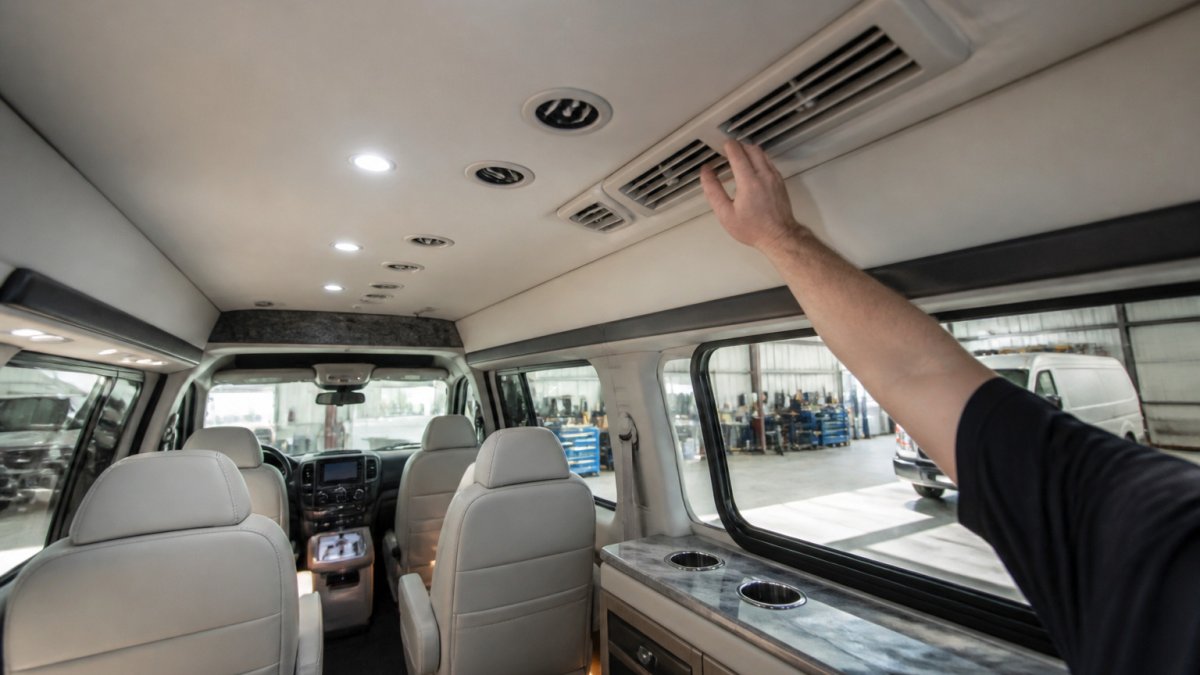
A custom golf van with a climate control system can help keep the cabin comfortable during travel.
For golfers in their 40s through their 60s, comfort matters on long drives between tournaments and resorts.
Climate control in a van is different from a home or car system. The cabin volume is larger, the glass area is often greater, and the vehicle may sit in direct sun for hours. Those conditions drive the heating and cooling loads your system must handle. Getting that right starts with understanding the components, the architecture, and the sizing decisions that follow.
Core Components: Compressors, Evaporators, Condensers and Blowers
Every van air conditioning system relies on the same basic parts working together. The compressor pressurizes refrigerant, the condenser releases heat outside the cabin, the evaporator absorbs heat inside the cabin, and the blower moves conditioned air through the ducts.
A common mistake is focusing only on the cooling capacity printed on a unit. Compressor size, condenser airflow, and blower capacity must match each other. A powerful compressor paired with an undersized condenser struggles to shed heat, especially in hot weather.
Watch out: a blower sized for a small cabin will leave the rear of a long van warm, even when the front feels comfortable. Confirm airflow reaches every seating and storage zone before you accept a layout.
Van Conversion Heating and Air Conditioning: Choosing a System Architecture
System architecture determines how heating and cooling are delivered and how many zones the van can support. Most conversions use either a single rooftop or underbody unit, or a split system with separate evaporators for different areas.
A single-zone system is simpler and usually less expensive to install. It works well for smaller groups traveling together. Split or multi-zone architectures give passengers more control, which matters when a couple prefers a cooler cabin than a teammate who wants it warmer.
The right architecture depends on how many people ride in the van and how you plan to use it.
Auxiliary Air Conditioning for Vans: Running Cool Without the Engine
Auxiliary air conditioning lets the cabin stay cool while the engine is off, such as during a lunch stop at the course or a pause in a parking lot, because modern climate control systems can be powered independently of the engine. For a closer look at whether solar can supply that power, read solar power for golf vans. This matters in warm climates, where idling for cooling wastes fuel, adds engine hours, and creates noise. Most top-ranking pages stop at that sentence. The practical question they skip is how the system is powered and how long it can actually run.
There are three common auxiliary architectures for a custom golf van, and each carries different trade-offs:
- Battery-driven electric compressor. A dedicated 12V or 48V compressor runs off a house battery bank, independent of the engine. It is quiet and can run with the engine off, but runtime is bounded by usable battery capacity. This is the most common choice for vans that park for short stops rather than overnight.
- Engine-driven compressor with an auxiliary evaporator. The factory or upgraded compressor drives an additional evaporator through a second circuit. Cooling is strong and continuous while the engine runs, but there is no engine-off cooling unless the system includes a battery-driven backup.
- Generator or shore-power-assisted system. A generator or campground shore connection powers the compressor. This supports long runtime but adds weight, noise, and a fuel or hookup dependency that many golf-trip itineraries do not want.
Ask for a power budget, not just a cooling capacity. A useful proposal lists the compressor’s running amps, the blower’s draw, the inverter or DC-DC losses, and the usable battery capacity in amp-hours. Runtime is roughly usable amp-hours divided by total running amps, minus a safety margin so the bank is not drained below its recommended depth of discharge.
Power requirements and energy use should be calculated before installation. Running a compressor for hours without adequate battery capacity drains the system quickly, and lead-acid banks tolerate far less depth of discharge than lithium iron phosphate (LiFePO4) banks. A common pattern is to size the house bank around the longest expected engine-off stop plus a reserve for lights, fans, and device charging.
Charging matters as much as storage. Alternator output, a DC-DC charger, and solar all determine how quickly the bank recovers between stops. A high-output alternator paired with a DC-DC charger is the usual baseline for vans that drive between courses; solar is a supplement, not a primary source for cooling loads.
Auxiliary systems are only as reliable as their power source. Undersized batteries, undersized wiring, and missing low-voltage cutoffs lead to shutdowns in the middle of a hot afternoon. Confirm the installer includes a low-voltage disconnect and properly fused, gauge-correct cabling.
For golf-specific use, the practical target is usually a system that holds a set temperature through a two- to four-hour stop without starting the engine. That is a power-sizing conversation, not a product-catalog one, and it should be settled before the interior is built.
The article compares three auxiliary air conditioning architectures and how each is powered.
| Architecture | Power source | Main trade-off |
|---|---|---|
| Battery-driven electric compressor | House battery bank | Runtime bounded by usable battery capacity |
| Engine-driven compressor with auxiliary evaporator | Engine | No engine-off cooling without battery backup |
| Generator or shore-power-assisted | Generator or shore connection | Adds weight, noise and hookup dependency |
Van Insulation for Temperature Control and Cooling-Load Sizing
Insulation reduces the heat entering and leaving the cabin, which lowers the load your climate system must handle. Better insulation in walls, floor, and roof lets a smaller system hold a stable temperature. That much is standard advice. What most guides omit is how the load is actually estimated, and that is the step that determines whether the system works on a 100°F afternoon.

A cooling-load calculation adds up every path by which heat enters the cabin:
- Conduction through the envelope. Walls, floor, roof, and doors transfer heat based on their area, the temperature difference across them, and their insulation R-value. Higher R-value means less heat gain, which is why spray foam and rigid board outperform bare metal and thin factory panels.
- Solar gain through glazing. Windows admit heat by radiation, and the effect is largest on high-roof vans with big windshield and side-glass areas. Tinted or reflective glazing and shades reduce this load more than almost any other single upgrade.
- Occupant load. Each seated person adds sensible and latent heat. A van carrying four golfers has a meaningfully higher load than the same van carrying one.
- Equipment and internal gains. Electronics, lighting, and any appliances add heat inside the envelope.
- Infiltration. Gaps, vents, and door seals let outside air in. Sealing the envelope is cheap and reduces load before any hardware is specified.
Sizing rule of thumb: calculate the load first, then choose a system with capacity above that load at the expected ambient temperature. An oversized unit short-cycles, dehumidifies poorly, and wastes energy; an undersized unit runs continuously and never catches up. Neither outcome is acceptable in a van that sits in direct sun.
Insulation choices interact with the calculation. Closed-cell spray foam gives a high R-value per inch and acts as a vapor barrier, but it must be applied by a trained installer. Rigid polyiso or XPS board is common in walls and ceiling cavities, with careful sealing at seams. Reflective radiant barriers help most against overhead sun and are usually combined with bulk insulation rather than used alone.
Ask for the load calculation as part of any build proposal, and ask what assumptions it uses: ambient design temperature, glazing area, occupant count, and insulation R-values. A proposal that quotes capacity without those inputs is a guess. For golf vans that park in open lots for hours, the design temperature and solar assumptions matter as much as the equipment brand.
Dual-Zone Climate Control Van Layouts for Players and Gear
Dual-zone layouts split the cabin into two climate areas, typically front and rear. This suits a setup where the driver and front passenger want different temperatures from passengers seated in the back with the equipment.
Equipment storage often sits in the rear zone, which can run warmer than the seating area. Before committing to built-in bays, see whether custom van interior storage is worth it. Planning the zones around the storage layout keeps clubs and bags in a stable environment while players stay comfortable. Confirm where the evaporators and return air paths sit before finalizing the interior.
Installation constraints matter here. Ductwork routed through storage bays can reduce usable space, so coordinate the climate layout with the interior design from the start.
Booking Your Climate System Consultation with GOLF Cruiser
If you are weighing options for a custom build, schedule a climate system consultation with GOLF Cruiser to compare architectures, review sizing, and understand what your van will require. You can also review custom golf van pricing and features to see how climate systems fit within a complete build.
Frequently Asked Questions
What climate control options are available for a custom golf van?
Custom golf vans typically combine a roof-mounted or under-floor air conditioning unit with a heater, often fed by the engine coolant or a dedicated heater. Options include single-zone systems for a small group and dual-zone systems that let front and rear passengers set different temperatures. Pricing and component choices depend on the vehicle, the number of seats and the build specification, so request a written quote from GOLF Cruiser for current figures.
Can a golf van have heating and air conditioning when parked?
Yes, with auxiliary systems. A parked van cannot rely on the engine, so builders often add an auxiliary air conditioner powered by a battery bank, shore power or a generator. Run time depends on battery capacity and outside temperature, so confirm the power plan and expected run time during the design stage before you commit to a configuration.
How do you keep a high-roof van comfortable in hot weather?
Combine adequate cooling capacity with insulation in the roof, walls and floor, and position supply vents to move air across seated passengers. Tinted glazing and reflective window film also reduce solar heat gain. Because high roofs add surface area, a larger cooling system and better insulation are usually needed than in a standard-height van.
What should you ask a golf van builder about climate control?
Ask which heating and cooling capacities are installed, whether the system is single-zone or dual-zone, how cooling load was calculated, and what power source runs the air conditioner when the engine is off. Also ask about installation constraints, warranty coverage for the compressor and refrigerant system, and how service is handled after delivery.
